

Your client’s website may rank well in Google. But are they visible in ChatGPT, Perplexity, Gemini, AI Mode, Claude, and Google AI Overviews?
Traditional SEO metrics still look healthy, rankings are stable, and traffic is steady.
Yet MQL volume is quietly declining, sales cycles are stretching, and prospects arrive already comparing alternatives your clients never considered.
This isn’t a demand problem; it’s a decision-path problem.
Get the AI SEO playbook agencies are using to modernize delivery and protect margins
> Download the Playbook
TL;DR:
- AI-generated answers now shape buying decisions before prospects visit websites, which means visibility is about being cited and trusted, not just ranking.
- Strong Google rankings can coexist with flat or declining MQLs because AI systems select sources differently than traditional search.
- Generative Engine Optimization (GEO) works when content is easy to extract, consistently described, and reinforced as an entity across platforms.
- Technical AI SEO for AI search prioritizes retrieval reliability: clean rendering, clear entities, internal linking that reinforces services, and consistent definitions.
By 2026, AI chatbots are expected to drive a 25% drop in traditional search traffic. Today, 60% of searches already end without a click. Nearly half of AI citations don’t overlap with top organic results, and one in two buyers now uses AI search to guide purchase decisions.
That means page-one rankings no longer guarantee consideration.
Prospects are forming opinions inside AI-generated answers, often before a website visit ever happens. If your client isn’t cited, referenced, or compared in those answers, they’re excluded from the decision regardless of where they rank in Google.
Traditional SEO reporting doesn’t surface this gap. It shows up first in pipeline performance, and shortly after in retention.
This is the AI visibility problem agencies now have to solve not as a tactic, but as an operational system.
The AI SEO training every agency needs as AI reshapes search
> Watch the Training
The AI SEO Execution Gap:
Understanding GEO is one thing. Delivering it across a 50-client portfolio is where agencies break.
Optimizing for AI Mode, AI Overviews (AIO) demands “answer-first” content, entity discipline, technical SEO depth goes beyond a standard Yoast checklist, and ongoing QA across platforms. For most agencies, hiring and retaining that talent isn’t realistic.
That’s where white-label GEO services are becoming the smarter path: digital agencies get immediate AI search SEO execution under their brand, without hiring an AI SEO specialist, without risk, delivery delays, or sacrificing quality.
What Is Generative Engine Optimization? (GEO Explained for Agencies)
Generative Engine Optimization (GEO) is the technical process of making digital content “consumable” for Large Language Models (LLMs). It’s about building a system that makes your clients’ expertise:
It’s about building a system that makes your clients’ expertise:
- Understandable to AI language models
- Extractable: Information is organized at the paragraph level for easy retrieval.
- Authoritative: E-E-A-T signals are reinforced across the “Entity Home” and third-party nodes.
- Consistent in how entities and services are described
The Three Layers of AI Visibility:
Generative Engine Optimization (GEO): Making sure the content is retrieved and reused inside AI answers.
Answer Engine Optimization (AEO): Structuring content to provide clear definitions, steps, and comparisons.
AI Search Optimization (The Umbrella Strategy): An umbrella framework combining technical SEO, entity clarity, and QA.
The Technical AI SEO/ GEO Blueprint: 4 Pillars of Retrieval Reliability
In 2026, Technical SEO is no longer about “crawlability”; it is about Retrieval Reliability. If an LLM cannot instantly parse and trust your data, it will move to a competitor.
Generative Engine Optimization doesn’t need new technical SEO tactics. It demands perfect execution of the fundamentals.
AI search systems don’t forgive slow loads, broken rendering, or unclear entities. If content isn’t instantly retrievable and trustworthy, it won’t be used even if it ranks #1.
In 2026, technical SEO = retrieval reliability.
Here’s the GEO checklist agencies need to operationalize, not audit and forget.
1. Index Parity and AI Retrieval Risk
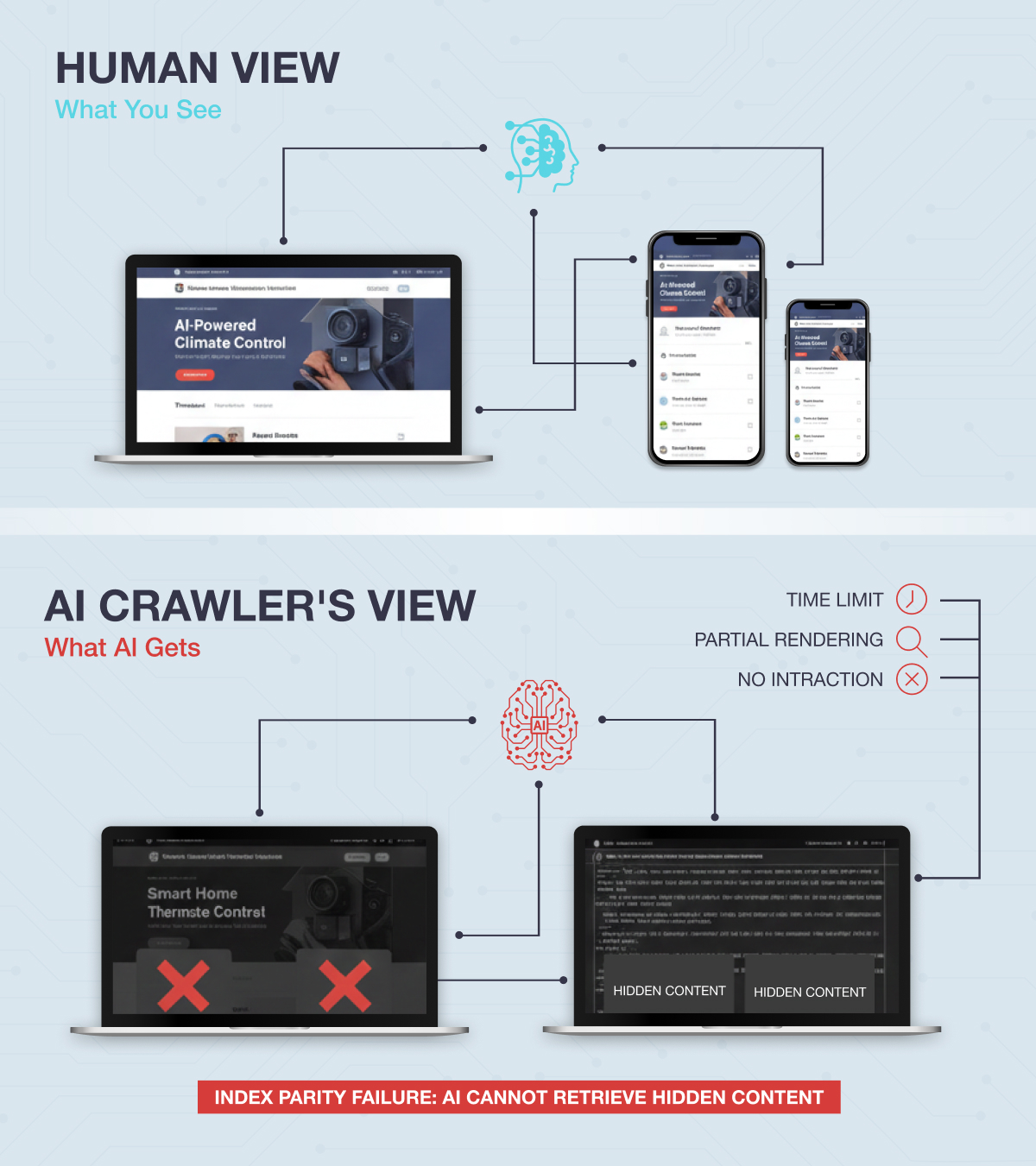
One of the most overlooked GEO failures is index parity, the mismatch between what humans see on your clients’ websites and what AI language models actually retrieve.
Where Agencies Go Wrong with Client Sites
- Heavy client-side rendering (JavaScript frameworks without proper hydration)
- Content hidden behind tabs, accordions, or user interactions
- Dynamic definitions or key explanations injected post-load
- Mobile layouts that suppress critical content blocks
- Lazy-loaded sections that never render for AI crawlers
Why This Breaks AI Search Optimization
AI retrieval operates under constraints:
- Time limits (faster than human browsing)
- Partial rendering (text-first extraction priority)
- No interaction simulation (clicks, scrolls, form fills)
If a definition, comparison, or key service explanation is not immediately available in the DOM on first render, it may never be extracted by AI systems.
GEO rule for client sites: If the answer is not visible without interaction, it is not reliable for AI systems, even if it ranks perfectly in Google.
See how one agency achieved 462% organic traffic growth in 6 months
> See the case study
2. Entity Reinforcement via Internal Linking
In classic SEO, internal linking helped distribute authority and manage crawl budget.
In entity-based SEO, internal linking clarifies relationships between entities, and AI systems use this to understand which pages represent core services versus supporting content.
What AI Systems Infer from Your Clients’ Internal Link Structure
- Which pages represent their core service offerings
- Which entities support their primary business identity
- How topics and services relate hierarchically
- Whether the site has authority on specific subjects
GEO-Optimized Internal Linking Principles for Client Sites
- Every service entity page links back to the primary organization page
- Supporting content (blog posts, case studies) links upward to commercial entity pages
- Anchor text reinforces entity names and service terms, not vague phrases like “click here.”
- No orphaned entity pages (every important page is linked from at least 3–5 relevant pages)
- Consistency in how services are named across all anchor text
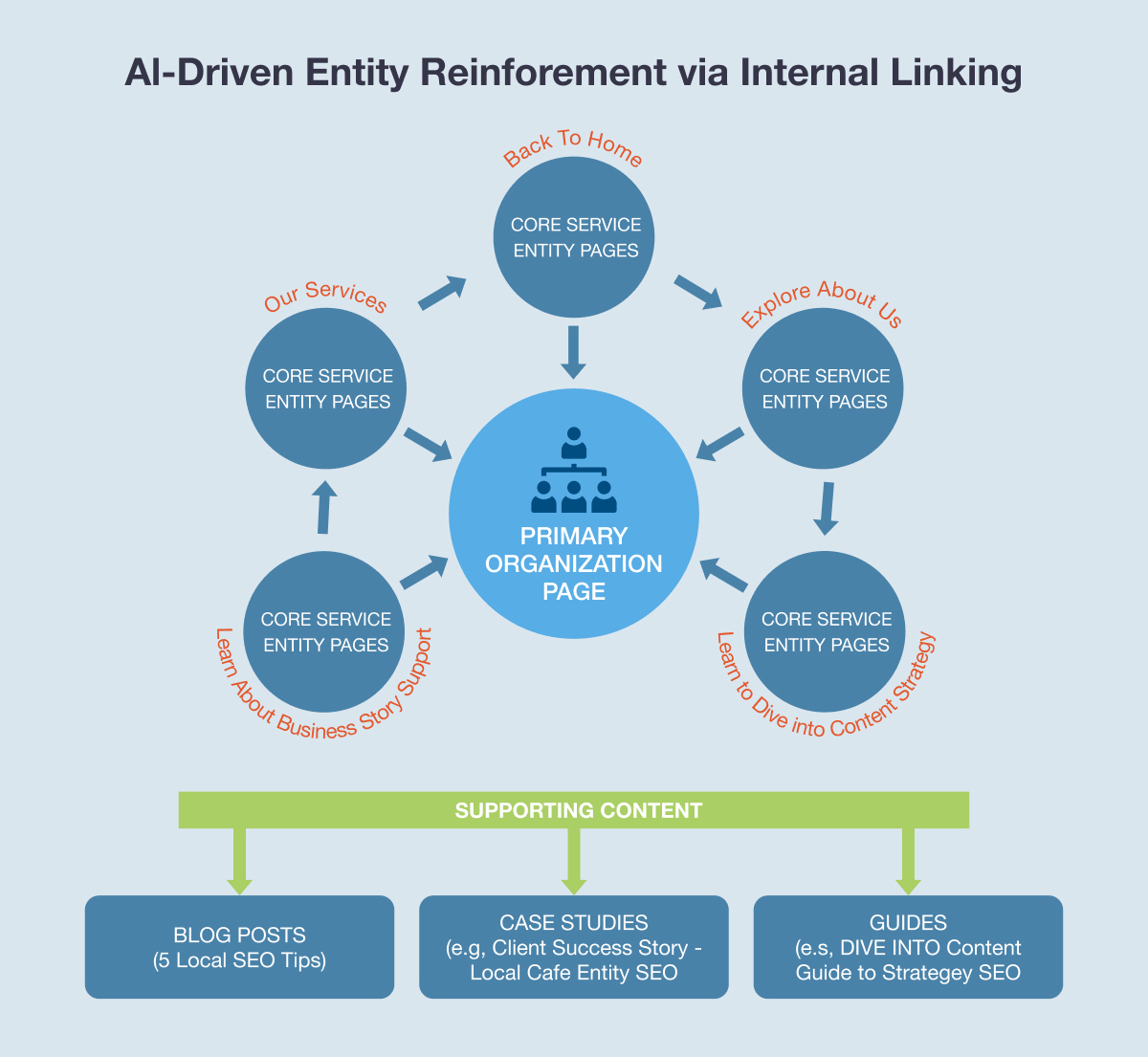
This is not a traditional link-building exercise.
Its entity reinforcement at scale and AI systems must understand your clients’ topical authority.
Agencies that rely on generic blog-to-blog linking or automated “related posts” widgets dilute AI clarity.
For agencies delivering AI SEO/GEO services, this becomes even more critical when your clients’ sites need entity clarity and internal linking architecture that mirrors best-in-class strategic frameworks.
See how your agency can leverage E2M to grow AI SEO
> Talk to our team
3. Messaging Symmetry (The Trust Factor)
Duplicate or near-duplicate content has always carried SEO risk.
In AI-generated search results, it’s significantly worse because AI systems cross-reference content to verify consistency and trustworthiness.
Why Duplicate Content Breaks AI Trust
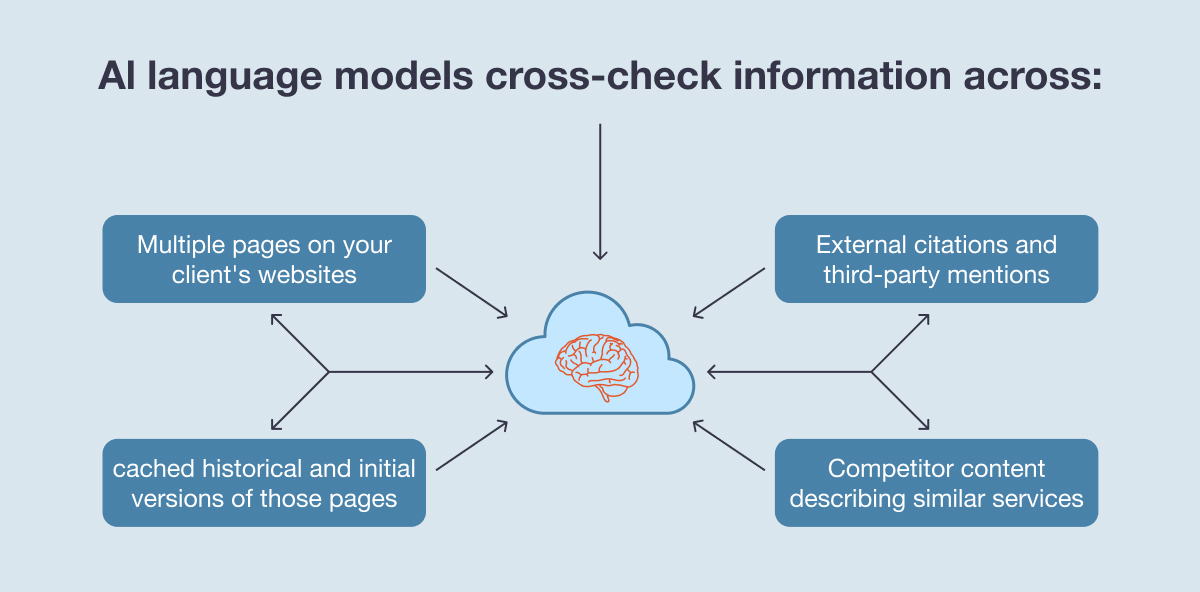
AI language models cross-check information across:
- Multiple pages on your clients’ websites
- Cached historical versions of those pages
- External citations and third-party mentions
- Competitor content describing similar services
If your clients’ definitions, service descriptions, or entity facts vary across pages even slightly:
- AI confidence in that information drops
- Retrieval likelihood drops
- Citation probability in generated answers drops
- Competitors with consistent messaging win the citation
Ex: If your client’s service definition on the “About” page differs from their “Service” page or their LinkedIn profile, the AI’s “confidence score” drops.
GEO Best Practice for Client Content:
- One canonical definition per entity (service, product, company)
- Consistent language deliberately reused across pages
- Controlled variation only where context genuinely changes (regional differences, audience-specific framing)
- Regular content audits to catch drift and inconsistency
This is why editorial QA is now technical SEO and why agencies need systems, not just writers, to maintain this consistency across dozens of client accounts.
The AI Playbook System Built for Agencies
> Access the Agency HQ
4. Log File Analysis for AI Bots
Very few agencies analyze server logs with AI retrieval behavior in mind.
But if you’re not monitoring how AI systems interact with your clients’ websites, you’re flying blind on whether GEO implementation is actually working.
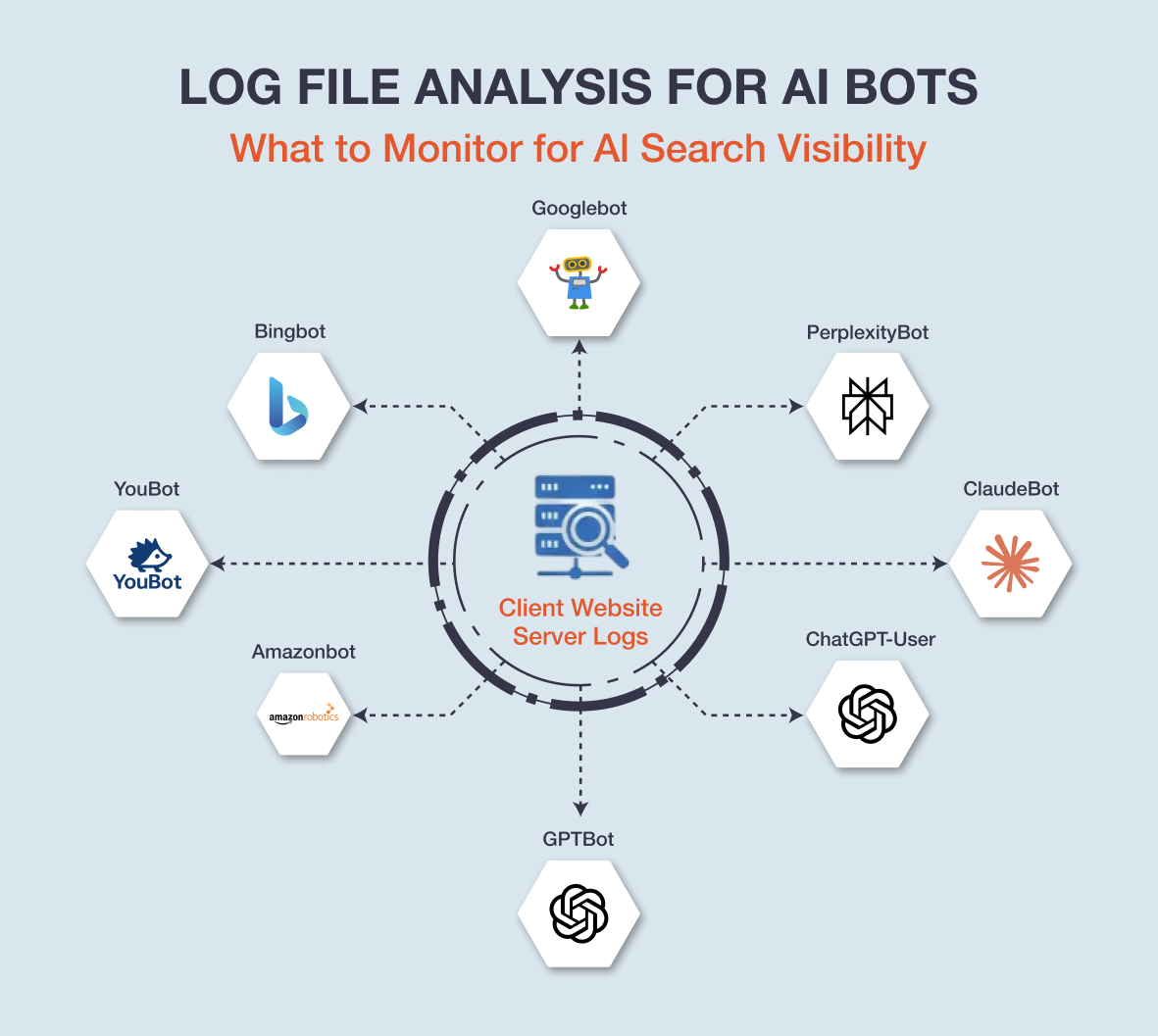
What to Monitor for AI Search Visibility
- Google-Extended activity patterns (Google’s AI training crawler)
- Bing-based crawler frequency (ChatGPT and Perplexity depend on Bing’s index)
- AI-specific bots: GPTBot, ClaudeBot, PerplexityBot, ChatGPT-User, Google-Extended
- Repeated fetch failures on key entity pages (means AI systems can’t reliably access content)
- Slow server response times during AI crawler visits (makes content “unreliable” in AI systems’ assessment)
AI search engines prefer stable, predictable, fast-loading sources.
If your clients’ content retrieval intermittently fails due to server issues, rendering problems, or blocking AI systems, mark that source as unreliable and move on to competitors.
Pro tip: Set up monitoring alerts when AI bot activity drops or fetch errors spike. This is often the first signal that your clients are losing AI visibility before it shows up in their MQL numbers.
Not sure where your clients’ biggest AI search gaps are?
Start with an AI Search Optimization audit to identify exactly which pages and entities need attention first and which AI platforms are already citing competitors instead of your clients.
Why Your Clients Rank in Google But Fail in AI Search
This is where traditional SEO breaks down:
- Google ranking ≠ AI visibility.
- You might hold position #1 for “Best CRM for Law Firms.” But when a prospect asks Perplexity or Gemini that same question, the AI might pull data from a #7-ranked site or no sources found, because of that site’s Entity Structure.
- AI visibility ≠ trust signals.
-
AI mentions create awareness; AI trust creates decisions. LLMs look for “Unlinked Mentions” and third-party validation. If the AI sees your client’s site but doesn’t see them mentioned on Reddit, industry forums, or G2, the AI will prefix the answer with “Some users suggest…” instead of “The leading provider is...”
-
- Trust signals ≠ MQLs.
- Trust matters, but conversion requires structure. AI models recommend next steps only when sites explicitly map actions like “Contact Us” and “Demo” in schema. Without those signals, AI summaries close without a call-to-action.
AI search engines don’t reward what worked in traditional SEO. They reward clarity, structure, and confidence at the extraction level.
If your clients’ expertise:
- Can’t be cleanly extracted from their content
- Isn’t reinforced by entity signals across platforms
- Lacks consistency between pages and external mentions
- Or hasn’t been refreshed in 12–18 months
…it won’t be reused in AI-generated answers, even when the site ranks at the top of Google.
This creates a new kind of invisibility.
Your clients’ websites exist. They rank. But when prospects ask ChatGPT, “Who are the best providers of [service]?” or tell Perplexity, “Compare options for [solution]“, your clients don’t show up.
The evaluation happens without them ever entering the consideration set.
Why White-Label GEO Services Are Becoming the Smart Scaling Move for Agencies?
For growing agencies, the constraint isn’t awareness of AI search.
It’s execution without adding operational risk.
GEO requires technical depth, entity discipline, content operations, and ongoing QA across multiple platforms. Building that internally usually means one of three things: a) hiring specialists before demand is predictable, b) slowing delivery while the team figures it out, or c) stretching senior operators even thinner.
None of those scale cleanly.
White-label GEO solves the execution problem without changing how agencies work with clients. Strategy stays in-house. Pricing and positioning stay under your control. The delivery runs under your brand, with systems built specifically for AI search.
With the right partner, agencies can:
- Add AI search optimization without committing to full-time hires
- Deliver consistently across multiple client accounts
- Protect margins while expanding service depth
- Scale output without exposing internal gaps
Partners like E2M Solutions support this model with dedicated GEO teams, entity-first frameworks, scalable content operations, and ongoing QA aligned to how AI systems retrieve and reuse information.
The result is steadier MQL performance, cleaner delivery, and higher retention without increasing internal complexity.
Final Takeaway: GEO Is No Longer Optional If Client Growth The Prize
If your clients’ inbound growth matters and if your agency retention matters, Generative Engine Optimization is no longer an experiment or a “nice to have.”
It’s the new baseline for competitive visibility in 2026.
Agencies that build AI search optimization systems deliberately will continue helping clients influence buying decisions before prospects ever click or even search traditionally.
Agencies that don’t may keep delivering traditional page one rankings while their clients slowly lose relevance, trust, and MQL velocity to competitors who show up in AI-generated answers.
The question isn’t whether to adopt GEO.
It’s whether you’ll:
- Build the systems, hire the specialists, and manage the execution yourself
- Or scale faster with a white-label GEO partner while your competitors hesitate and fall behind
Ready to Scale AI SEO in Your Agency?
Talk with our SEO experts, Vishal or Kevin, to see how E2M helps agencies deliver AI-powered SEO with confidence, without adding headcount or complexity.
We’ll walk through:
-
Where AI fits into your current SEO offering
-
How agencies are operationalizing AI SEO today
-
Whether E2M is the right backend partner for your goals



Vishal studied at Federation University Australia and has managed multi-million-dollar campaigns and actively participates in global industry events, including BrightonSEO and MavCon Live. His expertise spans technical SEO, content marketing, PPC optimization, and agency partnership development.
Outside of work, he enjoys traveling, playing cricket, and exploring new trends.