

If your clients aren’t showing up on Google Maps, in AI Overviews, or when someone asks ChatGPT for a local recommendation, they’re invisible. And you’re leaving your agency vulnerable to competitors who are delivering those Local SEO results.
Did you know? Google Maps and local search collectively drive over 1.5 billion destination visits every month, per aggregate data.
This Local SEO guide breaks down exactly how local search and ai visibility search works in 2026. You’ll learn the ranking signals that move the needle on Google Maps, how Google’s brand-new Ask Maps feature changes the game, and how to get your clients cited in AI tools like ChatGPT and Perplexity, all without burning out your team.
If you manage local SEO campaigns for multiple clients in your Agency, this is the playbook you need right now.
Table of Contents
- What Is Local SEO in 2026? (And Why Everything Just Changed)
- How Google Maps Ranks Local Businesses: The Three Pillars
- The 6 Google Maps Ranking Signals: Location Pages, Blog Content More
- Breaking: Google’s Ask Maps, What It Is and Why It Matters
- How ChatGPT and Perplexity Pick Local Businesses to Recommend
- GEO Optimization Tactics That Work in 2026
- Google Maps vs. AI Search: What’s Different, What’s the Same
- The Local SEO Priority Stack for Agency Owners
- Why Agencies Use White Label Local SEO
- How E2M Delivers White Label Local SEO for Digital Agencies
- Frequently Asked Questions
1. What Is Local SEO in 2026? (And Why Everything Just Changed)
Local SEO is the practice of making a business easy to find in location-based searches. But in 2026, the definition of ‘local search’ has grown well beyond the Google Maps 3-pack.
Your clients’ customers are now finding local businesses in three very different places, each with its own ranking logic, its own optimization requirements, and its own urgency for agencies.
| Channel | What It Is | Ranking Logic |
| Google Maps (Local Pack) | The map and 3 business listings that appear above organic results | GBP signals, reviews, proximity, citations |
| Google AI Overviews | AI-summarized answers at the top of Google search, pulling from web content | Structured content, schema, E-E-A-T |
| Ask Maps (NEW) | Gemini-powered conversational AI built into Google Maps | Places database, reviews, GBP completeness |
| ChatGPT / Perplexity | AI chatbots that recommend local businesses in response to natural-language questions | Training data, Bing index, third-party citations |
The agencies pulling ahead in 2026 aren’t running four separate strategies. They’ve built one unified local SEO system that feeds all four channels simultaneously and they’re delivering results competitors can’t explain.
The Question Your Clients Are Already Being Asked
‘Are you showing up when I ask ChatGPT for the best plumber in [city]?’ Your clients’ customers are asking this. If you can’t answer confidently, a competitor agency is about to win that retainer.
Get the AI SEO playbook agencies are using to modernize delivery and protect margins
2. How Google Maps Ranks Local Businesses: The Three Pillars
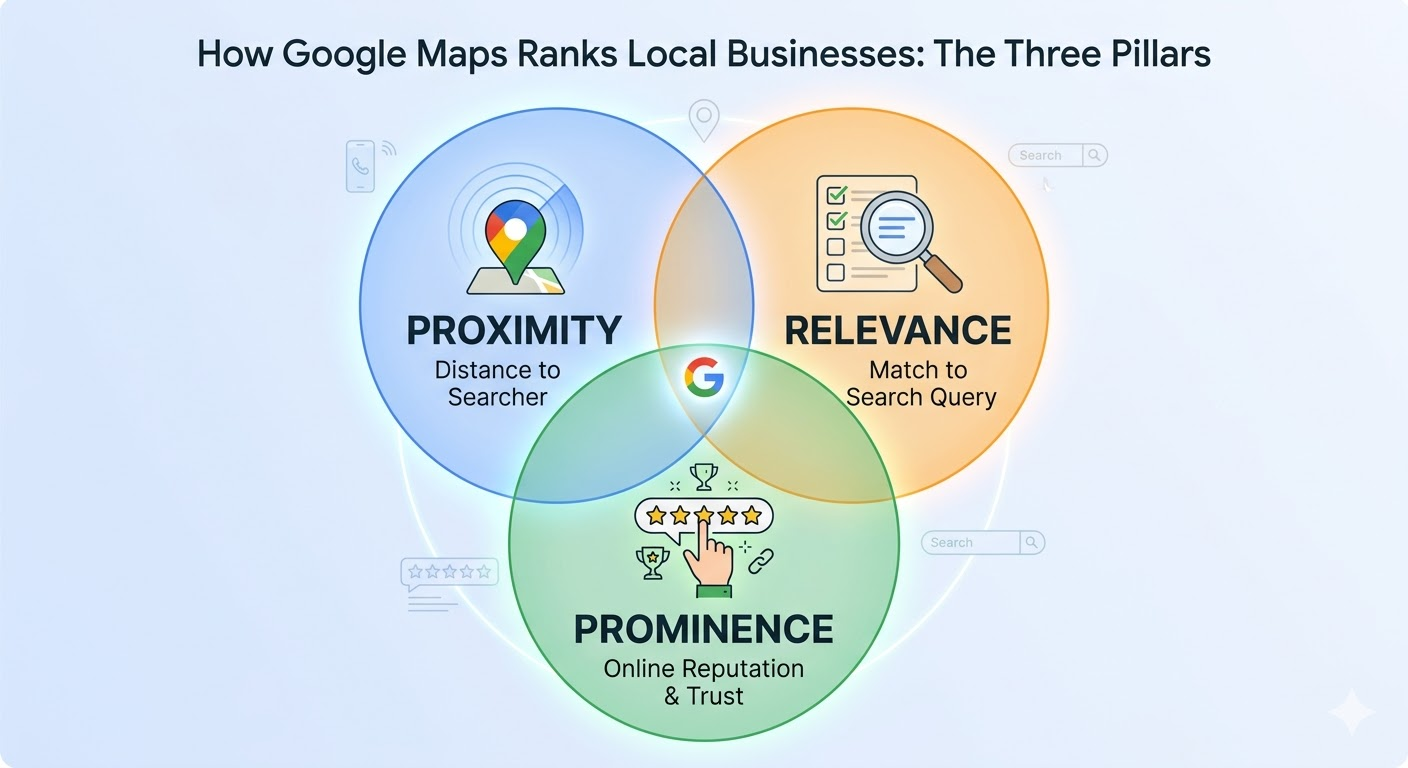
Google’s local ranking algorithm hasn’t changed its core framework but how it weighs each signal has. Every business is evaluated on three foundational dimensions:
| Pillar | What Google Is Asking | Can You Control It? |
| Proximity | How close is this business to the person searching? | Limited — tied to location and service area settings |
| Relevance | Does this business match what the person searched for? | Yes — GBP categories, services, website content |
| Prominence | How well-known and trusted is this business online? | Yes — reviews, backlinks, citations, brand mentions |
You can’t control proximity. That’s determined by where the searcher is standing. But relevance and prominence are 100% within your control as an agency. That’s where the real work happens and where great local SEO earns its fees.
3. The 6 Google Maps Ranking Signals That Actually Move the Needle
According to the 2026 Whitespark Local Search Ranking Factors report, compiled from 47 of the top local SEO professionals in the industry. Businesses are 70% more likely to attract a visit if they have a complete Google Business Profile
Here’s where to focus your effort and your clients’ budget:
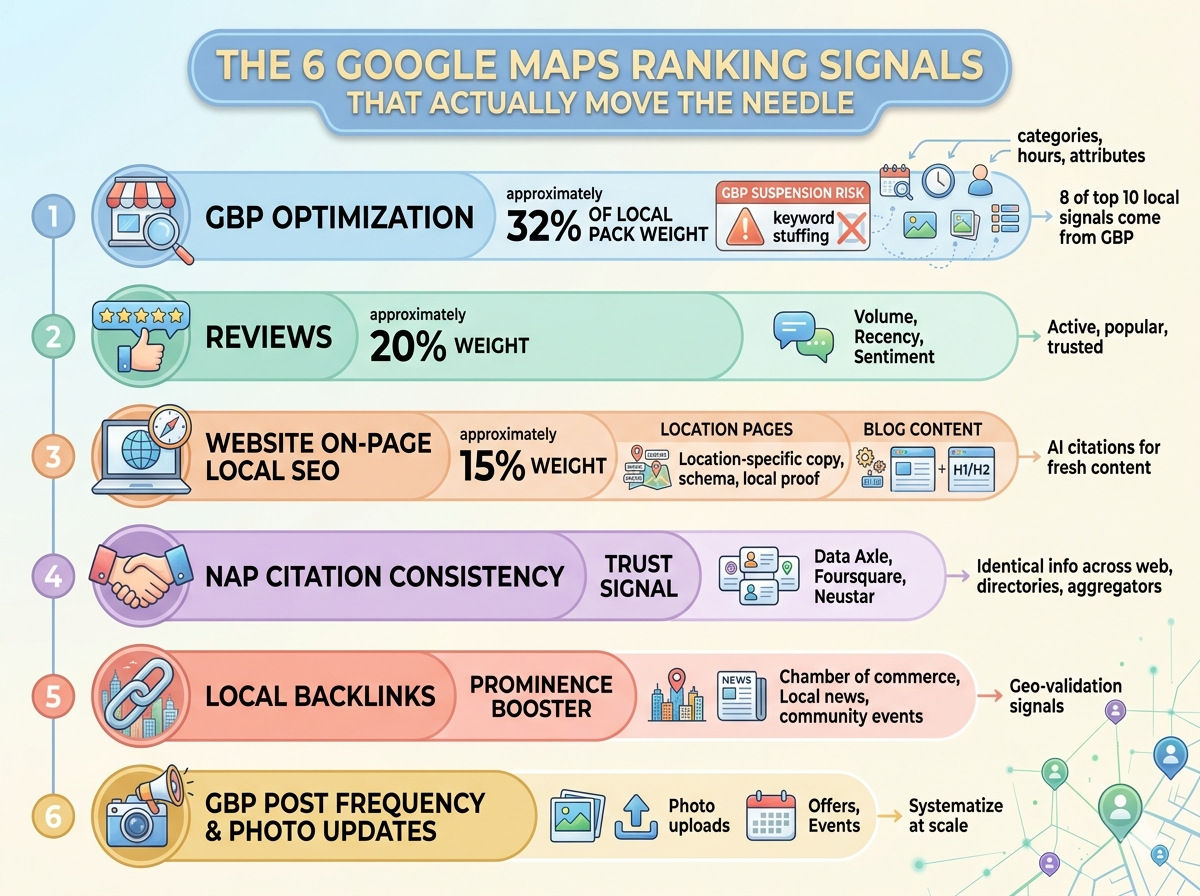
Signal 1: Google Business Profile Optimization (approximately 32% of local pack weight)
The GBP is the single most important ranking lever in local SEO. Eight of the top ten local pack ranking signals come directly from the GBP; nothing else comes close.
- Primary and secondary categories must precisely match the actual services the business delivers
- Business descriptions, service listings, and attributes need to be fully completed
- Photos should be genuine, regularly refreshed, and geotagged where possible
- The business name field must match the legal business name, no keyword stuffing, no city name, no tagline
Agency Warning — GBP Suspension Risk
Adding a city name, service keyword, or brand tagline to the GBP business name field is a direct violation of Google’s guidelines. It is a documented and common cause of GBP suspension. The business name must match the legal entity name exactly. Build this into your standard QA checklist for every new client onboarding.
Signal 2: Reviews: Volume, Recency, and Sentiment (approximately 20% weight)
A business with 500 reviews at 4.7 stars will almost always outrank a competitor with 10 reviews at 5.0 stars. Review volume signals to Google that the business is active, popular, and trusted; it’s a core Prominence signal.
- Build a repeatable, guideline-compliant review request process into every client engagement
- Respond to every review within 48 hours; positive and negative responses both carry weight
- Review recency matters: a steady drip of new reviews is more valuable than a one-time surge
The AI SEO training every agency needs as AI reshapes search
Signal 3: Website On-Page Local SEO (approximately 15% weight)
The client’s website is Google’s validation layer for the GBP. It answers a simple question the algorithm is always asking: ‘Does this website confirm what this business says it is and where it operates?’ Two-page types carry the most weight here: location pages and blog content.
Location Pages Writing
Every service area the business targets needs its own dedicated page. Not a generic ‘Contact Us’ page with a city name dropped in. A properly built location page gives Google a strong geographic relevance signal and gives potential customers a reason to actually call.
- Use a clean URL: /locations/city-state/ or /service/city/ (e.g., /plumbing/austin-tx/)
- Each page gets a unique H1 combining the primary service and city name
- Write location-specific copy don’t copy the same content across city pages with just the name swapped
- Embed a Google Maps widget, include the address in text, and display a local phone number
- Implement the LocalBusiness schema on every location page with accurate NAP data
- Add a genuine local customer testimonial or case study where possible, it signals real, on-the-ground presence
Blog Content Writing
A well-maintained blog/article does two things at once: it builds topical authority for traditional SEO rankings, and it creates the structured, answer-rich content that AI platforms like ChatGPT and Ask Maps prioritize when generating local recommendations. Generic industry posts won’t move the needle. Local blog content that addresses real questions from people in the service area does.
- Target hyper-local questions: ‘How much does HVAC service cost in Dallas?’ or ‘Best neighborhoods for landscaping services in Phoenix’
- Write in a direct Q&A format: Each H2 or H3 should answer a specific question, not just introduce a topic
- Update existing blog posts on a 30-day cycle: Freshness is a direct AI citation signal (3.2x more AI citations for recently updated content)
- Link blog posts back to the relevant location and service pages: This builds internal topical authority across the whole site
- Cite at least one sourced statistic per post: Referenced data increases the probability of AI platforms recommending your content
On top of location pages and blog content, the core technical on-page requirements are:
- City + service keywords in H1 tags, title tags, and meta descriptions
- Google Maps embed on all contact and location pages
- FAQPage and Organization schema markup implemented site-wide
Signal 4: NAP Citation Consistency (Trust Signal)
NAP stands for Name, Address, and Phone Number. Every instance of this information across the web, directories, social profiles, review platforms, aggregators must be identical. Inconsistencies create conflicting signals that erode ranking trust.
- Audit existing citations before building new ones, fix conflicts first
- ‘Main Street’ and ‘Main St.’ are treated as different addresses. Standardize every variation
- Prioritize the major aggregators: Data Axle, Foursquare, Neustar, they feed hundreds of downstream directories
Signal 5: Local Backlinks (Prominence Booster)
For local rankings, a link from a neighborhood business blog or city chamber of commerce often carries more weight than a national publication feature. These local backlinks are geo-validation signals; they tell Google the business is genuinely embedded in the community.
- Chamber of commerce memberships and local business association listings
- Local news features and ‘Best of [City]’ editorial roundups
- Community event sponsorships, nonprofit partnerships, local charity involvement
Signal 6: GBP Post Frequency and Photo Updates
Regularly publishing posts, offers, and event updates to the GBP signals ongoing activity to Google. It’s a lighter-weight signal, but it’s easy to systematize at scale across a client portfolio, making it a smart quick win. Also Know SEO Tips for Local Maps Optimization to Help Your Client Business Be Found on Search
| 8 of 10
Top local pack signals come from the GBP alone |
~20%
of ranking weight attributed to online reviews |
~32%
of local pack weight tied to GBP optimization |
See how one Modular Event Architecture Local SEO Business achieved +5,500% Growth in Lead Conversions
See the case study →
BREAKING NEWS — MARCH 2026
4. Google’s Ask Maps: The AI Feature That Changes Local Search Right Now
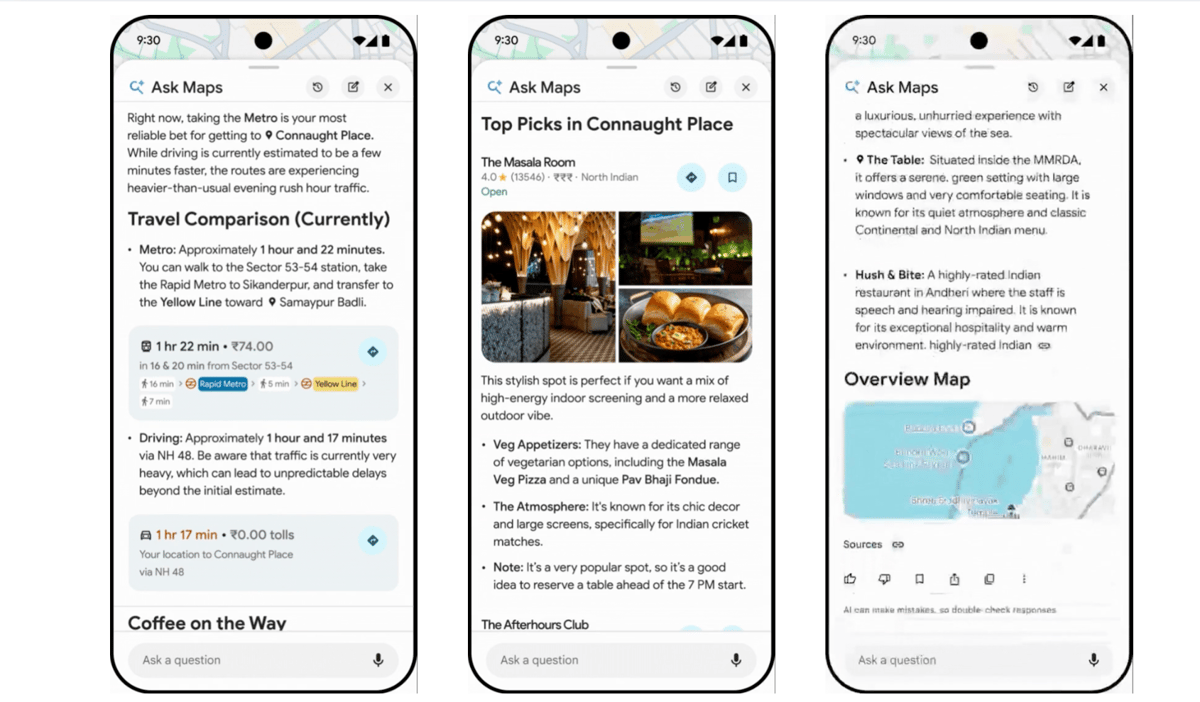
On March 12, 2026, Google officially launched Ask Maps, a Gemini-powered conversational search feature built directly into Google Maps. It’s rolling out now in the US and India on iOS and Android, with desktop coming soon.
This isn’t a minor feature update. Ask Maps fundamentally changes how people discover local businesses, and what agencies need to do to make sure their clients show up.
What Ask Maps Actually Does
Instead of typing a business name or a basic keyword into Google Maps, users can now ask natural-language questions like:
- “Is there a public tennis court with lights on that I can play at tonight?”
- “My phone is dying. Where can I charge it without waiting in a long line for coffee?”
- “Find me a quiet Italian restaurant for a business dinner near downtown that has outdoor seating.”
Ask Maps processes these questions using Google’s Gemini AI and its database of over 300 million places and reviews from 500 million contributors. Instead of returning blue links or basic map pins, it generates a single, combined answer with a personalized visual map.
What Google’s VP of Maps Said
Miriam Daniel, VP and GM of Google Maps, described Ask Maps as ‘a new conversational experience that answers complex, real-world questions a map could never answer before.’ That’s not marketing language, it’s an accurate description of a genuine capability shift.
Personalization: Ask Maps Knows Your Clients’ Customers
Ask Maps doesn’t just pull generic results. It personalizes recommendations based on each user’s Google Maps activity, their past searches, saved places, and stated preferences. If a user has previously searched for vegan restaurants, Ask Maps will filter a group dinner recommendation accordingly automatically.
This matters for your clients because it means Ask Maps favors businesses that have strong, consistent engagement signals: reviews, saves, repeat visits, and complete GBP profiles.
What Ask Maps Uses to Rank Local Businesses
Google hasn’t published a formal Ask Maps ranking algorithm, but based on available information, the feature pulls from:
- The business’s Google Business Profile, completeness, category accuracy, and photo quality
- Review content and volume from Google Maps contributors
- User personalization data from Maps activity history
- Real-time availability and attribute data (hours, accessibility features, amenities)
The Advertising Question Google Left Unanswered
Google didn’t announce ads in Ask Maps at launch. When the press asked whether businesses could eventually pay for placement in Ask Maps recommendations, Google executives declined to answer. Watch this space; if paid placements are introduced, it will change the competitive dynamics significantly.
See how your agency can leverage E2M to grow Local SEO services
What This Means for Your Digital Agency Right Now
Ask Maps doesn’t require a separate optimization strategy at least not yet. The businesses that will perform best in Ask Maps results are those that already have strong local SEO foundations:
- Fully optimized, verified, and category-accurate GBP
- High review volume with recent, detailed review content
- Complete attribute data: hours, accessibility, amenities, services
- Active GBP posts and regular photo updates
The practical implication: every local SEO campaign you run today is simultaneously an Ask Maps optimization campaign. There’s no additional work required, but there’s zero room for lazy GBP management.
Immersive Navigation: The Other Half of the Update
Alongside Ask Maps, Google also launched Immersive Navigation, a 3D navigation view that shows buildings and terrain during turn-by-turn directions. It includes Street View previews of destinations, building entrance highlighting, and parking recommendations on arrival.
For agency owners, the immersive navigation update reinforces the importance of keeping Google Business Profiles accurate and visually current. Businesses with complete, well-photographed profiles will present better when customers are navigating directly to them.
5. How ChatGPT and Perplexity Pick Local Businesses to Recommend
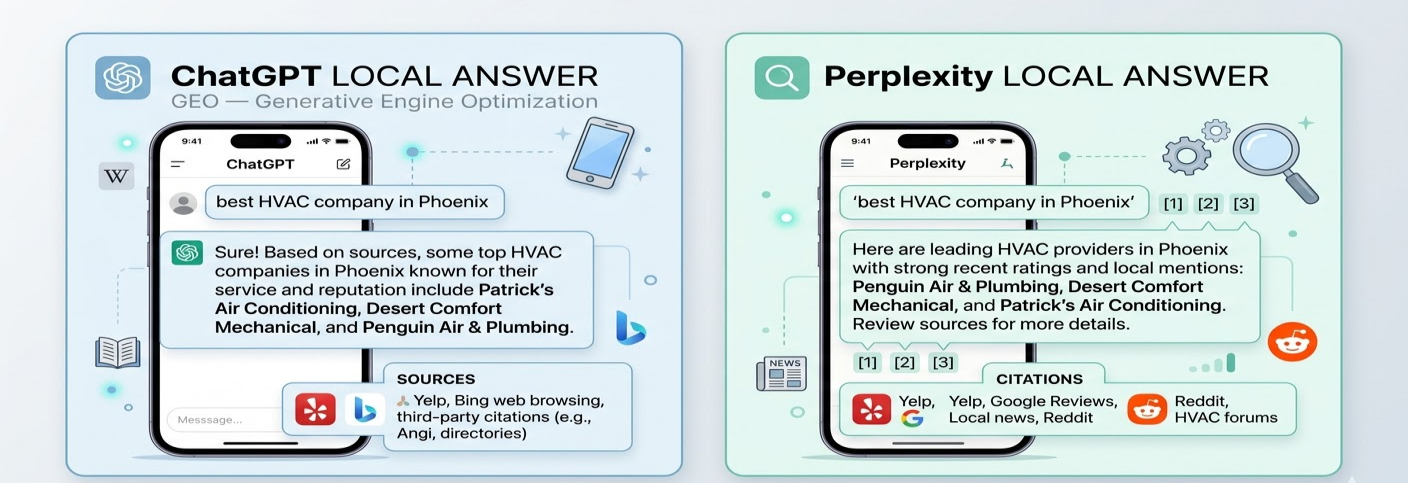
GEO( Generative Engine Optimization) is the discipline of making your content the source that AI tools cite when they answer questions. For local businesses, the goal is simple: when someone asks ChatGPT ‘What’s the best [service] in [city]?’ you want your client’s business to be in the answer.
How ChatGPT Sources Local Recommendations
ChatGPT doesn’t have a ‘local results database’ the way Google Maps does. It draws from three main sources:
- Training data: Content from authoritative websites that was indexed before ChatGPT’s training cutoff. Businesses mentioned in Yelp, Angi, local news, and industry directories are far more likely to appear.
- Bing web browsing: When ChatGPT uses live web browsing, it pulls heavily from the Bing index. This makes Bing Places optimization a direct ChatGPT local ranking signal.
- Third-party citations: Review platforms, directories, and editorial content that reference the business by name and location. The more sources that mention a business consistently, the more confident the AI is in recommending it.
ChatGPT vs. Perplexity: They’re Not the Same
A mistake many agencies make is optimizing for ‘AI search’ as a single channel. In reality, different AI platforms favor very different signals:
| Platform | Primary Source | Best Content Type | Local Signal |
| ChatGPT | Training data + Bing index | Wikipedia-style authority content | Bing Places + directory citations |
| Perplexity | Real-time web crawl | Reddit, forums, recent editorial | Fresh content + review platform presence |
| Google AI Overviews | Google index + structured data | FAQ and schema-rich pages | GBP + local schema |
| Ask Maps | Google Places database | GBP completeness + reviews | GBP categories + review volume |
Only 11% of domains appear in both ChatGPT and Perplexity results. That’s a signal that platform-specific tuning matters, but a strong, comprehensive local SEO foundation feeds all of them.
6. Local GEO Optimization Tactics That Work in 2026
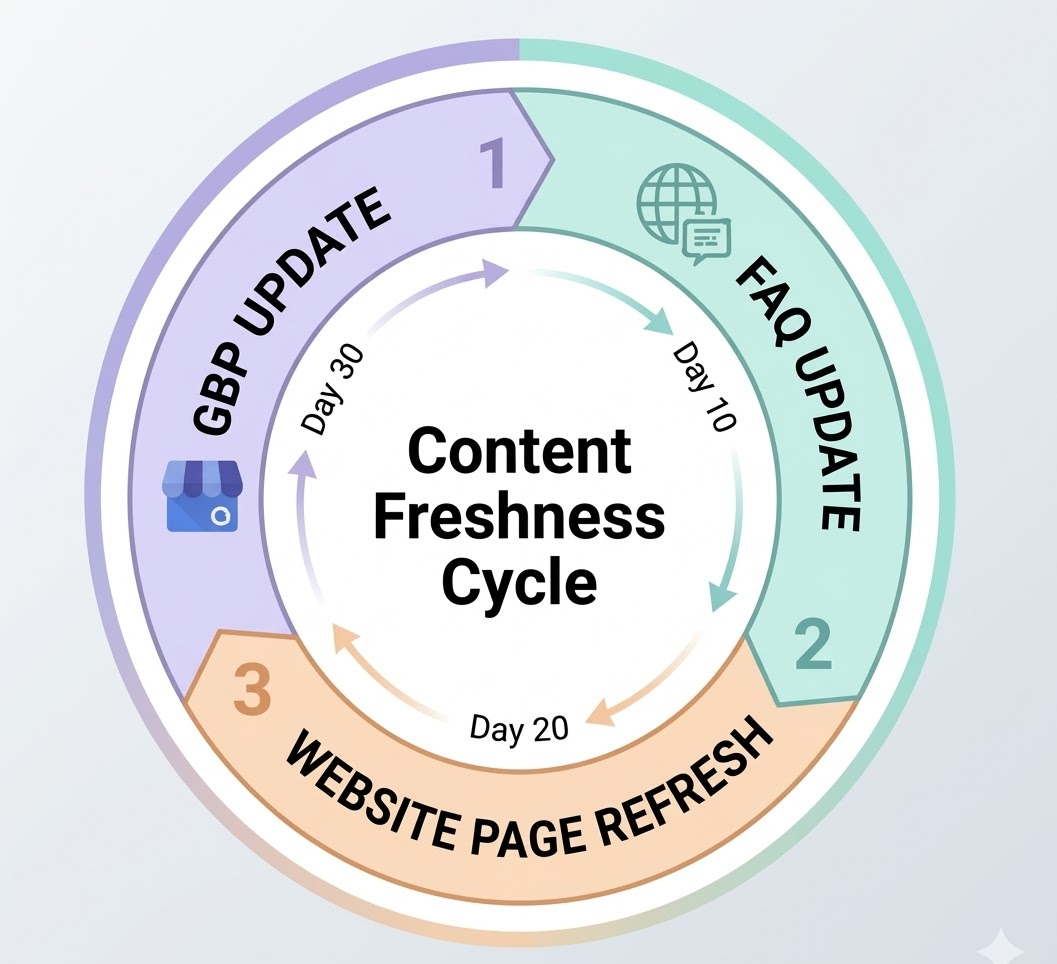
These GEO Optimization tactics come from current industry research on how AI platforms select and cite content. Implement them on every active local SEO client.
Tactic 1: Refresh Content Every 30 Days
Content updated within the past 30 days gets cited by AI platforms 3.2 times more often than older material. This applies to service pages, location pages, and blog content. Build a content refresh calendar into every client retainer; it’s one of the highest-ROI activities in modern local SEO.
Tactic 2: Write for AI Extraction, Not Just Readers
AI models extract content in discrete sections. They don’t read your page top-to-bottom; they scan for self-contained answer chunks. Structure content so that each H2 or H3 section can be understood on its own, without needing context from the rest of the page.
- Lead every section with a direct 1–2 sentence answer to the implicit question
- Keep paragraphs to 2–4 sentences maximum
- Use FAQ sections with conversational phrasing exactly how someone would type a question into ChatGPT
Result: content structured this way gets cited 40% more often in AI-generated answers.
See how your agency can leverage E2M to grow Local SEO Service
Tactic 3: Implement Schema Markup on Every Client Site
Schema markup is how you communicate directly to AI systems and Google’s crawlers. For local clients, these schema types are non-negotiable:
| Schema Type | What It Does | Priority Level |
| LocalBusiness | Core entity data: name, address, phone, hours, service area | Critical |
| FAQPage | FAQ sections: directly powers Google AI Overviews snippets | Critical |
| Organization | Brand entity: logo, social profiles, contact info | High |
| AggregateRating / Review | Star ratings visible in search results | High |
| Service | Individual service descriptions with pricing context | Medium |
| BreadcrumbList | Page hierarchy: signals topical structure | Medium |
Tactic 4: Optimize Bing Places for ChatGPT Visibility
This is the most overlooked tactic in local AI optimization. ChatGPT’s web browsing mode pulls from Bing’s index. Fully claiming and completing the Bing Places profile with NAP data, categories, hours, photos, and descriptions is a direct input into ChatGPT’s local recommendations. Most agencies aren’t doing this for their clients. That’s a competitive gap you can close today.
Tactic 5: Build Third-Party Citations as AI Training Signals
Getting a business mentioned consistently across authoritative platforms increases the probability that AI training data and ongoing web crawls have encountered that business name. Focus on:
- Review platforms: Yelp, Angi, Houzz, and industry-specific directories
- Editorial mentions: local news, ‘Best of [City]’ roundups, industry publications
- Community presence: chamber of commerce directories, local nonprofit listings
Tactic 6: Track AI Visibility, Not Just Rankings
Traditional keyword rank tracking doesn’t tell you how often your clients appear in AI responses. Measure AI visibility through:
- Share of voice — how frequently the business appears across a bank of 20–30 relevant local prompts
- Server log monitoring — check for ‘ChatGPT-User’ and ‘Perplexity-User’ user agents to confirm AI bots are crawling the site
- Cloudflare AI Crawl Metrics — if the client uses Cloudflare, this dashboard shows AI bot activity directly
See how this could work for your agency,
Book a call with E2M’s Local SEO team →
7. Google Maps vs. AI Search: What’s Different, What’s the Same
Agency owners managing local SEO campaigns need a clear picture of where the channels diverge and where strong foundational work carries over.
| Factor | Google Maps & Ask Maps | ChatGPT / AI Search |
| Primary Ranking Input | GBP completeness + review volume | Content authority + Bing index coverage |
| Reviews Impact | Direct ranking factor (~20% weight) | Sentiment signals via third-party citations |
| Schema Markup | LocalBusiness, Review, FAQPage | FAQPage, Organization, Service |
| Content Freshness | GBP posts + photo updates | Full page refreshes every 30 days |
| NAP Consistency | Core trust signal across citations | Bing Places + aggregator accuracy |
| Backlinks | Prominence signal local links strongest | Domain authority for citation likelihood |
| Measurement | Local pack position, Maps visibility | Share of voice / AI mention rate |
| Paid Placement | Promoted pins available (Maps Ads) | Not yet confirmed for Ask Maps / ChatGPT |
The core insight: the foundations are shared. A business with a strong GBP, consistent citations, high review volume, and well-structured content on its website is well-positioned for Google Maps, Ask Maps, AI Overviews, and ChatGPT simultaneously. There’s no need to split your strategy; just execute the fundamentals with precision.
8. The Local SEO Priority Stack for Agency Owners
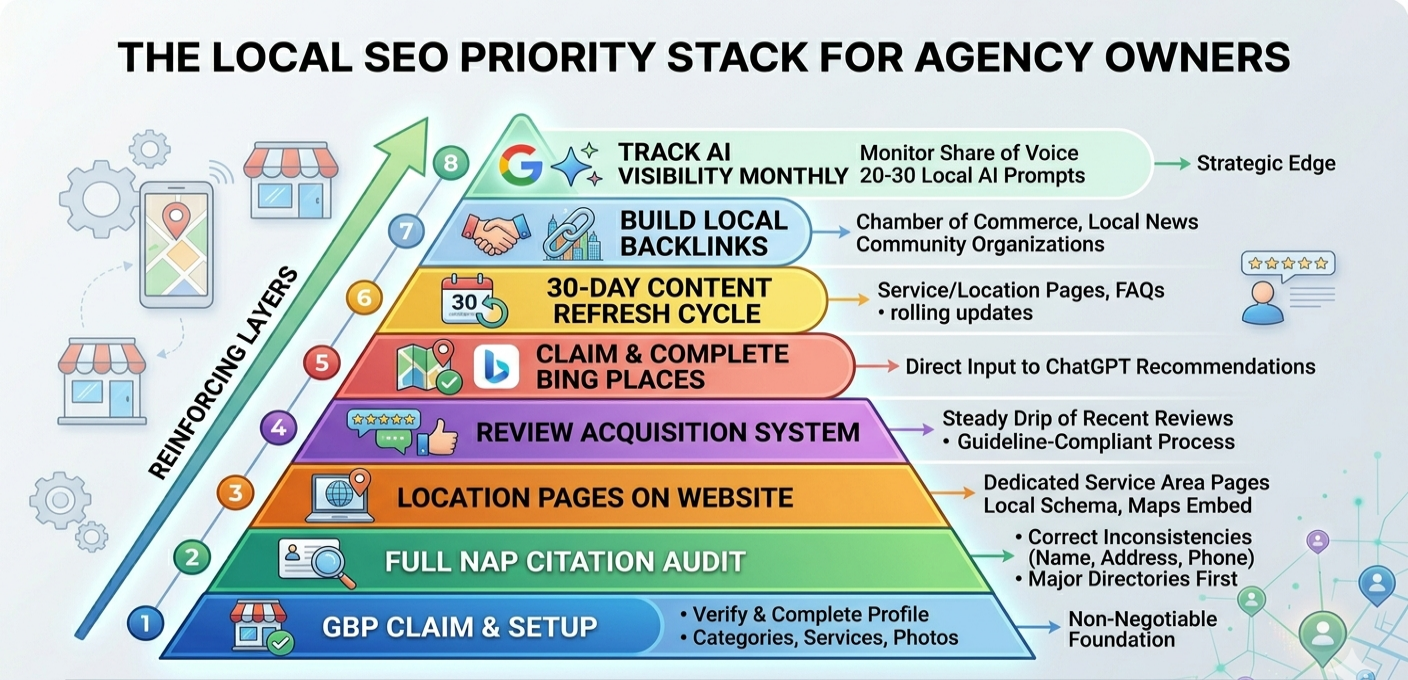
If you’re onboarding a new local SEO client or auditing an existing campaign , work through these in order. Each layer reinforces the next.
- Claim, Verify, and Complete the GBP. Categories, services, business description, photos, and all attributes. This is the non-negotiable foundation.
- Run a Full NAP Citation Audit. Find and correct every inconsistency in the business name, address, and phone number across directories before building new citations.
- Build or Optimize Location Pages on the Website. Each service area gets a dedicated page with local schema, location-specific copy, and a Google Maps embed.
- Launch a Review Acquisition System. A repeatable, guideline-compliant process that generates a steady drip of recent reviews not a one-time push.
- Claim and Complete Bing Places. Often skipped, almost always valuable. Direct input into ChatGPT local recommendations.
- Establish a 30-Day Content Refresh Cycle. Service pages, location pages, and blog content are updated on a rolling 30-day schedule.
- Build Local Backlinks. Outreach to the chamber of commerce, local news, community organizations, and industry directories.
- Track AI Visibility Monthly. Monitor share of voice across 20–30 AI prompts. Report it to clients alongside traditional rank tracking, they’ll notice it.
9. Why Agencies Use White Label Local SEO
Most agencies hit a local SEO delivery bottleneck well before they hit a revenue ceiling. The work of GBP management, citation audits, content refreshes, review strategy, schema implementation, and monthly reporting is high-volume, repetitive, and technically demanding.
When that work lands on senior team members, it consumes bandwidth that should be going to client relationships and new business. When it comes to junior staff, quality suffers, and clients notice.
The Cost Comparison Is Clear
| Delivery Model | Estimated Annual Cost (30 Clients) | Cost Per Client / Month | Scalability |
| In-House Local SEO Team | $322,000 – $485,000 | $894 – $1,348 break-even | Hard ceiling — ~15 clients per specialist |
| White Label Local SEO | Scales with client count | $300 – $800 per client | Unlimited — no hiring, no overhead |
But the cost difference isn’t even the biggest argument. It’s the risk of depending on one or two people to deliver an entire service line.
The Hidden Risk Most Agencies Ignore
The average tenure of a digital marketing specialist is 18–24 months. When your in-house local SEO person leaves, you face a 6–10 week gap: GBP management falls behind, citation audits stall, reporting delays pile up, and competitors gain ground during the window. White Label local SEO eliminates that single point of failure.
10. How We Delivers White Label Local SEO for Agencies
Our White Label Local SEO Services for digital agencies. Your clients see your brand behind all the Local SEO results. Your team manages the relationship. Our Local SEO expert team handles everything task behind the scenes, under your name, at agency speed, with senior-level execution.
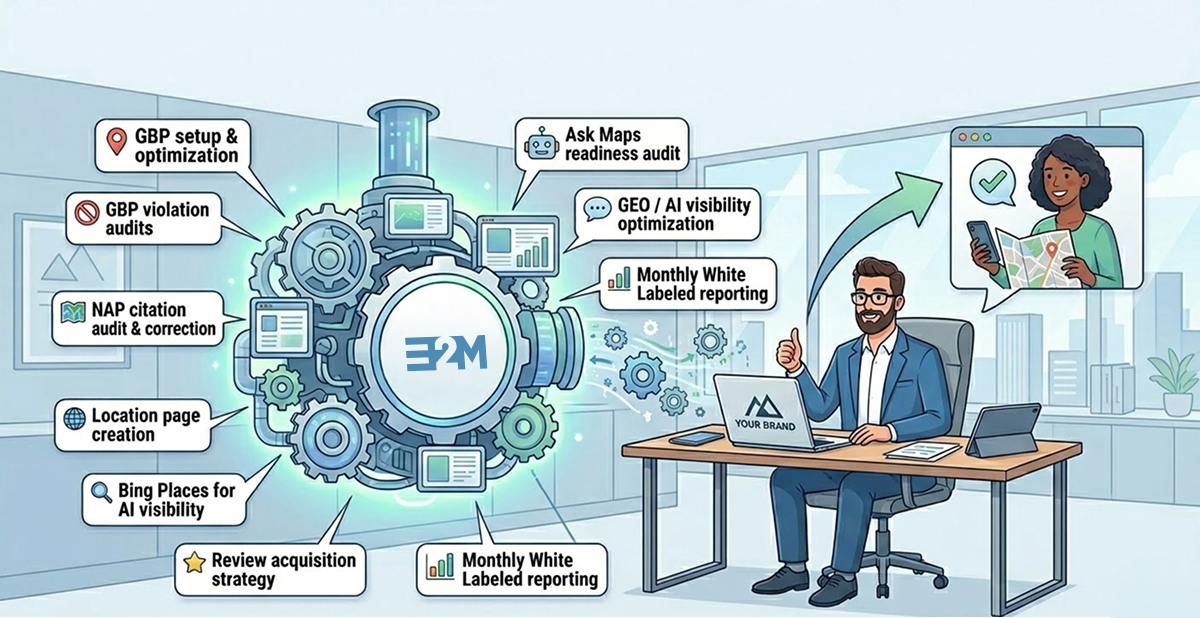
What’s Included in E2M’s White Label Local SEO Service
- Google Business Profile setup, optimization, and ongoing monthly management
- GBP violation audits, profile suspension risk identification, and remediation
- NAP citation audit, correction, and monitoring across all major directories and aggregators
- Location page creation and on-page optimization with local schema markup
- Bing Places optimization for AI search visibility
- Review acquisition strategy design and reputation management
- Local link building outreach: chamber listings, local directories, editorial placements
- Ask Maps readiness audit:GBP completeness check aligned to Ask Maps ranking signals
- GEO / AI visibility optimization: content creation, freshness, FAQ structuring, AI citation tracking
Monthly White Labeled reporting with rank tracking, citation growth, and review performance with Unlimited tasks.
Your Local SEO Fulfillment Is Handled.
Talk to an E2M White Label growth partner. We’ll walk you through exactly how White Label local SEO delivery works for your agency and what your margins could look like.
11. Frequently Asked Questions
Q1: What is local SEO and why does it matter in 2026?
A1: Local SEO is the process of optimizing a business’s online presence so it appears in location-based search results, Google Maps, AI Overviews, Ask Maps, and AI chatbots like ChatGPT. In 2026, it matters more than it ever has: consumers are now using AI tools to find local services, not just traditional search engines. Businesses that rank across all these channels see significantly more visibility and inbound leads than those optimized only for traditional search.
Q2:What is Google’s new Ask Maps feature?
A2: Ask Maps is a Gemini-powered conversational feature launched by Google in March 2026. It allows users to ask complex natural-language questions inside Google Maps and receive AI-generated, personalized recommendations, displayed on a visual map. It draws from Google’s database of over 300 million places and personalizes results based on each user’s Maps activity history. It’s rolling out now in the US and India on iOS and Android.
Q3: How does ChatGPT decide which local businesses to recommend?
A3: ChatGPT draws from three main sources for local recommendations: its training data (content indexed from authoritative sites before its training cutoff), the Bing web index accessed during browsing mode, and third-party citations from review platforms and directories. Businesses with strong Bing Places profiles, consistent NAP citations, and content that directly answers local intent questions are significantly more likely to be recommended.
Q4: How long does it take to rank on Google Maps?
A4: Most local SEO campaigns show meaningful movement in Maps rankings within 60 to 90 days of implementing a complete strategy, GBP optimization, citation correction, review building, and on-page SEO. Competitive markets, businesses starting from scratch, or profiles with serious citation inconsistencies may take 4 to 6 months to see significant shifts.



Vishal studied at Federation University Australia and has managed multi-million-dollar campaigns and actively participates in global industry events, including BrightonSEO and MavCon Live. His expertise spans technical SEO, content marketing, PPC optimization, and agency partnership development.
Outside of work, he enjoys traveling, playing cricket, and exploring new trends.