

Way to search: AI Mode
Google’s search experience has entered a new era, and it’s powered by AI Mode.
According to Alphabet and Google CEO Sundar Pichai, AI Overviews now reach 2 billion monthly users across more than 200 countries, marking the fastest adoption of any feature in Google’s history. The way people discover, evaluate, and engage with content online has fundamentally changed.
Table of Contents
-
- Introduction
- What Is Google AI Mode?
- Google AI Mode vs. Other AI Tools
- The Impact of Google AI Mode on SEO
- Step-by-Step Guide to Optimizing for Google AI Mode
- Step 1: Audit Your Current Content and Identify Quick Wins
- Step 2: Master the Technical Foundation
- Step 3: Build Powerful E-E-A-T Signals
- Step 4: Optimize Content Structure for AI Readability
- Step 5: Create Citation-Worthy Content
- Step 6: Build Brand Presence Beyond Your Website
- Step 7: Develop Deep Topical Authority
- Step 8: Optimize for Conversational Queries
- Step 9: Leverage Multimedia Content
- Step 10: Track AI Visibility and Measure Results
- Key Takeaways for 2026 SEO
- Conclusion
- Frequently Asked Questions About Google AI Mode
Introduction
Research from SE Ranking’s 2024 AI Overviews Study shows that long-tail queries (4+ words) trigger AI Overviews 60.85% of the time, while sensitive YMYL topics like Legal (28.32%), Healthcare (17.09%), and Finance (10.08%) increasingly appear in AI-generated responses on page one.
For digital agencies, this shift is a defining moment. Traditional SEO tactics centered on ranking and backlinks are no longer enough; visibility now depends on whether your client’s brand earns AI citations and contextual mentions inside Google’s generative results.
This guide breaks down everything you need to know about Google AI Mode. How it works, how it’s reshaping SEO, and most importantly, how agencies can stay ahead of the AI-first search curve in 2026.
What Is Google AI Mode?
Google AI Mode is an AI-driven search experience that replaces standard results with an AI-first layout.
Powered by Google’s Gemini 2.5 model with agentic reinforcement learning capabilities.
Think of it as having Google’s most knowledgeable research assistant built directly into your search experience. When you ask a question, AI Mode doesn’t just point you to websites that might contain the answer. Instead, you get answers immediately without having to dig or even scroll.
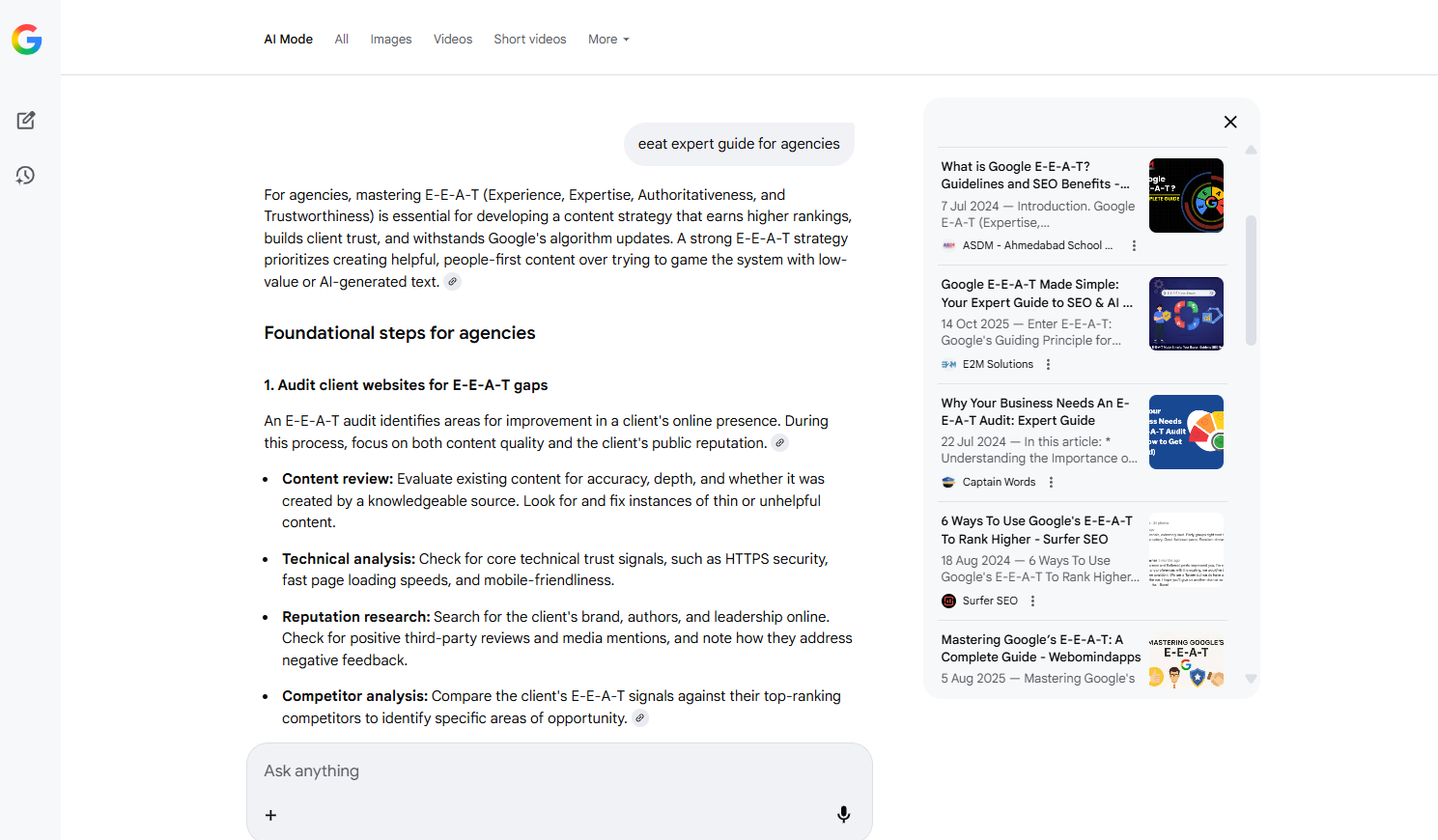
How to Access AI Mode?
You can activate AI Mode through Google Search Labs, Google’s experimental features platform. Once enabled, AI Mode appears as a separate tab in Google Search alongside familiar options like “Images,” “Videos,” and “Shopping.”
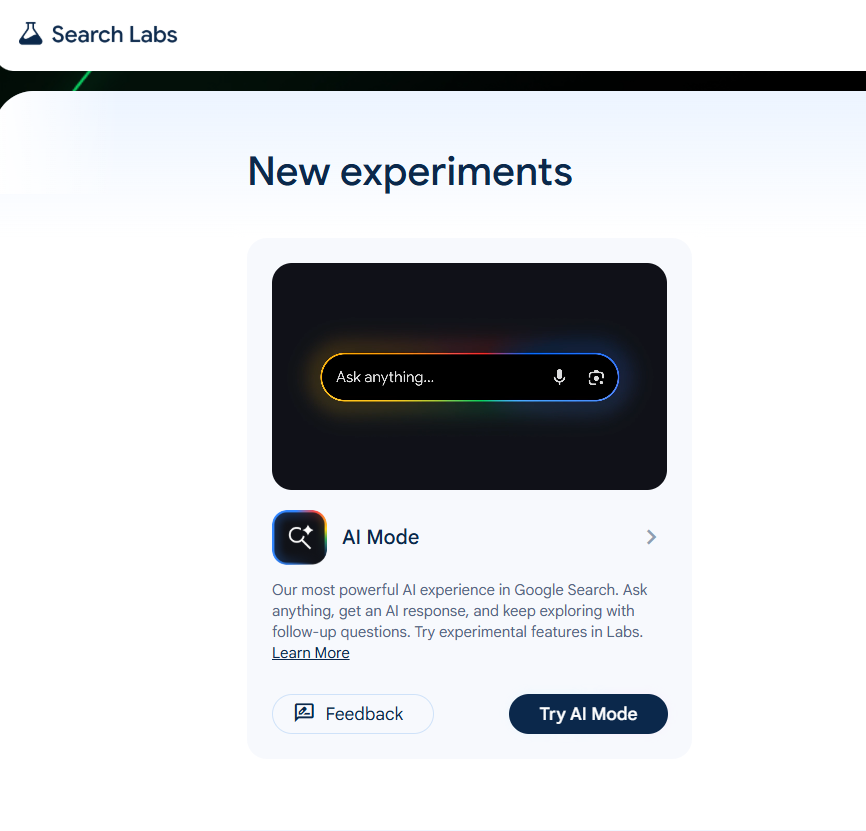
You can also access it directly by navigating to google.com/aimode.
When you turn on AI Mode in Google Search (currently available to some users through Search Labs or Gemini integration), Google uses its Gemini AI model to:
- Analyze your query in depth
- Summarize relevant information from multiple trusted sources
- Present an AI-generated overview at the top of the results
- Suggest follow-up questions or related searches you can tap for deeper exploration
You can then chat with the AI directly inside Search, refining or expanding your query just like you would with ChatGPT or Gemini.
Pro Tip from Experience: Brands that appear in AI Mode results aren’t just ranking; they’re trusted sources cited by AI. Being referenced in AI answers is now as important as ranking in traditional SERPs.
How AI Mode Differs from AI Overviews?
This is where many marketers get confused between Google AI Mode vs AI Overviews, so let’s clarify the distinction.
AI Mode and AI Overview are both part of Google’s new generative AI Experience in Search, but they serve different purposes and offer distinct user interactions.
1) How Google’s AI Overviews Works:
- Appear in regular search results when Google determines they’re helpful
- Provide quick summaries for complex questions with static summaries that appear at the top of Google Search results and with supporting links
- The goal is to quickly convey the main point of a topic with clear citations, offering a jumping‑off point for further exploration through linked sources.
- Best for understanding complex topics quickly
- Process is text-only, meaning users input written queries rather than images or voice
2) How AI Mode Works:
- AI Mode, on the other hand, is an opt-in experience that users must intentionally activate.
- Enables deeper, interactive exploration with follow-ups and comparisons through conversational interactions that allow follow-up questions and retain context
- Powered by an advanced Gemini model enhanced with agentic reinforcement learning and query fan-out, allowing simultaneous sub-queries to build comprehensive, multi-source answers.
- Best for exploratory tasks, product comparisons, how-tos, and planning
- Multimodal: accepts text, voice, and images
How AI Mode Uses More Queries and Sources
Google’s AI Mode introduces a major leap in how information is retrieved and synthesized compared to AI Overviews.
While AI Overviews are optimized for speed and simplicity, they typically generate responses in a single-pass synthesis, meaning Google’s system references a limited number of sources within a fixed token range. This makes Overviews efficient but somewhat restrictive in how deeply they analyze and cross-reference data.
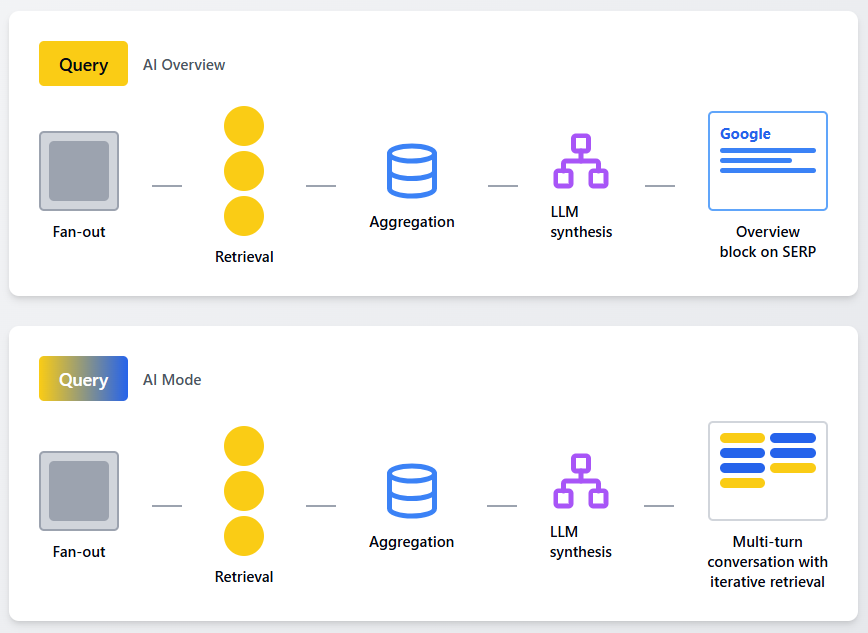
In contrast, AI Mode uses a multi-turn, iterative retrieval process. It can conduct several search and synthesis cycles within the same session, pulling from more queries, diverse data points, and evolving user inputs. This means every follow-up question prompts a refined and contextually updated response, creating a more dynamic and conversational experience.
For SEO professionals, this shift carries powerful implications. Multi-turn retrieval allows Google’s AI to identify broader topical coverage, reference fresh and authoritative sources, and reward content with strong E-E-A-T signals — experience, expertise, authoritativeness, and trustworthiness.
In essence, AI Mode doesn’t just summarize existing content, it continuously learns and adapts, prioritizing pages that demonstrate topical depth, credibility, and relevance across multiple user intents.
Comparative Summary of AI Overviews and AI Mode
| Feature | AI Overviews | AI Mode |
|---|---|---|
| Experience Type | Static summary in Search | Interactive conversation |
| Purpose | Quick insights for everyday queries | Deep reasoning and complex problem-solving |
| Interaction | One-shot answer | Multi-turn Q&A |
| Technology | Gemini 2.0 | Advanced Gemini 2.0 Flash (multimodal, reasoning-driven) |
| Availability | Public in Search | Experimental (Search Labs) |
| Output | Concise overview with citations | Iterative, contextual dialogue |
| Input Types | Text only | Text, voice, images |
| Source Breadth | Limited (single retrieval) | Extensive (multiple retrieval cycles) |
In short, AI Mode represents the next evolution of Google’s generative search — multimodal, adaptive, and deeply contextual, going far beyond the static, snapshot-style responses of AI Overviews.
Google AI Mode vs. Other AI Tools
To truly understand where Google AI Mode fits in the competitive digital scenario, we need to examine how it compares to other popular AI search tools. Each platform has a distinct architecture that affects SEO strategy.
ChatGPT, Perplexity, and Standalone AI Tools
The AI search world includes multiple players with distinct characteristics:

ChatGPT: Uses Bing and Google as Its Indices
Base ChatGPT models do not maintain their own web index. Instead, they generate search queries and send them to Bing’s API (with evidence suggesting they also pull from Google using SERPs API), retrieve a short list of URLs, then fetch and process the full content at runtime for synthesis.
Key implications: Traditional SEO still matters because ChatGPT relies on existing search rankings to determine which content to retrieve. However, its lack of direct search integration limits depth compared to native platforms.

Bing : Uses Its Index with ChatGPT
Copilot inherits Microsoft’s full-fledged Bing ranking infrastructure and then layers GPT-class synthesis on top. This creates a two-stage filter where traditional SEO signals determine which candidates make it to the grounding set, while extractability and clarity determine whether those candidates become citations in the final response.
Key implications: Content needs to satisfy both traditional SEO requirements AND AI extractability requirements. Integration with MS365 allows actions beyond search (scheduling meetings, editing documents, etc.).

Perplexity: Uses Bing and Google, Puts Citations in the Foreground
Perplexity foregrounds its citations, displaying sources prominently and often before the generated answer itself. Like ChatGPT, it doesn’t maintain its own index but pulls from both Bing and Google, generating search queries dynamically and fetching URLs in real-time.
Key implications: The transparency makes Perplexity an excellent “GEO laboratory” for practitioners to reverse-engineer what content characteristics earn citations. However, it operates outside Google’s ecosystem with a significantly smaller market share.
Why AI Mode Matters More for SEO?
For businesses and agencies focused on visibility and traffic, optimizing for Google AI Mode isn’t just about staying current with one AI tool among many. It’s about adapting to the fundamental evolution of the world’s primary information gateway.
Market reality: Google processes over 8.5 billion searches per day. While ChatGPT and Perplexity have growing user bases, Google’s search dominance means AI Mode will impact more businesses more quickly than any competing platform.
The Impact of Google AI Mode on SEO
Shift from Ranking to Reputation
AI Mode represents the biggest change to search in years, where traffic is down, Google Search Console can’t track it, and visibility now depends on citations, not just rankings.
The traditional SEO paradigm centered on achieving top rankings for target keywords. AI Mode fundamentally disrupts this by emphasizing source authority over position.
The Data Behind the Disruption
To understand how dramatic this shift is, E2M Solutions’ AI SEO expert conducted an analysis comparing sidebar sources cited in AI Mode responses versus traditional SERP results for five high-intent SEO queries:
- “Technical SEO checklist”
- “What is an AI search audit?”
- “White Label SEO solutions”
- “How to create a GA4 Audit report”
- “Best AI SEO tools”
The findings were eye-opening:
| Query | % domain Overlap | Differences |
|---|---|---|
| Technical SEO checklist | ~60% | AI Mode highlights emerging tools (Hostiger, search, Landingi) not in the top organic results; organic focuses on authority sites |
| What is an AI search audit? | ~40% | AI Mode emphasizes SaaS & AI tools, and organic focuses on classic SEO resources |
| GA4 Audit Report | ~30–40% | AI Mode integrates tool-specific recommendations, and organic focuses on official documentation and templates |
| White Label SEO solutions | ~40-50% | AI Mode uses community & emerging software references, organic uses traditional authority sites |
| Best AI SEO tools | ~50% | AI Mode favors newer and community-recognized tools, Organic favors traditional top SEO tools |
What does this mean for Your Digital Strategy?
- Ranking in the top 10 no longer guarantees visibility, as AI-generated answers are taking clicks from traditional search results
- Being referenced as a source within AI-generated responses becomes the new “ranking #1”
- Only 53% of domains cited in AI Mode match the top 10 organic search results, and only 35% of URLs match
- Brand recognition across the web amplifies citation likelihood
- AI Mode selects sources based on perceived trust, relevance, and formatting—not just rankings.
Your content is more likely to appear if:
- Your domain shows up across the web in forums, directories, and citations
- Your content is structured for AI readability with modular, concise, expert-backed information
- Your brand is cited by trusted third parties, even without links
Step-by-Step Guide to Optimizing for Google AI Mode
Here’s your practical roadmap for optimizing your clients’ content for maximum visibility in Google AI Mode.
Step 1: Audit Your Current Content and Identify Quick Wins
Start by analyzing which of your client’s existing content could be cited in AI Overviews. Use Google Search Console to track AI Mode appearances, data from AI Mode now counts toward totals in the Performance report starting June 2025, WordStream.
Look for pages already ranking in positions 1-10 with high impressions but declining CTR, these are prime candidates for AI optimization.
Review competitor citations by searching target keywords and noting which websites appear in AI Overviews. Create a simple spreadsheet tracking which client pages appear in AI Mode for their keywords. This helps prioritize optimization efforts and becomes powerful reporting material for clients.
Step 2: Master the Technical Foundation
AI Mode favors fast, mobile-optimized, well-structured content. Target specific Core Web Vitals metrics. Make sure responsive design works flawlessly on mobile devices, as AI systems evaluate cross-device performance.
Implement schema markup using JSON-LD format for Article, FAQ, HowTo, Organization, and Person schemas. AI prefers clear, concise, and structured content. Think structured bullet points, clearly defined glossaries, tables, and direct answers to specific questions.
Validate your schema using Google’s Rich Results Test and create logical site architecture with clean internal linking.
Step 3: Build Powerful E-E-A-T Signals
E-E-A-T (Experience, Expertise, Authoritativeness, Trustworthiness) has become crucial; citation is the new ranking, and your E-E-A-T signals determine whether Google’s AI deems your content worthy of quoting.
Demonstrate real-world experience through case studies, specific examples, and first-person accounts. Show expertise with detailed author bios, credentials, and industry certifications.
Build authoritativeness by earning quality backlinks from reputable sites and getting mentioned in industry publications. Establish trustworthiness through accurate information backed by credible sources, transparent citations, and clear contact information.
Content backed by reliable sources, citations, and transparent authorship is more likely to surface in AI-generated search features. For a detailed guide on implementing E-E-A-T, check out this comprehensive resource.
Step 4: Optimize Content Structure for AI Readability
AI systems need to quickly extract information from your content. Use a clear heading hierarchy (H1, H2, H3) with descriptive titles for each section. AI prefers direct answers to specific questions, formatted with clear headings and concise explanations.
Keep paragraphs short (2-4 sentences), use bullet points for lists, and add FAQ sections with schema markup.
Answer questions directly at the start of sections, then provide supporting details. Use tables for comparisons and numbered lists for step-by-step processes. Create content templates with optimized structures built in for consistency across all client content.
Step 5: Create Citation-Worthy Content
Use first-party data and original research to build trust and enhance discoverability, like proprietary studies, customer insights, and industry benchmarks position your brand as a primary knowledge source.
Develop surveys, trend analyses, and case studies with real results. Include expert quotes with credentials to add authority.
Create comprehensive, definitive guides that cover topics thoroughly. Listicles and regular informational content won’t make the cut anymore; you need content that showcases genuine topical expertise.
Include multiple examples, step-by-step instructions, visual aids, and downloadable resources. Position original research services as a premium offering to create unique content that competitors can’t replicate.
Step 6: Build Brand Presence Beyond Your Website
AI Mode synthesizes information from multiple sources across the web. Publish high-quality guest posts on authoritative industry sites focusing on value, not promotion. Engage authentically on Reddit, Quora, and industry forums by answering questions with helpful, non-promotional insights.
Complete profiles on Google My Business, Bing places, LinkedIn, and industry-specific directories with consistent NAP (Name, Address, Phone) information.
Develop relationships with industry journalists to position your clients as expert sources. Create a brand mention strategy document for each client showing where they should be visible online.
Step 7: Develop Deep Topical Authority
Build hub-and-spoke content structures with comprehensive pillar pages covering topics broadly and supporting articles on specific subtopics. Connect all related content through strategic internal linking.
Deep Search generates expert-level researched reports with citations. If your company has established authority in a specialized field, your in-depth articles and technical specifications will be prominently featured as sources.
Cover semantic richness by addressing related concepts, common questions at different knowledge levels, and various search intents. Regularly update pillar content with new statistics, recent examples, and emerging trends.
Topic cluster planning is an excellent upsell opportunity, showing clients how comprehensive coverage creates compounding SEO value.
Step 8: Optimize for Conversational Queries
Structure content around actual questions people ask using “How do I…?”, “What’s the difference between…?”, “Why does…?” as H2 or H3 headings. Write conversationally using second person (“you”), clear sentences, and simple explanations of jargon with practical examples.
Address multiple search intents by covering beginner questions (what, why, basic how), intermediate questions (specific techniques, comparisons), and advanced questions (optimization, troubleshooting).
Use tools like AnswerThePublic or “People Also Ask” boxes to find actual questions people are asking.
Step 9: Leverage Multimedia Content
AI Mode’s multimodal capabilities make visual content increasingly important. Use descriptive, specific alt text for images, add contextual captions, and implement image schema markup. Create video content with accurate transcripts, descriptive titles, and video schema markup host on YouTube for maximum reach.
Develop infographics and data visualizations that make complex information easier to understand. These are highly shareable, earn backlinks, and help AI systems extract and cite information.
Multimedia optimization can be a separate service offering for clients with visual assets that haven’t been optimized for search.
Step 10: Track AI Visibility and Measure Results
AI Mode data now counts toward totals in Search Console—clicks on external links count as clicks, page appearances in AI responses count as impressions, and position is calculated like standard search results. Track pages appearing in AI Mode, impression trends, click-through rates from citations, and position changes over time.
Regularly search for target keywords and document which pages get cited, what information AI extracts, and competing sources that appear. Google has seen that when people click from search results pages with AI Overviews, these clicks are higher quality—users are more likely to spend more time on the site.
Create monthly AI visibility reports showing citation frequency, competitive positioning, traffic impact, and month-over-month improvements to demonstrate clear ROI.
Key Takeaways for 2026 SEO
- Foundation Still Matters: Strong traditional SEO remains essential. GEO builds on these fundamentals rather than replacing them.
- Brand Building Amplifies Results: Cross-platform presence and authority compound AI visibility and citation likelihood.
- Content Quality Determines Citations: AI Mode rewards content that shows lived expertise, like case studies, tutorials, and frameworks.
- Conversational Optimization Differs: Natural language, question-based content aligns with how users interact with AI Mode.
- Measurement Requires Innovation: Develop tracking systems for citations, brand mentions, and AI share of voice beyond traditional metrics.
- Collaboration Is Essential: Winning in 2026 and beyond means zero tolerance for working in silos, with SEO, content, social media, CRO, UX, engineering, digital PR, brand, product, and analytics all working together.
- Early Adoption Creates Advantage: Establishing authority in AI citations now positions agencies and clients ahead of competitors who wait.
E2M Solutions’ White Label GEO Services empower digital agencies to adapt faster and achieve greater visibility in Google’s AI Mode. From technical GEO frameworks to content strategies built for conversational AI and LLMs, E2M helps your clients get cited, not side-lined.
Ready to Monetize AI Search Optimization?
Understanding Google AI Mode is just the beginning. The real opportunity lies in positioning these services as high-value offerings to your clients. If you’re an agency owner looking to package and sell AI search optimization services, our comprehensive guide walks you through pricing strategies, client communication frameworks, and service delivery models that work. Learn more about selling AI-driven SEO services by reading our guide: The Agency Owner’s Guide to Selling AI Search Optimization.
Conclusion
Staying Ahead of the AI Search Curve
Google AI Mode marks a major shift in how people find and trust information online, with the focus no longer just on rankings and clicks but now on citations, credibility, and context.
The transition to AI-driven search represents the most significant shift in search behavior since Google’s founding. For agencies, digital marketers, and business owners, this moment offers both extraordinary challenges and unprecedented opportunities.
AI isn’t here to replace your content; it enhances visibility when you speak with precision. The myth that AI search will render human-created content obsolete is fundamentally wrong. What AI Mode actually does is quote people and organizations that demonstrate genuine expertise.
Frequently Asked Questions About Google AI Mode
1) What are the most impactful AI mode ranking factors?
Answer: Your biggest, most fundamental focus for ranking on Google AI mode should be delivering clear, trustworthy, and structured information. Avoid the technical jargon and make sure your content directly answers common user queries with concise, authoritative language.
From here, you’ll need to focus on improving the E-E-A-T by demonstrating expertise and citing reputable sources; use structured data markup to help AI understand entities, relationships, and context within your messaging. We also recommend you create logical page architecture with clean headings and internal links. From here, you can work to improve performance metrics like Core Web Vitals; and maintain up-to-date, accurate information that aligns with real user intent so AI can confidently reference and summarize your content.
2) What is the difference between AI Mode and AI Overviews?
Answers: These terms are commonly used interchangeably, but there are many significant differences. Google AI Mode is an optional search experience users have to enable to get generative, conversational answers customized to them.
On the other hand, AI Overviews are automatic summaries Google shows directly in the standard search results for certain queries, similar to the Featured Snippet. AI Mode works to provide deeper interactions and personalized follow-ups, where AI Overviews provide quick snapshots without requiring user engagement. Generally, AI Mode pulls from a broader range of sources to support exploratory tasks, while AI Overviews rely more heavily on Google’s confidence in high-quality, verifiable information in mainstream search.
3) How does AI Mode select which sources to cite?
Answers: Google AI Mode pulls from a mix of real-time web content and Google’s own knowledge systems. This primarily includes publicly available indexed pages, structured data, factual knowledge graphs, and high-authority sources it can reliably cite.
Similar to standard Google Search, AI Mode emphasizes content that demonstrates strong quality signals (expertise, accuracy, freshness, clear structure). However, AI Mode can draw from a broader set of results for exploratory queries and may generate synthesized responses, rather than showing direct snippets.
4) What schema markup is most important for AI Mode optimization?
Answers: Prioritize FAQ schema for question-answer content, HowTo schema for instructional content, Article schema with proper authorship and organization details, Product schema for eCommerce commercial content, and Organization schema for business information and trust signals. Implement using JSON-LD format and validate with Google’s Rich Results Test.
5) Should I be posting regularly on Reddit and Quora to get placed on AI Overviews?
Answers: We recommend posting regularly on Reddit and Quora to improve your chances of getting content placed on Google AI Overviews. However, it’s not a direct guarantee for inclusion.
Google pulls from a variety of trusted and authoritative sources, and while content on platforms like Reddit and Quora can sometimes be included in search results, the focus is more on content quality, relevance, and engagement. To increase your chances, we recommend focusing your energy on creating well-researched, informative posts under your own platforms that answer common questions, are structured clearly. Being active on these platforms can improve your overall online presence and increase your chances of getting recognized as a reliable source for AI Overviews, but it’s not a sole factor.
6) How does multimodal search in AI Mode affect content strategy?
Answers: AI Mode’s multimodal capabilities mean you should optimize beyond text. Include descriptive alt text for images, create video content with searchable transcripts, develop visual data representations (charts, infographics), ensure audio content has proper metadata, and structure multimedia assets for discoverability. Diverse content formats increase citation opportunities.
7) Is optimizing for AI Mode/LLMs worth the investment in 2026?
Answers: Absolutely. Studies show that AI-generated results increasingly capture clicks that would have gone to traditional SEO organic results. Early adopters gain AI SEO results, competitive advantages as AI Mode adoption grows. SMB Businesses not optimizing for AI search risk becoming invisible as user behavior shifts toward AI-first search experiences.



Vishal studied at Federation University Australia and has managed multi-million-dollar campaigns and actively participates in global industry events, including BrightonSEO and MavCon Live. His expertise spans technical SEO, content marketing, PPC optimization, and agency partnership development.
Outside of work, he enjoys traveling, playing cricket, and exploring new trends.