If you run a digital agency, you know the feeling. Sales are finally working. The pipeline is full. And every new signed deal triggers the same question in the team channel: “Who’s actually going to do this?”
Winning clients is only half the job. The other half is delivering the work without slowing down, compromising quality, or hiring a new team every time demand rises.
That pressure is showing up in the numbers. According to Promethean Research’s 2026 State of Digital Services report, average digital agency revenue grew 7.5% in 2025, yet net margins slipped to 13% and average headcount contracted by 2% for the second year running. Agencies are growing. They are not hiring to match.
At E2M, we’ve spent 13+ years as the white label growth team behind 1,100+ agencies, and we’ve noticed something consistent: the agencies that scale profitably don’t treat white labeling as a production shortcut. They treat their white label partner as part of their growth infrastructure.
This playbook explains exactly how white label services work, when to use them, what they cost compared with hiring, how to vet a partner, and how to tell whether your agency is ready.
The core idea
Outsourcing gets a task done.
A white label partner gets your agency unstuck.
The difference shows up in your margins.
TL;DR
- White label services let an agency sell a service under its own brand while a specialist partner fulfills the work behind the scenes.
- Your agency keeps the client relationship, pricing, brand, and strategy. The partner owns agreed delivery, QA, and reporting back to you.
- The model fits web & marketing agencies whose pipeline is outgrowing their delivery team, but whose demand isn’t yet predictable enough for permanent hires.
- Cost: White-label services start at $1,299/month at E2M, compared with a U.S. web developer’s median salary of $92,650 a year before benefits, tools, and management time.
- Choose on quality systems, strategic thinking, communication, workflow fit, and scalable capacity.
- E2M is a white-label growth partner with 400+ active agency partners, 350+ full-time specialists, 25,000+ delivery hours a month, and 98% client retention. Most agencies start assigning work within 24–48 hours.
Why Delivery Capacity Is Becoming an Agency Growth Problem
For growing digital agencies, delivery capacity can bottleneck revenue growth. Winning new clients is only part of the equation. Agencies also need the people, processes, and expertise to deliver consistent results without overloading their existing teams or sacrificing profit margins.
The traditional growth model is straightforward: more clients → more work → more hires.
But hiring isn’t always the most practical way to meet rising demand. Recruitment takes time, onboarding requires resources, and every full-time employee adds ongoing costs for salaries, benefits, software, and management. When client demand fluctuates, agencies can end up paying for capacity they aren’t fully using.
For agency owners, the challenge is scaling delivery, protecting margins, and maintaining service quality without making every new client depend on another full-time hire.
The Agency Fulfillment Bottleneck
Picture a $750K digital agency. It has a proven sales process, account managers, a design and development team, and productized packages. The team is running at roughly 90% utilization.
In the same month, one client asks for SEO, another needs PPC management, and a third wants a new Shopify store. The agency has the opportunity to win all three projects, but its existing team doesn’t have enough available capacity to deliver them all on time.
This is the fulfillment ceiling: the point at which an agency’s delivery capacity becomes the bottleneck to revenue growth, even when demand for its services exists.
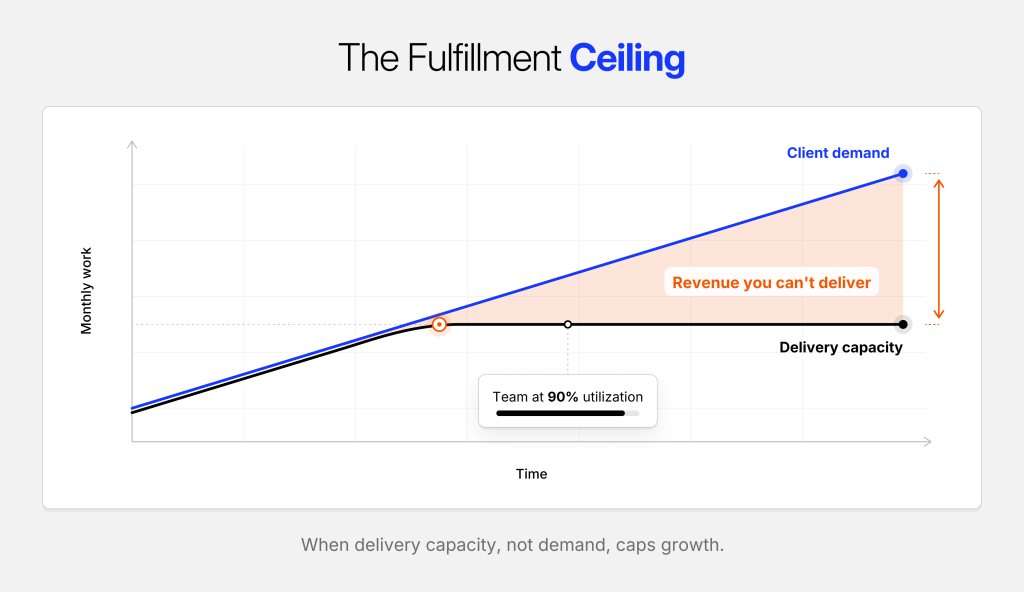
The Fulfillment Ceiling: How Growing Demand Can Outpace Delivery Capacity
When an agency reaches this point, it has three options:
- Turn down the work. Protect the existing team’s workload, but potentially lose revenue and opportunities to expand client relationships.
- Hire in-house. Build long-term internal capacity, while taking on recruitment, onboarding, and ongoing employment costs.
- Extend delivery through a white-label partner. Access additional specialist capacity while keeping the client relationship, brand, and agreed quality standards under your agency’s control.
The right approach depends on the consistency of demand, service requirements, profit margins, and how quickly the agency needs additional delivery capacity.
Why hiring isn’t always the answer
Hiring is the right move for capabilities that are core to your positioning and steadily in demand. It’s the wrong first move when demand is new, seasonal, or spread across several specialisms.
One SEO hire doesn’t give you an SEO department. A credible SEO offer in 2027 needs technical SEO, content, local SEO, link acquisition, analytics, and AI search expertise. Hiring for all of that before you’ve validated demand is how agencies quietly destroy margin.
Promethean Research’s data points the same way: agencies that reduced the number of services they offered grew 13% on average and posted 30% net margins. The lesson isn’t “offer less to clients.” It’s this:
Stay focused on what you build. Be deliberate about what you partner for.
What Are White Label Services?
White label services are services fulfilled by one company and sold by another under its own brand. For a digital agency, that means your agency wins and manages the client, a specialist partner delivers the agreed work, and the client receives everything under your agency’s name.
That’s how our white label services for agencies work: you stay client-facing, and our team operates as an invisible extension of yours.
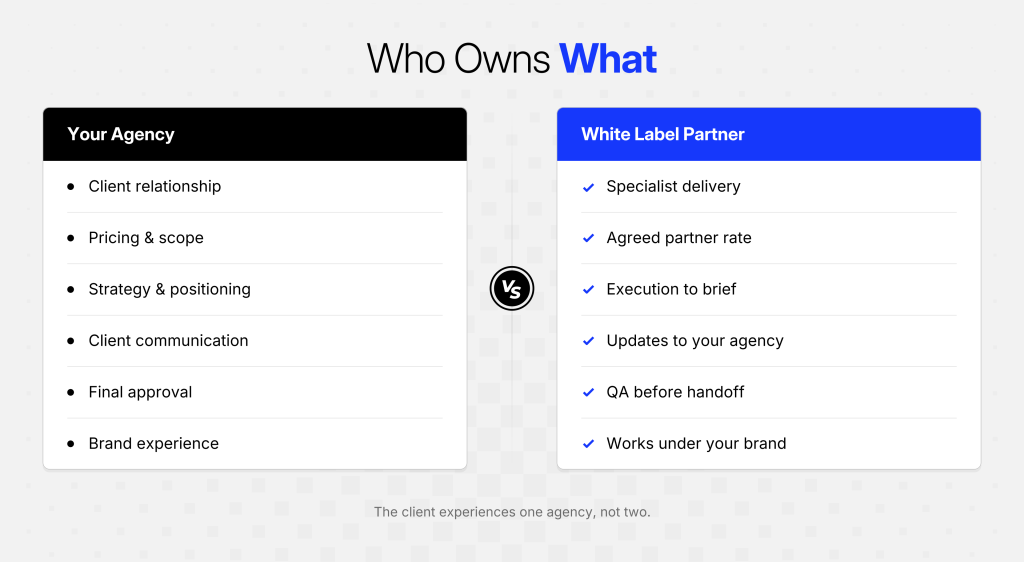
| Your agency | Your white label partner |
|---|---|
| Wins and manages the client | Provides specialist delivery |
| Sets retail price and scope | Charges an agreed partner rate |
| Owns strategy and positioning | Executes against the agreed brief |
| Communicates with the client | Communicates only with your agency |
| Reviews and approves deliverables | Completes and quality-checks the work |
| Owns the brand experience | Works under your brand, never its own |
The client experiences one agency, not two. For a deeper breakdown of service types, see our guide to what white label digital services are and how agencies use them.
White label vs. outsourcing
Outsourcing means someone outside your business does the work. White labeling adds a brand and client-ownership layer: the provider works invisibly behind your agency, uses your branding and reporting, and never contacts your client unless you ask.
Outsourcing is about who does the work. White labeling is about who does the work and whose brand the client experiences.
White label vs. freelancers
A freelancer gives you one person’s time and skill. A white label partner gives you a team: multiple specialists, project management, QA, documented processes, and backup when someone is out. Freelancers suit one-off projects. Recurring fulfillment across 10, 20, or 30 accounts usually needs a team.
White label vs. in-house
An in-house team gives you maximum control, and it’s the right home for your core capability. A white label partner gives you specialist capacity without the fixed cost and management load. Most $500K–$1M agencies we work with land on a hybrid: strategy, sales, and account management in-house; specialist production through a partner.
An in-house team gives you maximum control, and it’s the right home for your core capability. A white label partner gives you specialist capacity without the fixed cost and management load. Most $500K–$1M agencies we work with land on a hybrid: strategy, sales, and account management in-house; specialist production through a partner.
How Does a White Label Partnership Actually Work?
In a white label partnership, your agency sells and owns the client, sends a structured brief, and the partner fulfills and quality-checks the work. Your agency then reviews it, and the client receives it under your brand. Capacity scales as demand grows.
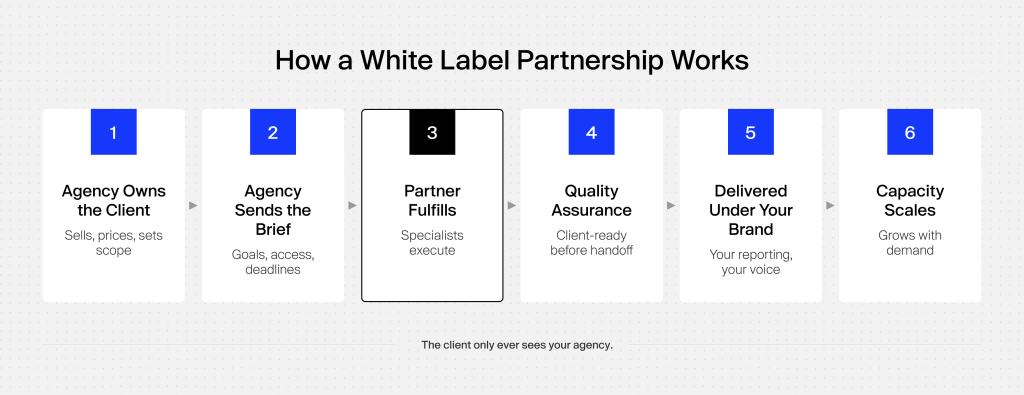
1. Agency owns the client relationship
Everything starts with you. You identify the opportunity, set pricing and scope, and manage expectations. When a web design client asks, “Can you also handle our SEO?”, the answer becomes yes, and the client still buys SEO from you.
2. Agency sends the brief
A strong brief kills back-and-forth. It should cover:
- Client goals and KPIs
- Scope, deliverables, and deadlines
- Target audience and markets (for example, the US, UK, or Australia)
- Brand guidelines and tone
- Work already completed and tools in use
- Access, credentials, and reporting format
- What “client-ready” means to your agency
A good partner learns your SOPs over time, so briefs get shorter, not longer.
3. Partner handles fulfillment
The partner’s specialists execute the agreed work: research, strategy inputs, technical implementation, content, design, development, optimization, and reporting. You manage the outcome, not every task.
4. Quality assurance
QA is where reliable partners and cheap vendors part ways. Work should pass the partner’s internal checks before it reaches you: technical accuracy, keyword targeting, schema, and reporting for SEO; responsiveness, forms, speed, tracking, and browser compatibility for web builds.
The standard is simple: work should be client-ready before it reaches your inbox.
5. Agency delivers under its brand
You review, add strategic context, and present the work. The client sees your brand, your reporting, and your account manager. The partner stays invisible.
6. Capacity scales with demand
This is where white label becomes a growth lever. If SEO grows from 5 to 10 to 30 clients, capacity grows with it, without a recruitment cycle for every account. For the practical setup, see how to integrate white label services into your agency workflow.
How fast can you get started?
Faster than most agency owners expect. With E2M, onboarding is three steps: a discovery call, choosing a plan, and kick-off within 24–48 hours. We plug into your tools and workflows so you can start assigning work the same week. Compare that with the two to four months it typically takes to recruit, hire, and ramp a specialist.
What Can Agencies White Label in 2027?
Agencies can white label almost any repeatable Digital & Web services. In 2027, the most common are SEO and AI search, website design and development (WordPress, Webflow, Wix, Duda), eCommerce, GoHighLevel builds, website care, content & Copy writing, video editing, paid media, and AI solutions, all can sell to clients under the agency’s own brand.
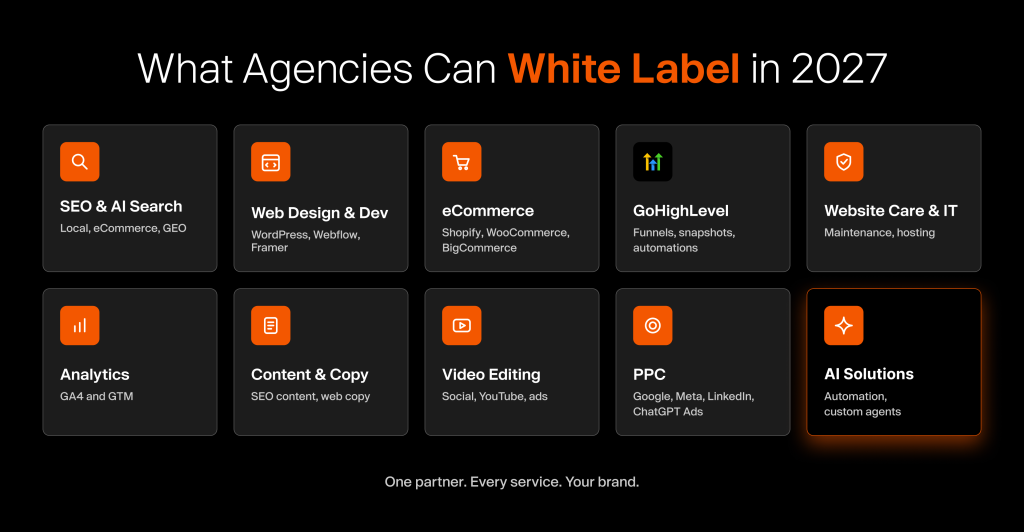
Here’s what that looks like in practice: what a partner like E2M delivers behind the scenes, and what your agency can sell under its own name.
| Service area | What E2M delivers white label | What your agency can sell | Why agencies white label it in 2027 |
|---|---|---|---|
| SEO & AI search | Technical and on-page SEO, local SEO (including niche programs for law firm, dental, and HVAC agencies), eCommerce SEO, GEO/AEO for AI Overviews and LLM answers, reporting | Monthly SEO retainers, local SEO packages, AI visibility (GEO) add-ons | AI Overviews and LLM answers have widened what “SEO” includes |
| Website design & development | Custom web design; WordPress (Elementor, Gutenberg, Beaver Builder, Oxygen); Webflow, Framer, Wix, and Duda; no-code builders; Figma-to-WordPress; converting vibe-coded sites to WordPress | New builds, redesigns, landing pages, migrations | Platform breadth is hard to staff in-house |
| eCommerce | White label eCommerce solutions on Shopify, WooCommerce, and BigCommerce: store builds, customization, and optimization | Store builds, replatforming, conversion improvements | Each platform needs its own specialists |
| GoHighLevel (GHL) | GHL funnels, websites, snapshots, and automations | GHL setup and build packages for clients | Fast-growing platform with few experienced builders |
| Website care & IT | WordPress maintenance and support, plus hosting, server, and IT support | Monthly care plans and hosting retainers | Recurring revenue, but low-glamour, high-dependency work |
| Analytics & tracking | GA4 and Google Tag Manager setup, audits, and fixes | Tracking setup, audits, and reporting packages | Broken tracking undermines every other service |
| Content & copy | SEO content writing, website copywriting, guides, thought leadership | Content retainers and copywriting projects | Volume swings month to month |
| Video editing | White label video editing for social, YouTube, and ad creatives | Video content retainers | Short-form video demand outpaces in-house editors |
| PPC & paid media | Google Ads, Meta Ads, LinkedIn Ads, YouTube Ads, and ChatGPT Ads management and reporting | Managed ad-spend retainers | Needs certified specialists and constant optimization |
| AI solutions | AI audits, workflow automation, custom AI agents, and implementation; an AI service reseller program; fractional AI consulting for agencies | AI readiness audits, automation projects, AI advisory retainers | Clients are asking now; few agencies have the bench |
Because E2M covers all of these white label services under one partnership, you can add a new service line without onboarding a new vendor each time. Same account manager, same workflow, same quality standards.
Start with the service that has proven client demand and the biggest delivery gap. Not the longest list.
When Should an Agency Use a White Label Partner?
An agency should use a white label partner when fulfillment, not demand, is what’s limiting its growth.
Watch for these signals:
- Your pipeline is growing faster than your delivery capacity. Every new deal triggers “Who’s going to do this?”
- Clients ask for services outside your core expertise. Web clients want SEO. SEO clients want a rebuild. Everyone wants AI.
- You’re turning down qualified work. A $6,000/month SEO retainer declined because no strategist is free for 60 days is a delivery constraint, not a demand problem.
- Hiring for every new service is too slow or too expensive.
- Senior people are stuck in production instead of strategy, upsells, and new business.
- Demand spikes from a big win or a seasonal push would force permanent hires for temporary work.
- You want to test a new service (AI SEO, for example) before building a department.
- The founder is still the delivery bottleneck, reviewing every deliverable and chasing freelancers.
When you shouldn’t use one
Keep a capability in-house when it’s your core competitive advantage, demand is steady enough to keep a dedicated team fully utilized, clients expect direct specialist access, or the work is tightly tied to your proprietary methodology.
White Label Partner vs. Hiring In-House vs. Freelancers
Hire in-house for core, steady work. Use freelancers for one-off projects. Use a white label partner for repeatable, multi-specialist fulfillment across many clients.
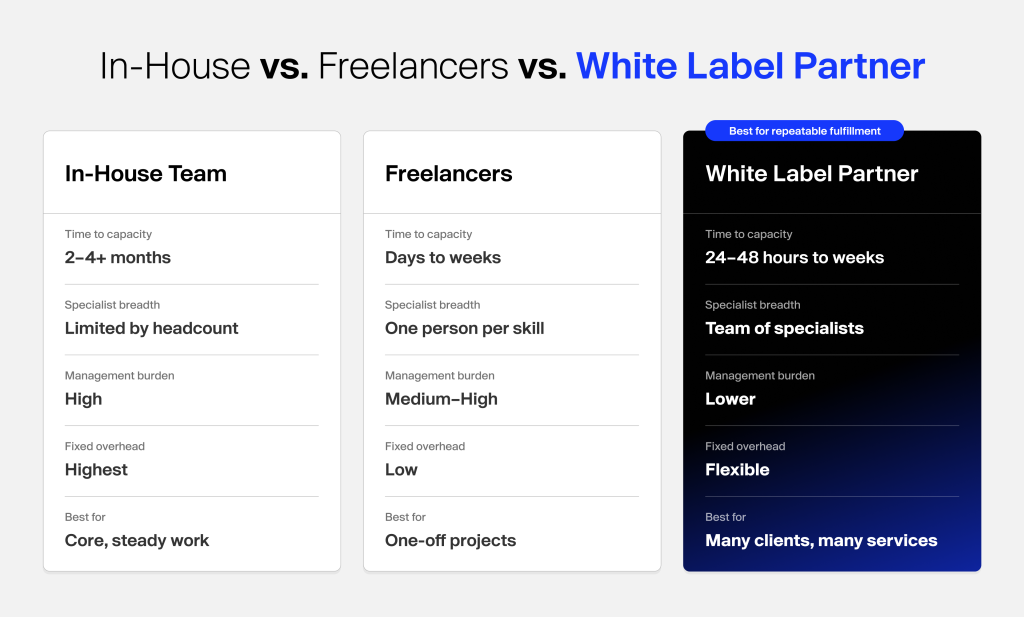
| Factor | In-house team | Freelancers | White label partner |
|---|---|---|---|
| Control | Highest | Medium | Medium–High |
| Time to add capacity | 2–4+ months | Days to weeks | 24–48 hours to weeks |
| Specialist breadth | Limited by headcount | One person per skill | Team of specialists |
| Management burden | High | Medium–High | Lower |
| QA & process | Built by you | Varies by person | Built in (verify it) |
| Fixed overhead | Highest | Low | Flexible |
| Client-facing brand | Agency | Agency or shared | Agency |
| Best for | Core capability with steady demand | One-off or niche projects | Repeatable fulfillment across many clients |
What you’re actually buying: an employee is dedicated to capacity. A freelancer is a skill for a project.
A white label partner is access to a delivery system: people, process, QA, project management, and tools you don’t have to build.
What does it actually cost?
Compare fully loaded cost, not salary vs. rate.
- In-house: the U.S. Bureau of Labor Statistics puts the median web developer salary at $92,650 a year (May 2025). Add benefits, payroll taxes, tools, recruiting, management time, idle weeks, and turnover risk.
- Freelancers: add sourcing, briefing, coordination, revisions, and finding a replacement when someone disappears mid-project.
- White label partner: usually a predictable monthly fee. E2M’s white label plans start at $1,299/month for 30–35 dedicated hours covering design, development, revisions, communication, and QA, and can be paused, adjusted, or cancelled.
An illustrative margin example (your numbers will vary):
| Amount | |
|---|---|
| Hours billed to clients (35 hrs at $125/hr) | $4,375 |
| White label cost (Standard plan) | –$1,299 |
| Internal review and account management (~4 hrs) | –$300 |
| Contribution margin | $2,776 (about 63%) |
Contribution margin = client revenue − fulfillment cost − internal management time − rework
A slightly pricier partner that cuts rework and management time often delivers better margin than the cheapest option. Cheap gets expensive fast.
What Should You Look for in a White Label Partner?
The right white label partner delivers to the standard your agency promises its clients, without adding another layer for you to manage. Evaluate these nine areas.
Quality
Ask for the documented QA process, who reviews work before delivery, how revisions work, and how missed requirements are handled. A portfolio shows what a partner can do. A QA process shows what they do consistently.
Strategic thinking
A task vendor asks, “What do you want us to do?” A growth partner asks, “What are you trying to achieve?” Look for partners who question briefs, flag risks early, and recommend improvements.
Communication
Expect a named account or project manager, a defined update cadence, a clear escalation path, and proactive status reporting. If you’re always asking “What’s the status?”, the partnership is costing you time. For agencies in the US, UK, and Australia working with an offshore partner, confirm time-zone overlap and turnaround windows up front.
Scalability
Don’t ask “Can you handle this project?” Ask “What happens if our volume doubles?” Get specifics on team size, how fast resources are added, and how quality and continuity are protected.
Workflow integration
The best partner works inside your project management tool, follows your naming and reporting standards, and fits your approval process. A partner that forces your team into its system has added work, not removed it.
Specialist expertise
Broad service menus can hide shallow benches. Ask who would actually do the work, which platforms they’re certified in, and for case studies from agencies like yours.
White-label protection
Confirm NDAs, IP ownership, zero direct client contact, unbranded deliverables and reports, and data handling aligned with the laws your clients operate under, such as GDPR and UK GDPR, the Australian Privacy Act 1988, and relevant US state privacy laws. Know what happens to files and access when the engagement ends.
Pricing
Look for transparent pricing, clear scope-change costs, revision policies, minimum commitments, and how rates change as you scale. Subscription or dedicated-resource models usually make margins more predictable than per-project quotes.
Track record
Agency-only partners understand agency realities: layered approvals, your brand standards, your deadlines. Ask for long-term agency references and retention data. Don’t just ask, “Who have you worked with?” Ask, “How did you work with agencies like ours?”
The 2027 White Label Partner Vetting Checklist
E2M built this checklist from 13+ years as the white label delivery team behind 1,100+ agencies. It covers the questions that separate partnerships that last from the ones agencies leave after a few months. It’s the same standard we hold ourselves to under our Black Label Standard, and we’d encourage you to put any partner through it, including us.
How to use it: run it before you sign. A strong white label partner should answer “yes,” with evidence, to at least 12 of the 15 questions. Anything less is a risk to your client relationships.
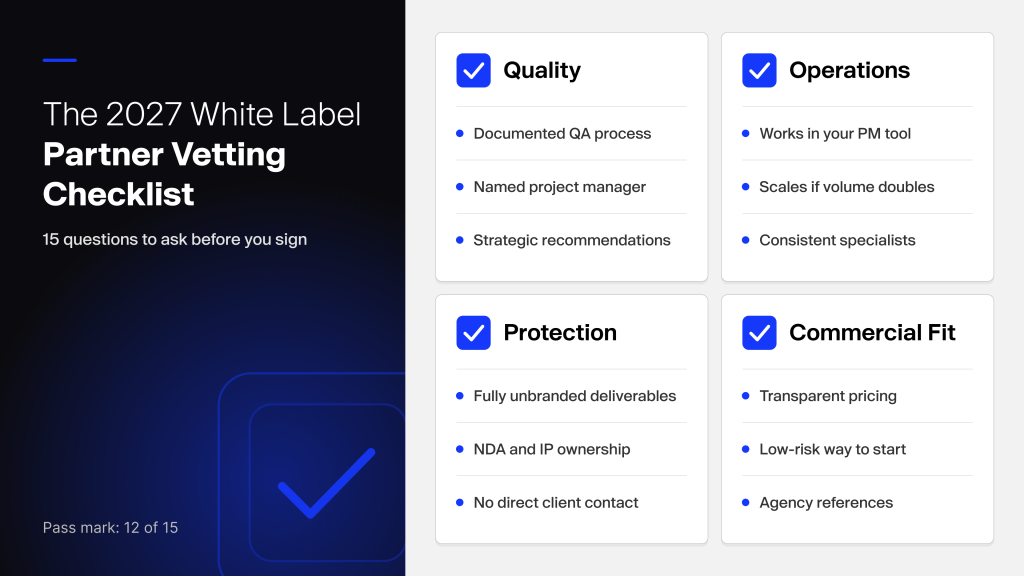
| # | Question | Evidence to ask for |
|---|---|---|
| 1 | Do you work exclusively or primarily with agencies? | Agency client mix, retention rate |
| 2 | Is there a documented, multi-step QA process? | Sample QA checklist |
| 3 | Will I have a named account/project manager? | Org chart for my account |
| 4 | Can you work inside our PM tool and SOPs? | Examples of tools supported |
| 5 | Are all deliverables and reports fully unbranded? | Sample white label report |
| 6 | Is there an NDA and clear IP ownership? | Contract terms |
| 7 | Do you never contact our clients directly? | Written policy |
| 8 | Can you scale capacity within weeks if volume doubles? | Team size, bench depth |
| 9 | Do specialists stay consistent on my accounts? | Resource allocation policy |
| 10 | Can you cover SEO, AI search/GEO, web, content, and PPC? | Service-specific case studies |
| 11 | Do you bring strategic recommendations, not just execution? | Example audits or proposals |
| 12 | Is pricing transparent, including revisions and scope changes? | Pricing sheet |
| 13 | What are the turnaround times and time-zone coverage? | SLA |
| 14 | Is there a low-risk way to start (pilot, guarantee, or pause option)? | Trial or guarantee terms |
| 15 | Can you share agency references we can call? | 2–3 references |
What White Label Fulfillment Looks Like in the Real World
A US agency serving personal injury law firms needed sophisticated, multi-location SEO without slowing its team or adding headcount. Working with E2M as its white label SEO partner, the agency kept the client relationship while our team integrated into its workflow and handled fulfillment. Over 12 months, the campaign delivered:
- 495% increase in organic sessions
- 444% increase in users
- 524% increase in form submissions
- 3,719 ranking keywords, 735 on page 1, 422 in the top 3
The takeaway isn’t just the traffic. It’s the operating model: the agency sold and owned the relationship, and the partner supplied the delivery infrastructure. Read the law firm SEO case study.

A Full Web Team of Specialists. Without the Full-Team Hire.
Unstuck Our Pipeline. Freed Our Team. Scaled Our Business.
Their Work Is Better Than Mine Was. My Only Regret Is Not Starting Sooner.
Why White Label Partnerships Matter Even More in 2027
White label partnerships matter more in 2027 because service menus are expanding faster than agencies can hire, and AI is changing what clients buy.
- AI adoption is mainstream inside agencies. Promethean Research found 34% of agencies had implemented AI across the business and another 28% were actively implementing it.
- Search now includes AI answers. Clients want to show up in Google AI Overviews, AI Mode, ChatGPT, Claude, and Perplexity, not just the blue links. That’s created demand for white label GEO services most agencies can’t yet staff.
- Specialists win, but clients want breadth. 86% of agencies identify as specialists. The winning 2027 model is specialized positioning + broader delivery capability.
- Headcount is flat while demand grows. That makes flexible capacity, not headcount, the main growth lever.
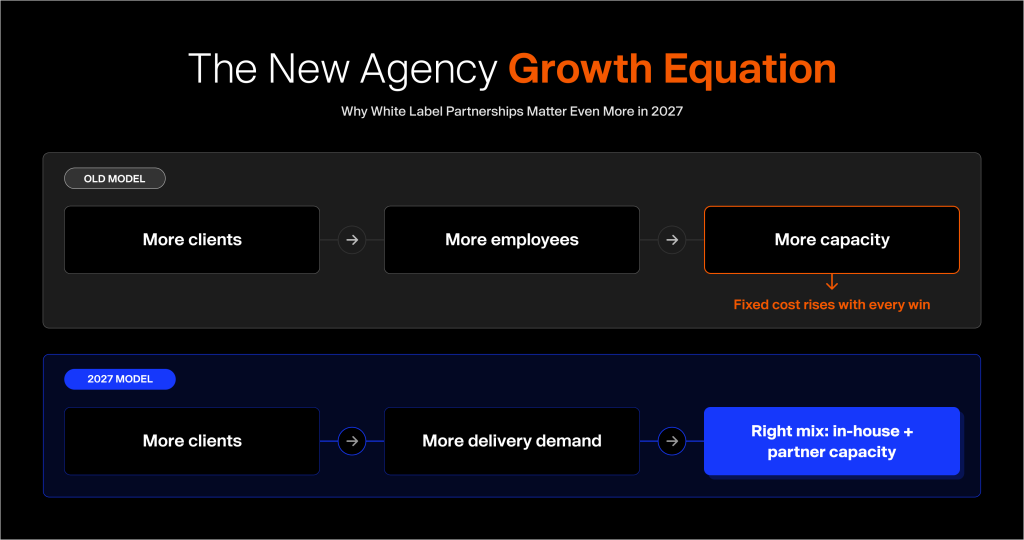
| Old model | 2027 model |
|---|---|
| More clients → more employees → more capacity | More clients → more delivery demand → the right mix of internal and partner capacity |
Why E2M Is Built Differently as a White Label Growth Partner
E2M is a white label growth partner for digital agencies, delivering SEO, AI search (GEO), web design and development, content, PPC, and AI solutions under the agency’s brand. Our model is built on the Black Label Standard: white label services delivered to a premium standard, with strategy, senior oversight, and proactive systems instead of price-led task completion.
| Proof point | E2M |
|---|---|
| Years in business | 13+ |
| Agencies served | 1,100+ |
| Active agency partners | 400+ |
| Full-time specialists | 350+ |
| Delivery hours per month | 25,000+ |
| Websites built | 15,000+ |
| Client retention | 98% |
| Time to kick-off | 24–48 hours |
What that means for your agency:
- Documented quality systems: SOPs and QA before anything reaches you.
- Strategic input: we flag opportunities and risks, not just close tickets.
- Proactive communication: dedicated project and account management, so you’re never chasing status.
- Workflow integration: we adapt to your tools and processes, not the other way round.
- Scalable capacity: add specialists as demand grows, without new hires.
- White-label protection: unbranded delivery and confidentiality by default.
As Alex Covert of Lasso Up put it: “8.5 Years Worked with White-Label Partners. E2M Is the Real Deal.”
How E2M Supports Agency Growth
SEO & AI SEO
Technical, on-page, local, and eCommerce SEO, plus AI search optimization (GEO/AEO), through our white label SEO services.
Web & Development
Custom design and builds on WordPress, Shopify, Webflow, WooCommerce, and more, plus ongoing maintenance, through white label website design and development.
Content
SEO blogs, website copy, and thought leadership written for your clients’ audiences, through our white label content services.
PPC
Google, Meta, LinkedIn, and YouTube campaign management and reporting through our white label PPC services.
AI Solutions
AI audits, automations, custom agents, and implementation through white label AI solutions for agencies.
How to Know If You’re Ready for a White Label Partner
You’re likely ready if three or more of these are true:
- Your pipeline is growing faster than your delivery capacity.
- Your team runs above 85% utilization most months.
- Clients regularly request services you don’t offer.
- You’ve turned down qualified work in the last quarter.
- Founders or senior strategists spend more time producing than selling.
- You want to test a new service before hiring for it.
- You’re spending too much time managing freelancers.
Start small: pick one service → choose one partner → run a 60–90 day pilot → measure quality, turnaround, and management time → refine → scale.
Frequently Asked Questions
White label services are services delivered by a specialist partner and sold by an agency under its own brand. The agency owns the client relationship, pricing, and strategy; the partner handles agreed fulfillment behind the scenes. E2M provides white label Marketing, SEO, web development, content, PPC, and AI services to digital, web & niche agencies.
The agency sells the service and sends a brief; the white label partner fulfills and quality-checks the work; the agency reviews it; and the client receives it under the agency’s brand. Capacity then scales as the agency wins more clients.
The best white label partner depends on your services and standards, but look for agency-only focus, documented QA, workflow integration, specialist depth, and long-term retention. E2M is a white label partner built exclusively for agencies in markets including the US, UK, and Australia, with 400+ active agency partners, 350+ full-time specialists, and 98% client retention.
It depends on the service and model. Dedicated-hour subscriptions are the most predictable: E2M’s plans start at $1,299/month for 30–35 hours of design, development, revisions, communication, and QA. Compare that with fully loaded in-house costs; the median U.S. web developer salary alone is $92,650 a year (BLS, May 2025).
With an established partner, days rather than months. E2M kicks off within 24–48 hours of choosing a plan, and agencies typically start assigning work the same week.
Not in a properly structured relationship. The partner works under your brand, delivers unbranded work and reports, and never contacts your clients directly. Confirm NDA, IP, and client-contact terms in writing before you start.
A good partner has a defined revision process, a named manager to escalate to, and clear exit terms. Ask how missed requirements are fixed, who pays for rework, and what happens to files and access if you leave. E2M plans include revisions and QA, can be paused or cancelled anytime, and new customers get a 14-day money-back guarantee on their first month.
No. Outsourcing means an external provider does the work. White labeling adds a brand layer: the provider is invisible and the client experiences the service as your agency’s own.
Usually, for new, variable, or multi-specialist services, because you avoid recruiting, benefits, tools, and idle capacity. For a core service with steady, high demand, an in-house team can be more economical over time. Compare fully loaded costs, not salary vs. rate.
SEO, AI search optimization (GEO/AEO), local SEO, website design and development (WordPress, Webflow, Framer, Wix, Duda), eCommerce on Shopify, WooCommerce, and BigCommerce, GoHighLevel builds, website maintenance and hosting, GA4/GTM tracking, content and copywriting, video editing, PPC (Google, Meta, LinkedIn, YouTube, and ChatGPT Ads), and AI solutions such as automation and custom agents. E2M delivers all of these white label for agencies.
Choosing on price alone. A cheap partner becomes expensive when your team spends hours fixing work, chasing updates, and managing client fallout.
Ready to Turn Delivery Into a Growth Lever?
If your agency has the demand but not the delivery capacity to say yes with confidence, the next step isn’t a big outsourcing commitment. It’s finding where your delivery model creates friction, and testing whether a partner can remove it.
We’re the delivery team behind 400+ agencies across SEO, AI search, web, content, PPC, and AI, while those agencies stay front and center with their clients.
Book a growth call with E2M, and we’ll map exactly where white-label capacity fits in your agency.