For two decades, SEO was a fight for shelf space, first-page rankings, map packs, featured snippets, ten blue links. Buyers no longer scan that shelf. They send a prompt to ChatGPT, Claude, Gemini, or Perplexity, or they read Google’s AI Overview, and they walk away with one recommendation.
Sometimes two. Rarely three. The brands that didn’t get named are invisible, and the buyer never knows they existed.
TL;DR
1. AI search visibility is still SEO. Google confirmed it in the official AI optimization guide (last updated May 15, 2026). The fundamentals haven’t changed. The geometry has.
2. The Six-Position Framework: Retrievable → Recognizable → Readable → Referenced → Reportable → Recommended.
3. LLMs cite finite sources. Brands either occupy them or stay invisible.
4. The Five-Question Diagnostic maps any client account to the positions they’re winning and losing.
5. For Strategic Scaler agencies (10–20 people, $1.1M–$5M revenue), the wall isn’t strategy, it’s production volume at quality.
This guide is for digital agencies working out how to get client brands cited inside LLM answers and how to productize it as a service line, not a side experiment.
We call the discipline AI search visibility, and it runs on a new geometry. Inside that geometry sit two things every agency needs:
- The Six-Position Framework: six dependency-ordered positions a client brand has to occupy to get cited inside an LLM’s response: Retrievable, Recognizable, Readable, Referenced, Reportable, and Recommended.
- The Five-Question Diagnostic: the audit any agency can run on any client account, every quarter, to identify which positions they currently hold and which they’ve lost.
Get the AI SEO playbook agencies are using to modernize delivery and protect margins
“The shelf you built your agency on no longer exists. AI search replaced it with one you cannot see and one your clients still believe in because they grew up with it.”
What Google’s AI Optimization Guide Actually Says (and What It Doesn’t)
Before the framework, anchor on what Google has officially confirmed. The Generative AI optimization guide (Search Central, last updated May 15, 2026) is the source of truth. Three points matter for agencies:
AI features run on the same ranking systems as classic Search
AI Overviews and AI Mode use retrieval-augmented generation and query fan-out to surface content from Google’s existing Search index. The quality signals are the same. The E-E-A-T framework is the same. There is no parallel “AI index” your client needs separate optimization for.
Non-commodity, first-hand content is the differentiator.
Google’s own example contrasted commodity content like “7 Tips for First-Time Homebuyers” with non-commodity content like “Why We Waived the Inspection & Saved Money: A Look Inside the Sewer Line.”
The distinction is whether the content provides unique insight beyond common knowledge. AI engines can summarize commodity content endlessly.
They can only cite first-hand experience.
The “AEO/GEO hacks” most vendors are selling, Google has officially disclaimed
AI-specific content chunking, special schema types for AI, or AI-specific content rewriting to appear in AI Overviews or AI Mode. Agencies still pitching these as standalone deliverables are selling a repackaged product Google has officially disclaimed.
What does matter, per Google: indexable and crawlable pages, first-hand experience content, unique points of view, organized writing for human readers, multimodal assets, and consistent E-E-A-T signals.
This is SEO.
The bar is just higher because AI engines paraphrase anything generic into invisibility.
The strategic implication is that Google’s guidance tells us the discipline has not changed. It does not tell us that the geometry of visibility has changed. That second shift is what The Invisible Shelf addresses.
The Six-Position Framework for Getting Page Cited in LLMs
There are six positions on it. To be recommended by an AI engine for a commercial-intent prompt, a brand has to occupy all six, and the positions are dependency-ordered, meaning each one depends on the positions beneath it.
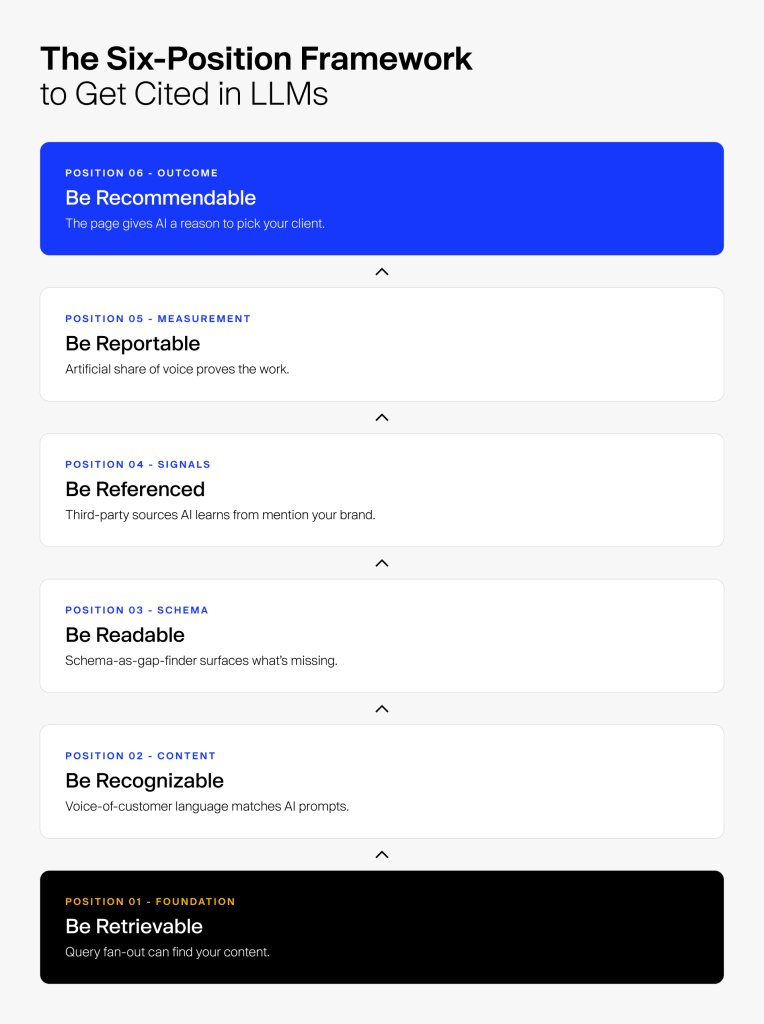
The order is not arbitrary.
- Retrievability is the foundation because AI engines have to find candidate sources before they can cite anything.
- Recognizability rests on retrieval: once you know which sub-queries AI engines fan out into, you need content that matches them in real buyer language.
- Readability sits on content because schema cannot create substance; it can only surface what is missing and make existing content machine-readable.
- Referenceability sits above on-site work because once your owned content is solid, third-party citations become the next bottleneck.
- Reportability runs across the lower positions because you cannot optimize what you do not track.
- Recommendability is the top position, visibility (Positions 1–4), and measurement (Position 5) are necessary but not sufficient. The final work is turning citations into actual recommendations.
Most agencies run two or three positions in isolation and wonder why client AI citations stay flat. The lift compounds only when all six positions are running together.
“Most agencies are occupying two positions on the new shelf and wondering why their clients don’t get recommended. The lift compounds only when all six are running together.”
Position 1: Be Retrievable (Foundation Layer)
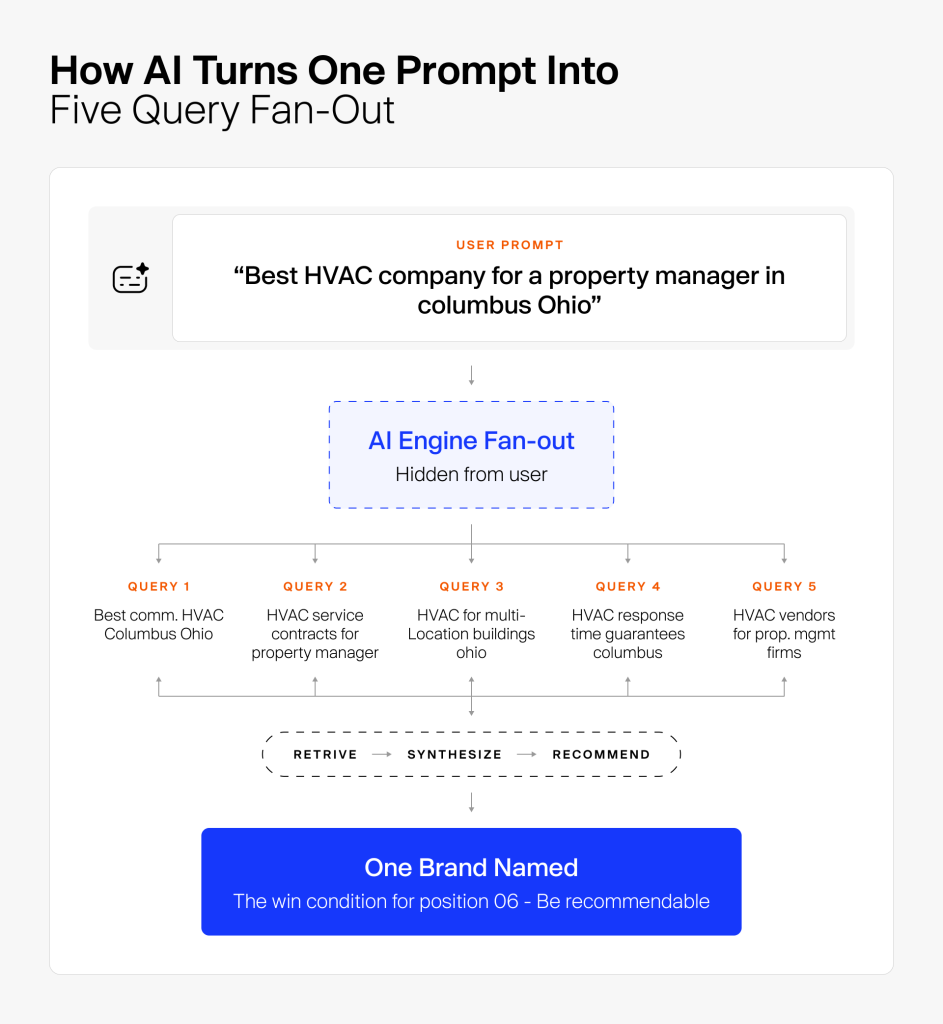
Before an LLM can recommend a brand, it has to retrieve content about that brand. The retrieval mechanism Google has now officially confirmed is query fan-out: when a buyer sends a natural-language prompt, the LLM silently generates a set of related sub-queries, retrieves content for each, and synthesizes one answer.
Google’s own example: a prompt like “how to fix a lawn that’s full of weeds” fans out into “best herbicides for lawns,” “remove weeds without chemicals,” and “how to prevent weeds in lawn.” Your client doesn’t need to rank for the original prompt. They need to be retrieved for the sub-queries.
What Query Fan-Out Actually Does
When a buyer sends a natural-language prompt, “What’s the best HVAC company for a property manager in Columbus, Ohio?” the AI engine does not run that single query.
It silently generates a fan of sub-queries, then retrieves content for each, then synthesizes one answer.
Why This Changes Your Keyword Strategy
Your client does not need to rank for the original prompt. They need to rank for the sub-queries the AI engine fans out into. A single piece of comprehensive content covering a topic from multiple angles can earn citations across dozens of fan-out variations. A page narrowly optimized for one head term often misses the actual queries AI engines are running.
The agency workflow:
- Pull the top 20 commercial-intent prompts a client’s buyers send.
- Run each through a fan-out exposure tool (Ahrefs Brand Radar, Backlinko’s free ChatGPT extension, or Semrush’s AI Visibility Toolkit).
- Extract the unique sub-queries.
- Audit which of those sub-queries the client’s existing pages already cover.
- The gaps become the content roadmap, built into existing pages, not spun up as new ones. This is the line between depth and scaled content abuse.
The Agency Move
Take the top 20 commercial-intent prompts a client’s buyers are likely to send. Run them through a fan-out exposure tool. Pull the unique sub-queries. Audit which of those sub-queries your client’s existing pages already cover. The gaps become your content calendar for the next quarter.
Want to run fan-out audits across your entire client roster without building the workflow in-house? Grab the AI search visibility template inside our…
Position 2: Be Recognizable (Content Language Layer)
Retrievability puts content in the LLM’s path. Recognizability is whether the LLM treats it as a real answer.
Recognizability determines whether the AI engine treats that content as a real answer to the buyer’s question.
This is where most agency content strategies break.
Why Keyword Tools Fail at AI Recognition
The default workflow for FAQ and on-page content is to pull questions from Semrush, Ahrefs, or “People Also Ask.”
Those tools surface phrases optimized for a keyword volume metric, a metric that no longer maps to how AI engines pick sources.
The questions AI engines reward are decision-stage, natural-language, and specific. That language does not live in keyword tools. It lives in your client’s sales call recordings.
The Voice-of-Customer FAQ Workflow
This is the workflow the best agencies are quietly running for their best clients in 2026.
Step 1: Aggregate sales call recordings
Pull the last 60 to 90 days of recorded sales calls from the client’s notetaker (Fathom, Gong, Otter, Granola). Fifteen to twenty-five calls is the practical sweet spot. Fewer than 10 is too thin; more than 40 produces diminishing returns.
Step 2: Consolidate transcripts
Strip out speaker labels if needed, but preserve the natural back-and-forth. Load the consolidated file into an LLM with a long context window. Claude is preferred for transcript volume; ChatGPT works for smaller batches.
Step 3: Run four targeted extraction prompts
This is the move most agencies skip. Generic prompts produce generic outputs.
The prompts that surface usable FAQ targets are sharper:
PROMPT BLOCK COPY/PASTE READY
You are an expert SEO content strategist analyzing sales call transcripts for a [INDUSTRY] client.

Below are [N] sales call transcripts from the last [60/90] days.

Please answer the following four questions in order, with specific examples and direct quotes where possible:

1. What questions are prospects most frequently asking asking on these calls? List the top 10.

2. What is the most significant question prospects are THINKING but seem hesitant to ask out loud? What's the silent objection?

3. What specific criteria or requirements do Prospects mention when comparing this company to alternatives?

4. What do prospects assume about this company That turns out to be wrong? And what category What labels do they use for this company and its competitors?

TRANSCRIPTS:
[paste consolidated transcripts here]
Each of these surfaces has a different layer of buyer intent. The hesitant questions are often the highest-converting FAQ targets because they represent silent objections. The wrong assumptions reveal exactly where the existing website content is creating confusion. The category labels tell you which entity associations to reinforce on the site.
Step 4: Map questions to the right pages
Service-specific questions on service pages. Pricing-related questions on pricing pages. Process questions on “how it works” pages. The mapping matters because AI engines extract from the page that contains the most relevant context.
Step 5: Draft standalone answers (40–80 words)
No lead-ins. No, “as we mentioned above.” Each answer should make sense lifted out of context, because that is exactly how AI engines will extract it.
Step 6: Add FAQ schema markup
Use the FAQPage schema on dedicated FAQ pages and the inline Question markup on service pages where Q&As appear naturally.
Step 7: Re-run quarterly
Conversations evolve. New objections emerge. New competitors enter the picture. Stale FAQs lose retrievability.
Real Example: North HVAC Company
| BEFORE: Keyword tools surfaced | AFTER: Sales calls surfaced |
|---|---|
| What is HVAC? | How do you handle service calls when our property manager is in a different city? |
| How much does HVAC repair cost? | Do you stock parts for older systems, or will I be waiting two weeks on a backorder? |
| How long does HVAC repair take? | What’s the difference between a “tune-up” and a “maintenance visit”? |
| Best HVAC company near me | Are you the company that does the school district contracts? |
| HVAC repair in Ohio | What happens if your tech finds something we didn’t approve in the work order? |
North HVAC Company is a regional service company with four locations across Ohio, a composite client scenario from Vistara 2026.
The agency pulled 18 sales calls, ran the four-question prompt, and got back questions no keyword tool would have surfaced. Within 90 days of publishing new FAQ content targeting these questions, the client started appearing in Perplexity and ChatGPT responses for commercial property manager queries prompts the keyword tools would never have flagged, because the search volume for those exact phrases is essentially zero.
But the fan-out queries AI engines generate when a property manager asks for HVAC vendor recommendations are full of that exact sales-call language.
“Sales-call language matches AI-prompt language because both reflect how humans actually talk about decisions. Keyword tools do not.”
Position 3: Be Readable (Structure Layer)
Retrievability gets your client found.
Recognizability helps your client understand.
Readability is whether the AI engine can extract a self-contained chunk of content from the page and use it cleanly.
This is where agencies misunderstand schema. Google’s own guidance is explicit: structured data isn’t required for AI search, and there’s no special AI schema.
But Google also says it remains “a good idea” because of rich-result eligibility in classic Search. So the question isn’t whether to use schema — it’s how.
Use schema as a content gap-finder, not a tagging exercise.
The default schema workflow is reactive: look at what is already on a page, mark it up with the appropriate schema, and ship it. That earns a technical credit and produces zero new content.
The shift the best agencies are making in 2026 is to use schema as a content gap-finder, not a tagging exercise.
The Schema-as-Gap-Finder Method
Step 1: Identify the page type
Service, location, product, organization, article, FAQ, person.
Step 2: List the standard schema properties for that type
For a Service page: Service.serviceType, Service.areaServed, Service.provider, Service.hoursAvailable, Service.offers, Service.review, Service.aggregateRating.
Step 3: Walk through each property and ask: Is the content for this property actually on the page?
The answer is almost always a long list of gaps. Process not explained. Service areas not enumerated. Pricing tiers not described. Industries served are not named. Reviews not embedded.
Step 4: Write the content first
Each gap is a content opportunity, not a schema opportunity.
Step 5: Then apply the schema
Once the content is written, the schema follows automatically.
Step 6: For pages that fail more than 40% of fields
Schedule a content rebuild, not a schema fix. The page is structurally thin, and a quick markup pass will not help.
Why This Matters for AI Specifically
AI engines pull citations based on the depth and clarity of information on a page. A service page that lists the industries served and the geographies covered.
The typical timelines, the specific outcomes, and proof of expertise yield far more retrievable content than one that simply says “we offer HVAC service in Ohio.” Schema as a gap-finder forces agencies to identify exactly what is missing from a page before AI engines penalize them for the thinness.
Position 3 only works when Position 2 is already producing the right content underneath it.
Position 4: Be Referenced(Off-Site Authority Layer)
On-site work Positions 1 through 3 get your client into the AI engine’s consideration set. But AI engines do not just learn about a category from a brand’s own website. They learn about it from a finite set of third-party sources.
Be Referenced is whether your client appears in those sources.
The Off-Site Source Influencer Audit
The trap most agencies fall into is assuming the right sources for every category. Reddit. Quora. Forbes. Inc. Industry rule-of-thumb logic that worked for traditional PR.
The disciplined approach is to stop guessing and find out empirically.
The Workflow
Step 1: Generate 10 synthetic buyer prompts
Use prompts a typical buyer in your client’s category would actually send:
PROMPT BLOCK -- SYNTHETIC BUYER PROMPT TEMPLATE
You are a [BUYER PERSONA] looking for a [CATEGORY] vendor. Write 10 different prompts you would send to ChatGPT or Perplexity to research and shortlist vendors.

Make the prompts:
-- Specific to your use case
-- Including buyer-side qualifiers (size, budget, geography, industry)
-- Commercial-intent (you are ready to evaluate)
-- Varied in phrasing

BUYER PERSONA: [e.g., "VP of Operations at a 200-person SaaS company evaluating accounting firms"]

CATEGORY: [e.g., "B2B accounting services for
early-stage SaaS"]
Step 2: Run each prompt through Gemini, ChatGPT, and Perplexity
Capture the cited sources for each response.
Step 3: Aggregate the source URLs
Deduplicate and group by domain.
Step 4: Rank the source domains by citation frequency
Across the full prompt set.
Step 5: Identify the off-site source map for your client’s category
The output is the actual answer to: where is AI learning about my client’s category?
Real Example: A B2B Accounting Firm
A digital agency we partner with serves a regional accounting firm targeting early-stage SaaS founders. The default off-site PR plan was “get featured in Forbes, Inc., Entrepreneur.” Reasonable, but generic.
Running the source map for “best accounting firm for SaaS startups” prompts surfaced an entirely different set of cited sources:
BEFORE vs AFTER OFF-SITE TARGET LIST
| BEFORE: Default tier-1 list | AFTER: Actual cited sources |
|---|---|
| Forbes | SaaStr |
| Inc. | Indie Hackers |
| Entrepreneur | Y Combinator Hacker News threads |
| Fast Company | SaaS-focused newsletters (3 specific writers) |
| Business Insider | SaaS founder podcasts (2 specific shows) |
None of the default tier-1 publications appeared in the actual cited source map for this category. The agency shifted its outreach budget to the actual cited sources. Within four months, the client was appearing in ChatGPT responses for SaaS founder accounting queries with measurably higher frequency than before.
“Most agencies are running generic ‘tier-1 publication’ outreach without checking whether their client’s category-specific AI sources include those publications at all.”
Position 5: Be Reportable (Measurement Layer)
Five of the six positions are about doing the work. Position 5 is about proving it.
This is where most AI SEO services break down. Rank tracking does not work for AI Overviews and AI Mode the way it works for classic SERPs. Clients want to see results. Agencies hand them a story instead of a number. The relationship erodes.
Artificial Share of Voice: The Metric That Anchors Reporting
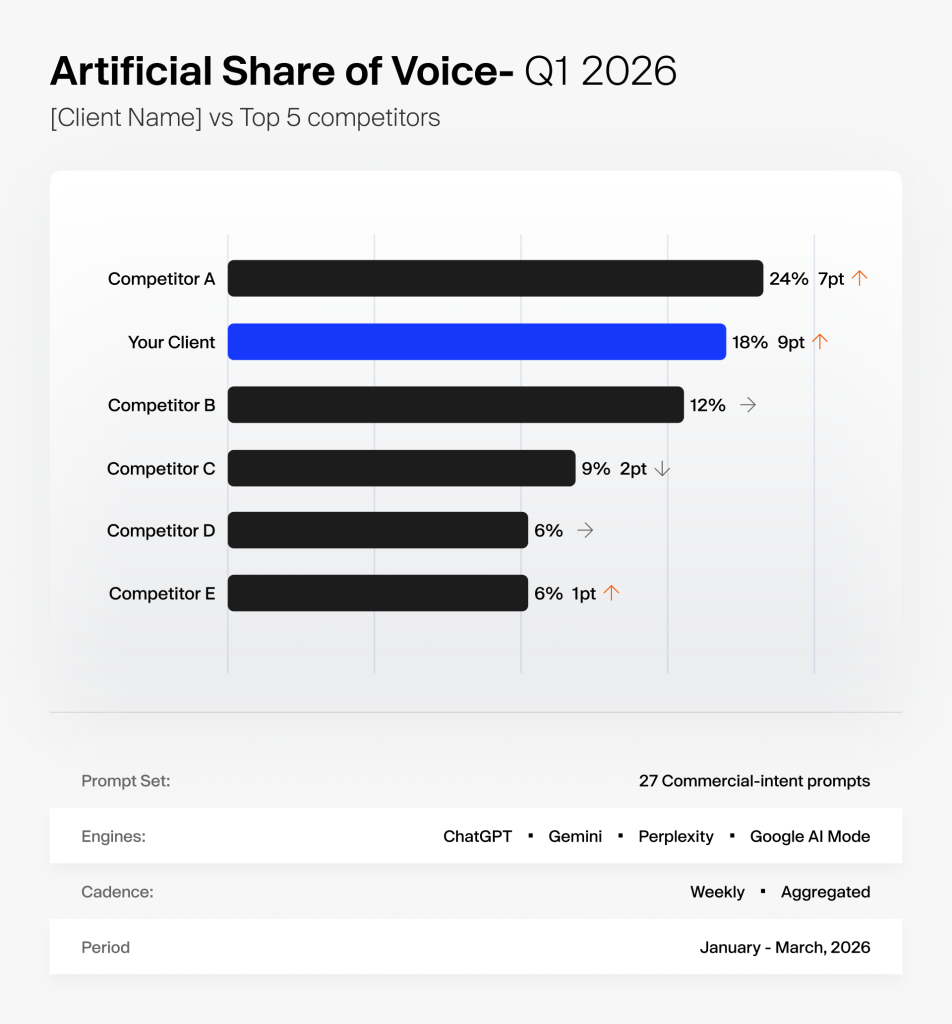
Artificial Share of Voice (ASOV) is the cleanest metric to anchor client reporting around in 2026.
Across a defined set of commercial-intent prompts in your client’s category, how often does your client’s brand appear in AI engine responses relative to competitors?
How to Build ASOV for a Client
- Define a set of 20–30 commercial-intent prompts that buyers in the client’s category actually send to AI engines. (Position 2’s voice-of-customer workflow produces this list as a byproduct.)
- Identify the 5–10 most relevant competitors.
- Run each prompt regularly, weekly, or monthly across ChatGPT, Perplexity, Gemini, and Google AI Mode.
- Count brand mentions for each competitor in each response.
- Calculate the share of mentions across the prompt set, by engine, and in aggregate.
The output is a single, defensible number you can put in client reports.
The ASOV Reporting Format
The Four Sub-Metrics Worth Tracking
Reporting all four side-by-side is what separates an AI SEO service that retains and expands from one that gets cut at renewal:
| Metric | Definition |
|---|---|
| Mention rate | How often the brand appears across the prompt set |
| Citation rate | How often the brand’s owned content is linked as a source |
| Share of voice | Mentions relative to competitors |
| Sentiment | Whether mentions describe the brand positively, neutrally, or negatively |
A high mention rate with poor sentiment is a Position 2 problem (content). A low citation rate with a high mention rate is a Position 3 problem (structure). Each pattern points to a specific position on the shelf that needs work, which is the kind of diagnostic clarity that earns retainer expansions.
Tools That Automate ASOV Tracking
Profound, Otterly, Peec AI, AthenaHQ, Bluefish, Superlines, Semrush’s AI Visibility Toolkit, and Ahrefs Brand Radar. Most agencies pick one or two and standardize across the client roster.
Position 6: Be Recommended (Decision Layer)
Five positions get your client visible on the invisible shelf. The sixth gets them picked.
AI recommendations are driven by what content is on the page at the moment a buyer is making a decision.
The questions AI engines weigh at the recommendation stage are not “is this brand relevant?”; they are “Does this brand match the buyer’s specific decision criteria better than the alternatives?”
The Content Elements That Drive AI Recommendations
Named outcomes with specificity
Not “we help businesses grow.” Instead: “We helped a 14-location dental group reduce GBP-driven no-show rates from 22% to 8% in seven months.”
Comparison-ready content
Buyers prompt AI engines with “X vs Y” and “best X for [specific use case].” Pages that explicitly address those comparisons are far more retrievable for recommendation-stage prompts.
Buyer-specific use cases on dedicated pages
A generic services page rarely gets recommended. A page titled “Web design for multi-location dental practices” gets recommended every time a multi-location dental practice owner prompts an AI engine.
Proof at the paragraph level
Numbers. Named clients (where permitted). Durations. Conditions. AI engines retrieve specificity over generality.
Authentic expertise signals
Author bylines with credentials. Quotes from named team members. Real first-hand observations from running the work, not summaries of what the category does.
The Recommendation-Layer Diagnostic
PROMPT BLOCK -- RECOMMENDATION-LAYER TEST PROMPT

I'm comparing four [CATEGORY] vendors for [USE CASE]. Below are URLs to each vendor's main service page. Based only on what's On these pages, which would you recommend And why?

Vendor A: [client URL]
Vendor B: [competitor 1 URL]
Vendor C: [competitor 2 URL]
Vendor D: [competitor 3 URL]

Be specific about which page content drove Your recommendation.
Run this prompt for your client’s top 10 revenue pages. If your client’s page is consistently second or third, Position 6 needs rewriting before any other work moves the needle.
Connecting Back to Google’s Guidance
The pages that get recommended in AI engines are the same pages that satisfy first-hand experience signals in classic Search. Optimizing for one is optimizing for both.
The Five Questions: Your Diagnostic for Every Client Account
The six positions of The Invisible Shelf describe the geometry. The Five Questions describe the diagnostic that an agency runs on every client to find out which positions they currently hold and which they have lost.
Run these five questions across any client account in your roster. Each question maps to a workflow described above. The answers tell you where to spend the next quarter.
Question 1: Can AI find your client’s content?
Maps to: Position 1 Be Retrievable
Run their top 20 commercial-intent prompts through a fan-out exposure tool. Check whether their existing pages cover the sub-queries the AI engines generate. If the answer is “no” on more than half the prompts, Position 1 is broken, and nothing above it can compensate.
Question 2: Does the content sound like your client’s actual buyers?
Maps to: Position 2 Be Recognizable
Audit the FAQ and on-page content against 60–90 days of sales call transcripts. If the questions on the page are categorically different from the questions in the calls, Position 2 is broken.
Question 3: Can AI extract it cleanly?
Maps to: Position 3 Be Readable
Walk the top revenue pages against the standard schema fields for the page type. Count how many fields cannot be filled because the underlying content is missing. If more than 40% of fields are unfilled, the page needs a content rebuild before any schema work.
Question 4: Is the rest of the internet talking about your client?
Maps to: Position 4 Be Referenced
Run the synthetic prompts → Gemini, ChatGPT, Perplexity → source extraction workflow. Pull the top 20 cited sources for the client’s category. If fewer than three of those sources mention the client at all, Position 4 is the highest-leverage next investment.
Question 5: Does the page give AI a reason to recommend you over the alternatives?
Maps to: Position 6 Be Recommended
Take the top 10 revenue pages. For each, paste the URL alongside three competitor URLs into ChatGPT and ask which the AI engine would recommend. If your client’s page is consistently second or third, Position 6 needs rewriting.
(Question 5 implicitly tests Position 5, too. If you cannot run a clean ASOV measurement, your reporting layer is not in place to validate any of the work.)
“Five Questions. Five workflows. One audit any agency can run, every quarter, on every client. The shelf is invisible. The diagnostic is not.”
Why The Shelf Breaks When Agencies Run It In-House
Every workflow above is achievable for one client account in a focused sprint. Strategic work is not the bottleneck. The bottleneck is running all six positions, the Five Questions, across 15 to 30 active client accounts every quarter, at consistent quality, while the senior strategist is also selling, leading client calls, and running the rest of the agency.
For a Strategic Scaler agency, the 10 to 20-person team running $1.1M to $5M in revenue, this is the wall most owners hit somewhere around their tenth AI SEO account.
The Monthly Production Load, Honestly
- Quarterly fan-out audits across every active client
- Voice-of-customer FAQ workflow refreshed quarterly per client
- Schema-as-gap-finder audits on top-priority page types
- Off-site source influencer audits rerun as AI engines update
- Artificial Share of Voice tracking, reporting, and competitive analysis monthly
- Recommendation-layer page audits on top revenue pages
- New content production is tied to every gap surfaced above
- QA on schema implementation across hundreds of pages
- Client communication that translates the work into business outcomes
This is not strategy work. It is production work repeatable, high-volume, quality-sensitive, and senior-bandwidth-consuming when it lives in-house. The senior people who could be selling new accounts end up running schema audits. The juniors who can run the audits at scale lack the judgment to interpret outputs. The work either ships at a lower quality or gets dropped from the retainer.
The White-Label GEO Execution Model
This is the gap our white label AI SEO services were built around. We have spent 13 years building the production layer underneath digital agencies and the last 18 months turning every SEO workflow in this article into a standardized monthly service we ship across our partners’ client rosters.
The split is clean:
| You keep | We E2M handle |
|---|---|
| Strategic relationship | Production at scale |
| Client communication | All six positions monthly |
| Brand voice | Same QA, same templates |
| Decision-making layer | White-labeled under your brand |
| Senior strategic bandwidth | 24–48 hour onboarding |
No contracts. No minimums. The traditional white-label model is hourly, offshore, task-only execution that often shows up as a problem in disguise. What we built is closer to an embedded production team, senior project managers in your time zone, world-class fulfillment across SEO, AI, web, content, and PPC, scaled to whatever your client roster requires.
You stay in front of your client. We stay invisible. The shelf gets occupied.
“You stay in front of your client. We stay invisible. The shelf gets occupied.”
FAQ: The Six-Position Framework and AI Search Visibility
AI search visibility is the discipline of getting client brands cited inside LLM-generated responses across ChatGPT, Perplexity, Google AI Overviews, Google AI Mode, Claude, and Gemini for commercial-intent prompts. E2M’s Six-Position Framework operationalizes it across six dependency-ordered positions: Retrievable, Recognizable, Readable, Referenced, Reportable, and Recommended.
According to Google’s May 2026 official AI optimization guidance, no optimizing for AI Overviews and AI Mode is still SEO. From a service productization standpoint, however, agencies can absolutely package AI search visibility as a separate engagement (audit, scorecard, ongoing optimization) because clients understand and pay for it as a distinct deliverable. The optimization fundamentals are SEO. The packaging and reporting layer is what makes it sellable.
ChatGPT, Perplexity, Google AI Mode, Google AI Overviews, Claude, and Gemini are the priority surfaces for most B2B and local services clients in the US market in 2026. Different industries skew toward different engines B2B SaaS buyers heavily use ChatGPT and Perplexity, while consumer searches still skew toward Google AI Mode. A defensible AI visibility program tracks all of them.
For well-indexed sites with reasonable existing content, fixes to Position 2 (Be Recognizable) and Position 3 (Be Readable) can produce visible AI citation lifts within 60 to 90 days. Position 4 (Be Referenced) takes longer, four to six months, because the lift depends on getting cited on third-party sources, which is a digital PR timeline. Artificial Share of Voice baselines stabilize within 30 days and then track meaningful month-over-month change from there.
ChatGPT, Perplexity, Google AI Mode, Google AI Overviews, Claude, and Gemini are the priority surfaces for most B2B and local services clients in the US market in 2026. Different industries skew toward different engines B2B SaaS buyers heavily use ChatGPT and Perplexity, while consumer searches still skew toward Google AI Mode. A defensible AI visibility program tracks all of them.
For a roster of fewer than 10 active AI SEO clients, yes, with a dedicated AI-aware strategist and one production person. For the past 10 clients, the per-account workload makes in-house execution operationally fragile. The white-label GEO service model exists specifically to absorb the production layer so Strategic Scaler agencies can offer the full framework without hiring against it.
Search has changed. The agencies that treat AI visibility as a core service line, not a side experiment, are the ones whose clients will be cited in AI answers over the next 24 months. The agencies that wait will spend 2027 catching up to where their competitors started 2026.