

TL;DR
- Agencies don’t lose projects because of demand; they lose them because delivery can’t keep up. White-label development gives you instant capacity without hiring.
- Today’s white-label works because it’s not random freelancers, it’s structured teams with PM oversight, QA, and predictable timelines.
- Selling it is simple: promise fast, stable, conversion-ready websites delivered under your brand with zero client exposure.
- Profits come from clean markups, productized packages, and mandatory maintenance retainers that turn every build into recurring revenue.
- You protect your margins by running every project through a tight 4-step workflow and clear governance so delivery stays predictable, scalable, and in your control.
Table of Contents
- 1. Introduction: The Agency Capacity Challenge
- 2. Why Modern White-Label Works Today (and Why Outsourcing Never Really Did)
- 3. How Agencies Sell White-Label Web Development (And Why E2M Makes It Easy)
- 4. How White-Label Improves Internal Team Focus
- 5. How to Price White-Label Web Development Profitably
- 6. White-Label vs Hiring vs Freelancers: A Simple Comparison
- 7. How to Measure Performance
- 8. Conclusion
Introduction: The Agency Capacity Challenge
This guide shows you how to sell, price, and deliver white-label web development in a way that expands your capacity, protects your margins, and helps you scale your agency without hiring developers.
You’ve probably seen this happen in your agency: the work comes in, the interest is there, but the delivery side doesn’t keep up at the same rhythm.
Some projects move smoothly, and others get jammed because one designer or one developer suddenly becomes the bottleneck.
And when capacity slows down, everything else starts to wobble: timelines, margins, client communication, even how confidently you can say yes to the next project.
Hiring sounds like the clean fix, but it rarely behaves that way. A new full-time dev means more overhead, more management, and a skill set that only fits certain types of builds. Freelancers help until they don’t, great one month, missing the next.
So you get this awkward gap: demand is flexible, but your delivery resources aren’t. And that mismatch shows up fast when you’re trying to grow.
White-label web development steps in right there, not as a replacement for your team, but as a way to let your delivery expand and contract without messing up your margins or your momentum.
Why Modern White-Label Works Today (and Why Outsourcing Never Really Did)
Outsource web development for agency projects has never earned a great reputation in the agency world, and for good reason.
Freelancers juggling five clients, vague timelines, shifting quality, missed messages, and a lot of “I’ll send it tomorrow.” It always felt like you were handing work into a black box and hoping something good came out.
Modern white label web development is a completely different experience. It behaves less like outsourcing and more like adding a structured production unit to your agency, one that runs the way you already run things.
That’s the approach teams like E2M Solutions were built around: predictable workflows, platform specialists, and PM-led delivery that agencies can plug into without changing how they operate, making them a reliable white label Web development partner.
Here’s what actually makes it work now:
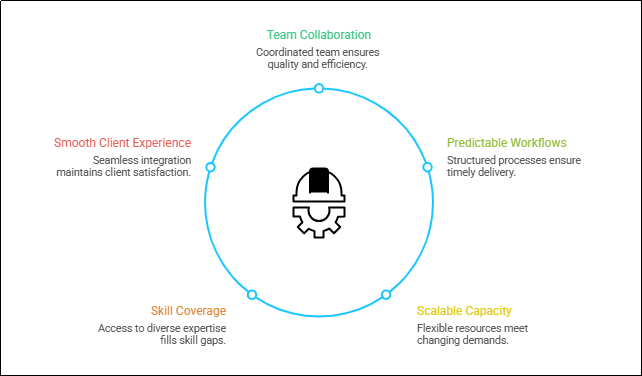
- A team, not a single overloaded freelancer.
Design, development, QA, and project management all work together. You’re not chasing one person; you’re supported by a coordinated bench. - Predictable workflows you can plan around.
Staging links, milestone approvals, documentation, and revision tracking. The normal agency process, not a loose “send the files when they’re ready” approach. - Capacity that scales with your pipeline.
Busy month? Quiet month? A rush of white label Webflow development or white label WordPress development builds? The capacity flexes on demand, so you don’t pause sales or overload your team. - Full coverage of the skills you don’t want to hire for.
From white label WordPress development agency services to Webflow to Shopify to custom integrations, you’re not hunting specialists every time a client needs something specific. This solves the skill-gap problem many agencies face. Especially when delivering CRM, funnel, and automation solutions using platforms like GoHighLevel. To speed up delivery even further, many agencies rely on ready-to-deploy GoHighLevel templates built specifically for niche agencies. - A smoother client experience.
Everything flows through your agency, your brand, your communication. Your clients never feel the shift in workload behind the scenes.
This is why modern white label website development for agencies works: it gives agencies the delivery consistency they’ve always wanted from outsourcing, but in a structure that actually matches how agencies operate.
Quiet, flexible, dependable, and built to keep pace with your pipeline, not slow it down.
How Agencies Sell White Label Web Development (And Why E2M Makes It Easy)
Selling website projects becomes much simpler when you’re not limited by your in-house capacity.

Agencies we work with usually position it in a straightforward way, not by mentioning white-label at all, but by reinforcing the confidence that their delivery is solid.
Here’s the positioning that tends to land well with clients:
“You’ll be working directly with our team as always, we just have a larger production bench behind the scenes, so timelines stay tight and quality stays consistent.”
That’s it. Clean, honest, and easy for clients to understand.
And it works because the experience on the backend actually supports that promise.
Once the positioning is clear, different types of clients usually need different kinds of reassurance.
Agencies tell us they approach it like this:
How Agencies Frame the Conversation Based on the Client
- When the client is price-conscious
They’re not looking for the cheapest option; they just want to understand the cost.
Agencies keep it simple:
“Our process is efficient. You’re not paying for an oversized internal team, you’re paying for a streamlined system that produces reliable builds.”
This shifts the conversation from “cheap vs expensive” to “smart vs inefficient.”
- When the client is focused on ROI
These clients care about performance, SEO, speed, and UX. The things that actually move metrics.
Agencies usually say:
“We build with performance and structure in mind. So the site doesn’t just launch, it works for your goals.”
E2M’s technical depth makes this statement accurate, not aspirational.
- When the client has been burned before
This is the most common scenario, especially for redesigns.
A grounded response that agencies use:
“We keep everything visible, staging links, milestone reviews, and clear approvals. You’ll always know where things stand.”
This is possible because E2M works with real PMs, workflows, QA, and documentation all outlined in a clear Statement of Work (SOW).
Objections Agencies Hear And How They Address Them
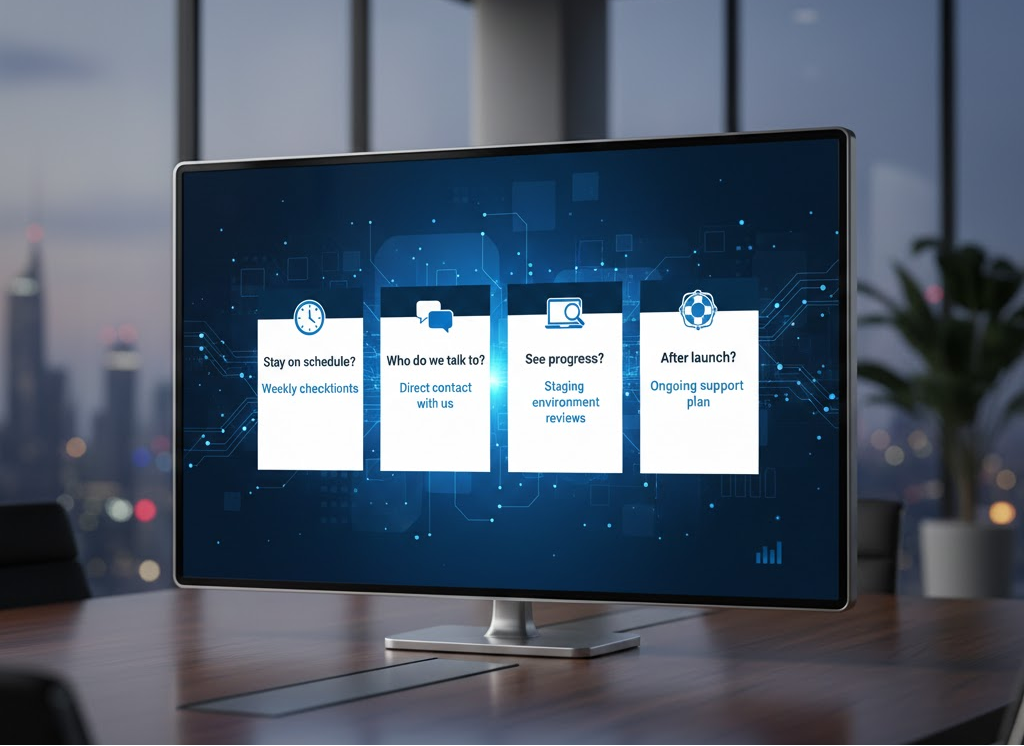
Nothing fancy. Just straight answers that clients appreciate.
“Is this going to stay on schedule?” “We work in weekly checkpoints, so nothing drifts.”
“Who do we talk to?” “You’ll talk to us directly; nothing changes on your end.”
“Will we see progress?” “Everything happens on staging, so you can review as it moves.”
“What about after launch?” “We have a support plan so nothing gets left behind.”
Everything here is easy to say because the delivery behind the scenes actually behaves that way.
And that’s the whole advantage of working with a white label development partner who understands how to resell web development services profitably.
How White-Label Improves Internal Team Focus
As agencies scale, focus becomes just as important as capacity. White-label web development removes delivery pressure from your core team so each role can operate where it adds the most value.
Designers Stay Focused on Design
Designers can concentrate on UX, visual clarity, and conversion instead of worrying about development constraints or post-handoff fixes. The result is stronger creative output and fewer compromises during execution.
PMs Manage Flow, Not Fire-Fighting
With predictable timelines and structured workflows, PMs spend less time chasing updates and more time managing milestones, approvals, and client communication with confidence.
Founders Spend More Time on Sales & Partnerships
When delivery is stable, founders step out of day-to-day project rescue mode. Time shifts back to sales conversations, strategic partnerships, and growing the agency pipeline.
No Internal Burnout During Peak Months
White-label absorbs workload spikes without stretching your internal team. Projects move forward without late nights, rushed decisions, or quality drop-offs during high-demand periods.
White-label doesn’t replace your team; it protects their focus, which is what keeps quality, morale, and output high as you grow.
How to Price White-Label Web Development Profitably
One thing agencies tell us all the time: pricing becomes a lot easier when delivery is predictable. When you know exactly what a build will cost you and how long it will take, margins stop being a guessing game.
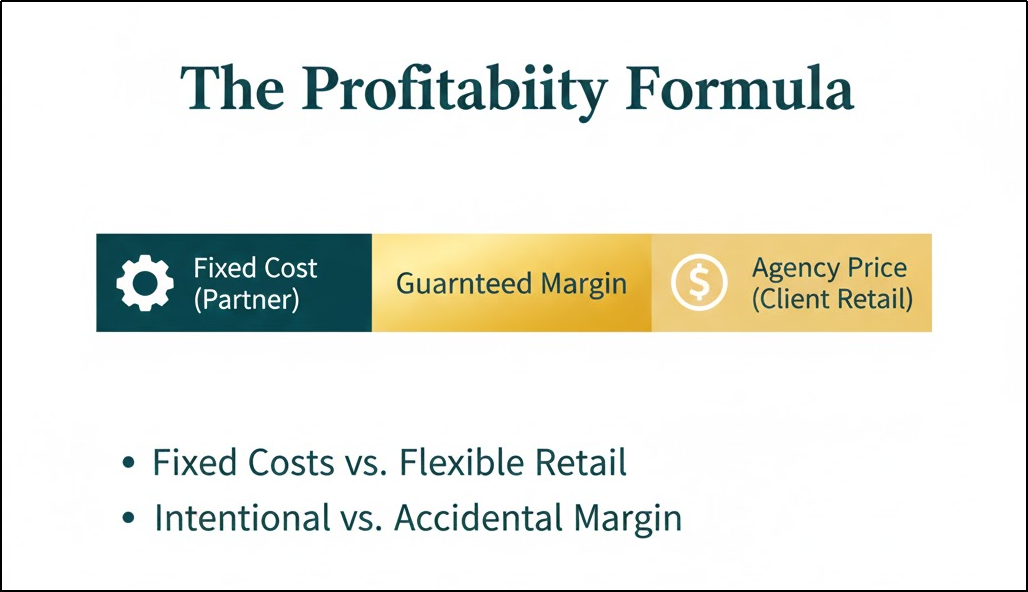
That’s the real advantage of white-label in pricing: your cost is fixed costs vs. variable costs, your retail is flexible, and your margin becomes intentional instead of accidental.
Most agencies follow a simple model when pricing profitable white-label web development work:
“What does this project cost me on the backend, and what margin do I want to make consistently?”
Here’s how they usually break it down:
1. Start With a Clear Baseline Cost
Your partner (like E2M) gives you a predictable cost for the build, not an open-ended hourly estimate.
That predictability is what lets you price confidently on your side.
Some agencies keep a spreadsheet of common builds:
-
- Standard marketing site
How White-Label Improves Internal Team Focus
- WordPress Development
- Webflow build
- WooCommerce setup
- Shopify storefront
- Custom feature/integration
Each one has a known backend cost and a typical scope. Understanding the technical requirements helps with accurate pricing.
This becomes the foundation of your white label web development pricing strategy.
2. Add a Margin You Can Stand Behind (Not Just “Whatever Feels Right”)
Here’s what agencies usually aim for with their agency profit model:
- 30–40% margin on straightforward builds
- 40–50% margin on specialized or complex builds
- Lower margin upfront, higher margin through support retainers
They don’t present it as markup the client sees a flat project price that reflects:
- project management
- communication
- strategy
- revisions
- delivery
- launch support
Everything the client already expects.
Margins stay consistent because backend cost stays consistent, which is only possible with a partner who doesn’t fluctuate.
This approach directly improves your agency’s profit margin white label results.
3. Use Productized Packages to Keep Pricing Clean
This is where pricing becomes easier for both sides.
Most of our agency clients break their offering into tiers, not because clients need “tiers,” but because it creates boundaries.
Something like:
Foundation Build
- For small businesses or simple sites
- template-based
- 5–7 pages
- simple UX, clean design
- basic SEO setup
Clients like this because it answers: “Can you get me something solid without overkill?“
Growth Build
- For established businesses
- custom design
- conversion-focused UX
- integrations (CRM, bookings)
- more revision cycles
- speed + SEO optimization
This is usually the sweet spot and where margin is strongest when you sell white label WordPress projects or other platform builds.
Advanced / Ecommerce / Custom Build
- For complex or high-traffic needs
- custom architecture
- WordPress development
- WooCommerce / Shopify / Webflow advanced setups
- API integrations
- advanced performance tuning
- full documentation
Clients understand the investment because the complexity is obvious.
4. Keep Revenue Stable With a Maintenance Plan
Most agencies treat support as optional. The smart ones don’t.
A white label development partner makes it easy to offer profitable white label services through ongoing support:
- monthly/weekly updates
- fixes and enhancements
- security checks
- backups
- speed improvements
- minor design/dev tweaks
This creates WP maintenance and support packages that agencies can resell.
A simple support plan turns a one-time project into recurring revenue and often delivers higher annual margins than the build itself.
It’s win-win-win.
5. Why This Pricing Model Works Specifically With E2M
Because you’re not guessing.
You already know:
- the cost
- the delivery timeline
- the skill set available
- the QA process
- the staging workflow
- the typical revision path
That predictability is what allows agencies to finally set pricing rules they can follow on every project instead of reinventing them every time a brief comes in.
When delivery is stable, pricing becomes stable. And once pricing is stable, profit becomes stable.
That’s the whole point of agency scaling without hiring developers.
Also Read: How To Price Your WordPress Development Services?
White-Label vs Hiring vs Freelancers: A Simple Comparison
Agencies usually consider three ways to increase delivery capacity. On paper, they all look viable. In practice, they behave very differently.
Here’s a clear, side-by-side comparison agencies use when deciding what actually scales.
| Factor | White-Label Development | Hiring In-House | Freelancers |
|---|---|---|---|
| Speed to Capacity | Immediate | Slow (recruiting + onboarding) | Medium (availability dependent) |
| Cost Structure | Predictable, project-based | Fixed salary + overhead | Variable, often unpredictable |
| Scalability | Flexible up or down | Rigid | Inconsistent |
| Skill Coverage | Broad (multiple platforms & specialties) | Limited to hire profile | Narrow, per freelancer |
| Project Management | Built-in PM & workflows | Internal burden | Usually none |
| Quality Control (QA) | Structured, repeatable | Depends on team maturity | Inconsistent |
| Reliability | High | High (once stable) | Low to medium |
| Client Transparency Risk | None (fully white-labeled) | None | Medium to high |
| Burnout Risk | Low | Medium to high | High during peak periods |
| Best Use Case | Scaling delivery without hiring | Long-term core capabilities | Short-term or overflow tasks |
How to Measure Web Development Performance
One nice thing about adding white label web development to your delivery model is that it becomes very obvious, very quickly, whether it’s helping.
You don’t need a dashboard full of numbers or a complex reporting rhythm; a few clean signals tell the whole story.
Here are the KPIs agencies usually track when they’re working with a partner like E2M:
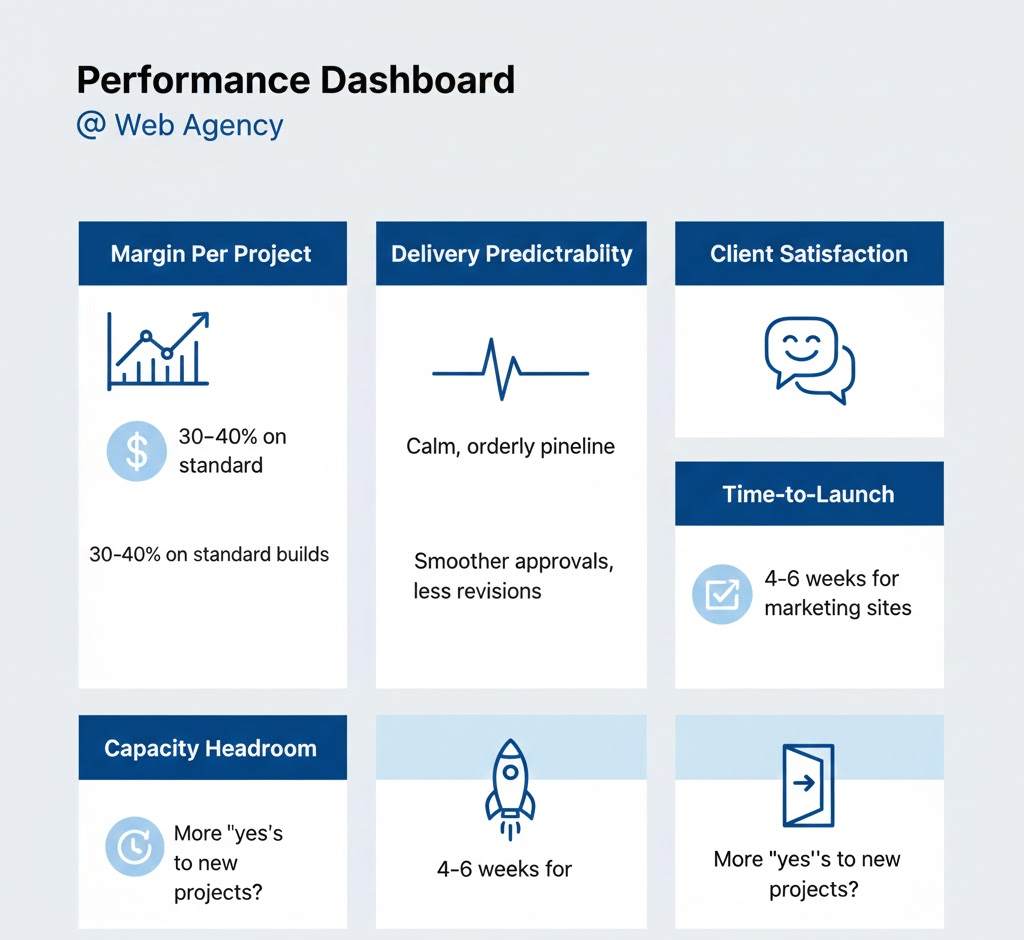
1. Margin Per Project
This one is straightforward: Are you keeping more profit per build than you were before?
Most agencies see margins stabilize once backend costs become predictable.
The target many aim for:
- 30–40% on standard builds
- 40–50% on complex or e-commerce builds
- A higher combined margin when support retainers stack over time
If your margin is consistent from project to project, the model is working.
2. Delivery Predictability (Your Internal Stress Meter)
This isn’t a formal KPI, but it’s the one agencies feel immediately.
A predictable delivery cycle looks like:
- no disappearing resources
- clear weekly updates
- staging links on time
- QA happening before client review
- no last-minute scramble before launch
If your project pipeline feels calmer and more orderly, you’re on the right track.
It means the backend system is absorbing the chaos, so you don’t have to.
3. Client Satisfaction (or Simply: Are Clients Relaxing?)
You don’t need a long NPS survey. The signals show themselves quickly:
- fewer “just checking in” emails
- smoother approvals
- fewer revision rounds
- faster signoffs
- clients commenting on how “organized” the project felt
Agencies often tell us their client communication becomes lighter because delivery becomes smoother. That’s a good sign the model is settling in.
4. Time-to-Launch
This metric tends to get better fast.
When you’re not bottlenecked internally, sites move through:
- design
- development
- QA
- revision
- launch
…without sitting idle between stages.
A typical target many agencies aim for:
- 4–6 weeks for standard marketing sites
- 6–10 weeks for ecommerce or complex builds
If websites are shipping sooner without adding pressure to your internal team, the system is doing what it’s supposed to do.
5. Capacity Headroom (Your “Yes” Rate)
A big reason agencies use E2M is to say “yes” more often without taking on hiring risk.
A simple measure: Were you able to take on projects this month that you would’ve turned down six months ago?
If the answer is yes, the white label website development for agencies model is paying off not just financially, but strategically.
Why Monitor These Metrics
Because they reflect the business outcomes agencies actually care about:
- profit stability
- cleaner operations
- a calmer production pipeline
- clients who notice the difference
- room to grow without adding payroll
You track them so you know the model is creating the breathing room and profitability it’s supposed to, and so you can confidently scale on top of it.
Conclusion
Scaling an agency gets a lot easier when delivery stops being the limiting factor.
White label web development gives you the flexibility to take on more work, keep timelines steady, and protect your margins, all without adding headcount or stretching your internal team.
When the backend is consistent, the front end of your business becomes simpler: pricing becomes clearer, project flow becomes smoother, and clients feel the difference in how organized everything is.
That’s the space where agencies grow confidently, not reactively.
Curious about when agencies start using white-label services? Read this guide → When Agencies Start Using White Label Services.
E2M was built to support that kind of growth, not by replacing your team, but by giving you the production depth and stability that lets you say yes to more opportunities without increasing overhead.
Whether you need to outsource web development for agency projects or resell web development services, having a reliable white label web development partner changes everything.
If you want to see how this model fits into your agency, book a call with our team and walk through how E2M can plug into your delivery without changing how you operate.



Ajay specializes in WordPress automation, headless architectures, and multisite management. He has helped agencies streamline workflows, automate repetitive tasks, and scale WordPress operations efficiently, enabling them to focus on growth and client success.
His technical expertise spans HTML5, CSS3, jQuery, PHP, and platforms including WordPress, Magento, and Opencart. Passionate about innovation, he blends creativity with cutting-edge technology to deliver seamless digital experiences. Outside work, he enjoys traveling, reading, and exploring emerging tech trends.