

TL;DR
- ChatGPT is now a major shopping destination with 700 million weekly users and 2 billion+ daily queries
- Three ways to appear in ChatGPT: Organic discovery, Instant Checkout, and Product Feeds
- Real-time updates: Merchants can refresh product feeds every 15 minutes with live pricing and inventory
- Instant Checkout removes friction: Users can complete purchases directly in ChatGPT without redirects
- 38% of GenAI shoppers already use ChatGPT for gift and product ideas
- AI Agents for agencies: Autonomous systems that cut operational drag by 40% and handle tasks like lead enrichment, content creation, and project management
- White-label opportunities: Agencies can offer ChatGPT optimization as a service without hiring new staff
For many years, search engine optimization (SEO) has been dominated by one major player: Google.
We’ve dedicated ourselves to understanding the terms of keyword research, link building, structured data, and Core Web Vitals, all aimed at improving website visibility in search results.
However, things are starting to change.
OpenAI accelerated that shift with three major releases:
- OpenAI announced a new feature that allows merchants to submit product feeds directly to ChatGPT in a structured format.
- Sep 29, 2025, OpenAI announced a new product that allows users to purchase products: “Buy it in ChatGPT: Instant Checkout and the Agentic Commerce Protocol.”
- After 2 months on 24 Nov 2025, OpenAI is introducing shopping research in ChatGPT
So what does this mean for your eCommerce brand?
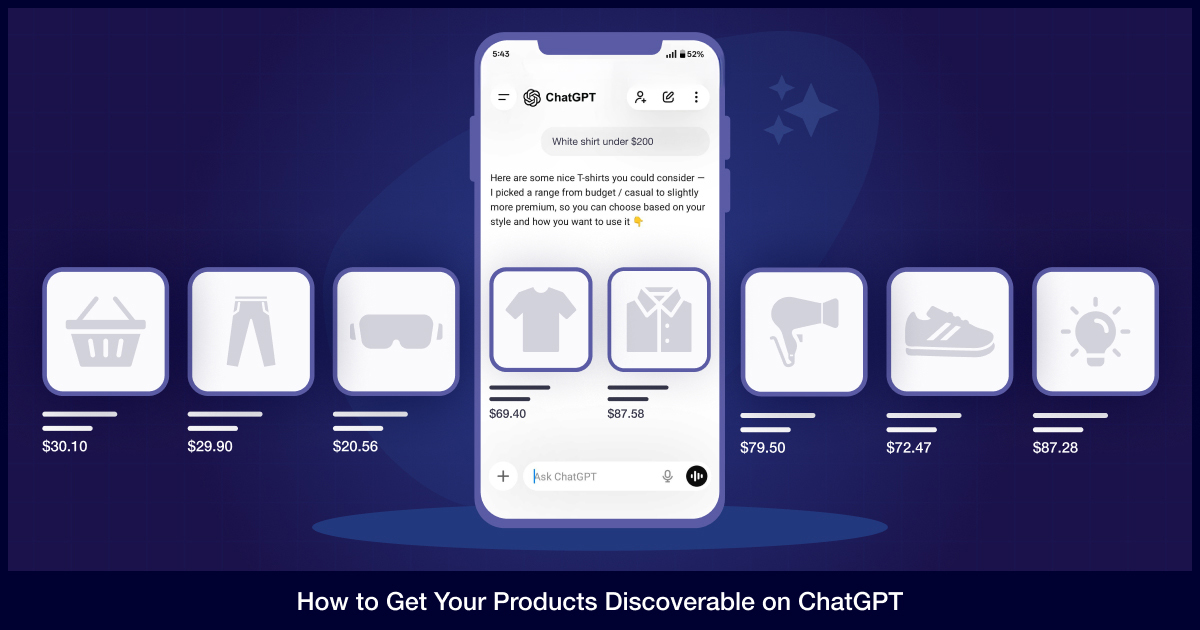
Your product catalog can now appear directly inside conversations, complete with accurate pricing, real-time availability, and richer context than a standard search listing. Think of it as Google Shopping feeds, but specifically tailored for AI-driven searches and conversational commerce.
1. Why ChatGPT is Important for eCommerce Right Now
E-commerce website visibility is shifting.
For years, brands have focused on mastering Google Shopping, Meta Ads, and Amazon’s algorithms. Now, with ChatGPT reaching 700 million weekly active users, it has quickly become a powerful new destination for shopping and product discovery.
Today, when someone asks, “What are the best running shoes under $150 for trail hiking?” they’re not shown a carousel of ads or a list of marketplace items.
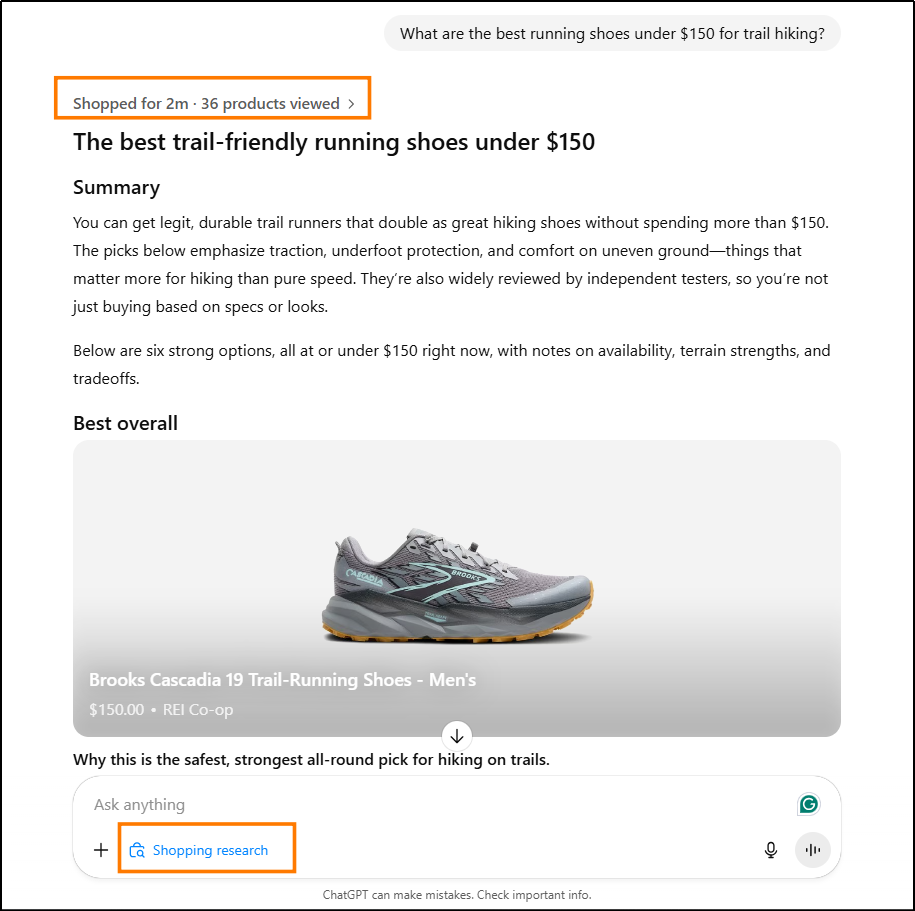
Instead, ChatGPT delivers a curated set of recommendations, up to 36 relevant products, all customized to the user’s needs, budget, and context.
OpenAI’s new Shopping Research experience takes this even further.
When a user submits a shopping-related query, ChatGPT automatically generates an in-depth guide that breaks down top choices, highlights key differences, and explains what to consider before buying.
For e-commerce brands, this shift represents both a major opportunity and a new challenge. ChatGPT’s influence on purchase decisions is not something that will happen “someday”; it’s happening right now.
And with OpenAI allowing merchants to submit and refresh their product feeds every 15 minutes, the platform is evolving into a real-time commerce ecosystem.
This guide will walk you through everything you need to know about your Products Found in ChatGPT.
You’ll learn how to submit your product feed, which data fields matter most, and how to optimize your titles, descriptions, variants, and trust signals so that ChatGPT product recommendations can find your items more effectively.
2. The Growing Impact of ChatGPT on E-commerce
The platform now processes over 2 billion queries every day and brings in 5.8 billion visits each month, making it one of the most active digital touchpoints on the internet.
What does this mean for online shopping or e-commerce websites?
A meaningful share of their questions is tied to shopping, product research, or buying decisions. This is no longer an experimental trend; shopping has become a core behavior for millions of ChatGPT users.
According to Adobe Analytics, nearly 38% of generative AI shoppers are already using this technology to find gift ideas, tying gift shopping directly into ChatGPT’s functions.
Merchants initially worried that ChatGPT wouldn’t convert as well as traditional channels. Early data suggested the same, until OpenAI launched Instant Checkout. With this update, shoppers can now complete transactions directly inside the chat.
A complete buying journey within one interface.
This shift creates a remarkable moment for brands and consumers. The infrastructure is finally aligned: high-intent queries, personalized recommendations, and instant purchasing, all happening inside ChatGPT.
It’s a new frontier for e-commerce, and the brands that adapt early will have the strongest advantage.
3. How ChatGPT Shopping Works: Three Key Layers
Understanding ChatGPT’s shopping ecosystem requires recognizing three distinct but interconnected features.
3.1 Organic Product Discovery (No Registration Required)
When users ask ChatGPT for shopping advice, the platform analyzes publicly available retail pages and delivers recommendations based on relevance, quality, and contextual fit.
This is fully organic.
No ads.
lass=”yoast-text-mark” />>No sponsorships.
lass=”yoast-text-mark” />>No paid product placements.
For merchants, getting discovered at this layer is straightforward. You don’t need to join a program or submit an application. You just need to make sure your product pages are technically and semantically optimized.
Here’s what matters most:
- Open access for OAI-SearchBot
Your robots.txt must allow OAI-SearchBot to crawl your product pages. If it’s blocked, ChatGPT can’t see your catalog. - Strong eCommerce SEO fundamentals
Implement clean, complete schema.org/Product markup so ChatGPT can extract the right attributes, price, availability, brand, ratings, variants, and more. - Conversational product descriptions
Write copy that answers real customer questions instead of relying on dry bullet lists or specs. ChatGPT responds best to content that mirrors natural intent. - Accurate pricing and inventory
ChatGPT won’t recommend products with missing or outdated data. Keeping your catalog fresh is essential.
Any accessible online store can appear in ChatGPT’s organic shopping recommendations. If your product pages are crawlable, structured, and context-rich, you’re already in the game and often ahead of competitors who ignore these foundational steps.
3.2 Instant Checkout (Transactional Layer)
Instant Checkout introduces a new way to buy products directly inside ChatGPT. Powered by the Agentic Commerce Protocol (ACP) and supported by Stripe, it creates a fast, secure, and frictionless checkout flow.
Here’s how it works:
When a user asks ChatGPT for product recommendations, eligible items display a simple “Buy” button. With one click, the purchase is completed through the merchant’s existing payment system, no redirects, no added steps.
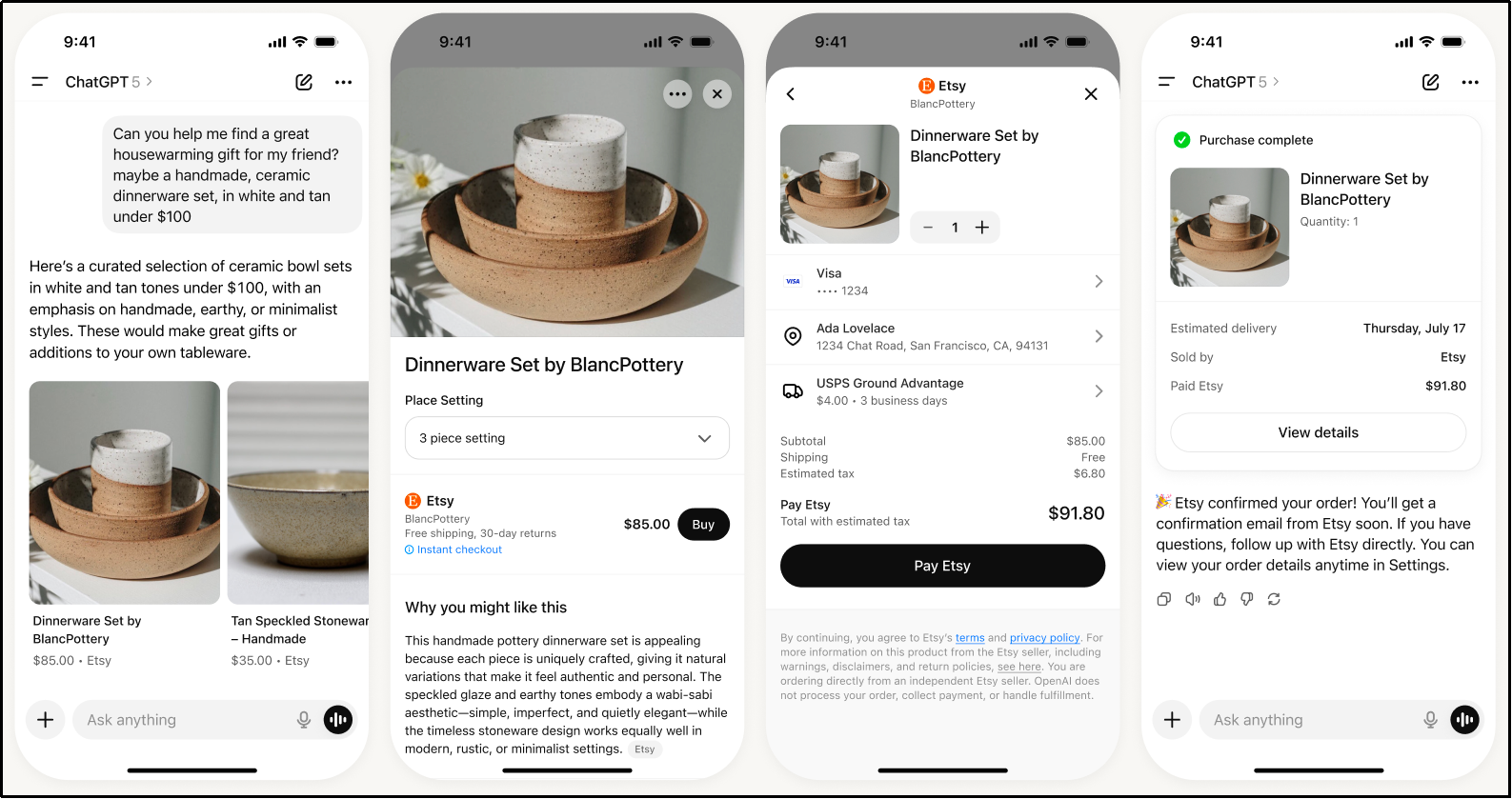
Right now, Instant Checkout supports single-item purchases from U.S. Etsy sellers. Soon, it will expand to more than one million Shopify merchants, including major brands like Glossier, SKIMS, and Spanx.
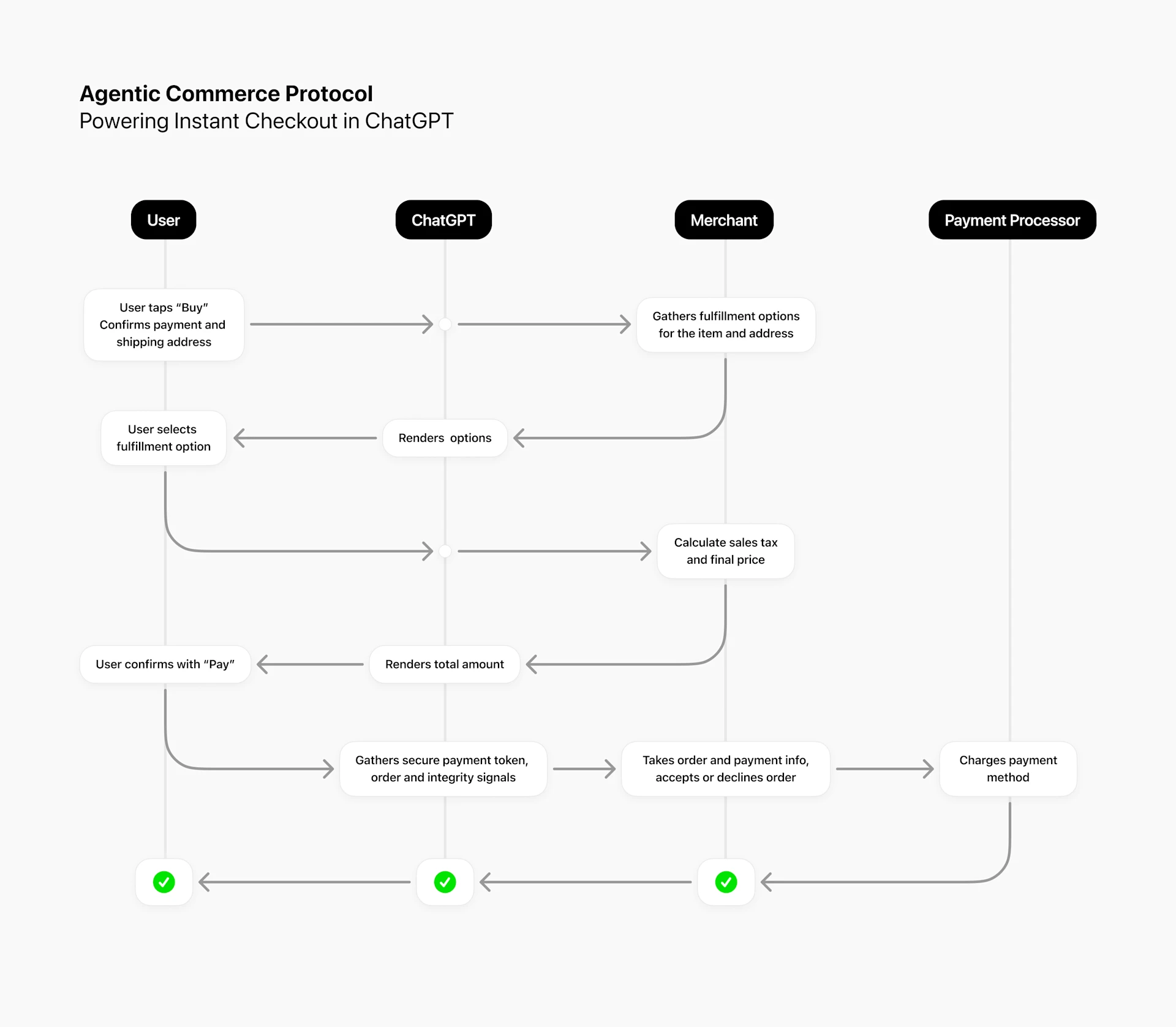
Image Source: https://openai.com/index/buy-it-in-chatgpt/
For merchants, the model is straightforward:
You pay a small fee only when a transaction is completed. There’s no impact on your product pricing, and no preferential treatment in ChatGPT’s ranking. For users, the experience is free, secure, and fully transparent.
When multiple merchants sell the same item, ChatGPT ranks options based on factors like:
- Availability
- Price
- Product quality
- Whether the merchant is the primary seller
- Whether Instant Checkout is enabled
The goal is simple: deliver the best possible shopping experience with the least friction.
3.3 What are ChatGPT Product Feeds and How Does It Work?
A ChatGPT product feed is a structured file — CSV, TSV, XML, or JSON that contains all your product information in the exact format required by OpenAI’s Product Feed Specification.
Unlike organic discovery (which relies on crawling your website), ChatGPT product discovery works by treating your merchant feed as the source of truth. Whatever you submit in the feed is what ChatGPT trusts and uses.
Each feed includes the core details ChatGPT needs to recommend or sell your products:
- Essential product data: product ID, SKU, title, description, and product URL
- Pricing & availability: price, sale price, inventory levels
- Rich media assets: primary image, additional images, videos, and even 3D model links
- Merchant details: brand name, seller URL, and store policies
- OpenAI Flags: settings like enable_search and enable_checkout to control whether a product appears in search or supports Instant Checkout
Beyond the basics, you can include deeper attributes such as promotions, variant information, fulfillment timelines, return policies, performance signals, compliance data, reviews, and Q&A. All of which strengthen your product’s relevance in ChatGPT results.
Once you submit the feed, OpenAI processes it through four steps:
- Ingestion – Your file is received by OpenAI’s system.
- Validation – Every field is checked against the official feed requirements.
- Indexing – Your products are stored and organized so ChatGPT can surface them in conversations.
- Continuous refreshing – Updates are accepted every 15 minutes, ensuring real-time accuracy.
In simple terms, your product feed becomes the official record ChatGPT uses for pricing, availability, descriptions, and checkout. It’s the backbone of AI commerce, reliable, structured, and always up to date.
To stay competitive, brands and agencies must adapt to AI-first discovery models that extend beyond Google, making it essential to understand how AI is reshaping SEO and search strategy overall.
4. How to Get Products on ChatGPT
4.1 How to Show Organic Products in ChatGPT Shopping?
As AI-driven shopping continues to expand, making sure your products are visible within ChatGPT’s shopping platform is becoming a core part of modern eCommerce SEO. Even if you do not submit a formal product feed, you can still earn visibility through strong technical foundations and well-optimized product content.
If you’re not ready for technical integration, start here:
- Audit your robots.txt – Make sure OAI-SearchBot is allowed to crawl your product pages. If the bot can’t access your site, ChatGPT can’t surface your products.
- Add structured data – Implement schema.org/Product with complete attributes, price, availability, ratings, brand, and variants. This helps ChatGPT extract accurate, high-quality product information.
- Optimize descriptions for conversational intent – Write for conversational intent (“durable work shoes for standing all day” vs. “men’s steel-toe boots”). Natural language increases your chances of aligning with user queries.
- Monitor analytics – Track referrals using utm_source=chatgpt.com referrals in Google Analytics
- Register for product feed program – Sign up for OpenAI’s interest form for future direct feed access
When these elements come together, your product pages become more crawlable, more relevant, and better aligned with ChatGPT’s ranking signals even without submitting a feed.
Ready to see how your store performs in AI search?
Get your Ecommerce AI Search Audit and understand exactly where your products are showing up and where they’re missing out inside ChatGPT and other AI platforms.
4.2 How to Submit your Feed to ChatGPT
Ready to take your products from “searchable” to “shoppable” inside ChatGPT?
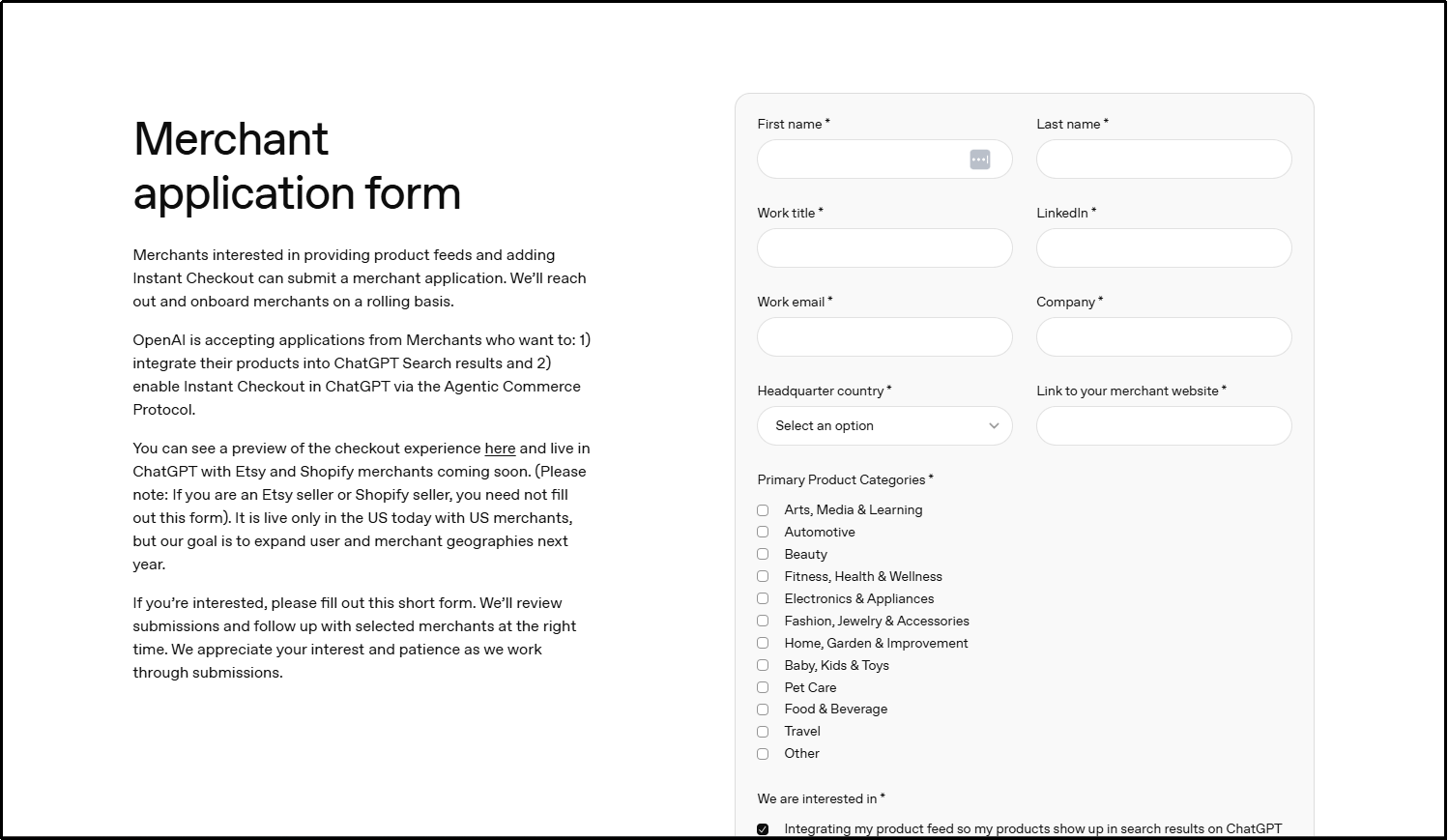
If you want to submit your product feed and enable Instant Checkout, OpenAI now accepts merchant applications. This allows ychaour catalog to appear directly in ChatGPT Shopping results and unlocks the full power of the Agentic Commerce Protocol (ACP).
OpenAI is already partnering with Etsy and Shopify merchants, with more platforms on the way. For now, eligibility is limited to U.S. merchants, but global expansion is expected.
Here’s the step-by-step process:
- Apply via chatgpt.com/merchants:
Submit your business details, catalog information, and payment setup.
- Get approved:
OpenAI reviews your application and issues secure HTTPS endpoint credentials for feed submission. - Choose file format:
Select the structure that fits your stack: CSV, TSV, XML, or JSON. - Build your feed with required fields:
-
- id – Unique product ID
- title – Conversational title (≤150 characters)
- description – Natural-language description (≤5,000 characters)
- link
- image_link
- price
- availability
- inventory_quantity
- enable_search (true/false)
- enable_checkout (true/false)
Optional fields like promotions, reviews, Q&A, variants, and policies further boost your relevance in ChatGPT’s ranking.
-
- Validate and upload:
Run validation checks, submit your feed, and set up automated refresh cycles every 15 minutes. - Monitor performance:
Track impressions, CTR, and conversions to understand how your catalog performs inside ChatGPT Search.
4.3 Enabling Instant Checkout
Instant Checkout is the transactional layer that allows users to complete purchases directly inside ChatGPT, fast, secure, and frictionless.
Enable it in two ways:
If you use Stripe: you can activate Agentic Commerce with as little as one line of code.
If you use another payment processor:
You can still participate without rebuilding your backend:
- Use Stripe’s Shared Payment Token API, or
- Use the Delegated Payments Specification
Both options preserve your existing customer relationships, fulfillment processes, and payment infrastructure. while giving you access to ChatGPT’s native checkout experience.
5. eCommerce SEO Strategies to Optimize for Maximum Visibility in ChatGPT Shopping
To win inside ChatGPT Shopping, your product content has to do more than rank. It has to communicate. ChatGPT surfaces products that are clear, helpful, and context-rich. Here are the essential optimization strategies every merchant should follow.
1) Write Conversational, Intent-Driven Titles
Traditional SEO: “Nike Air Zoom Pegasus 40”
ChatGPT-Optimized SEO: “Nike Air Zoom Pegasus 40 Men’s Lightweight Running Shoes for Long-Distance Comfort”
This enriched title helps ChatGPT understand use case, fit, and intent, increasing your chance of being recommended for relevant queries
2) Enrich Descriptions with FAQ-Style Answers
ChatGPT loves structured clarity. Adding FAQ blocks instantly improves semantic relevance and answers the questions shoppers typically ask.
Example:
- Q: Is this waterproof?
A: Yes, it features a Gore-Tex upper for all-weather protection. - Q: How long is the break-in period?
A: Most runners feel fully comfortable after 2–3 runs.
This style gives ChatGPT ready-to-use responses when shaping product recommendations.
3) Highlight Trust Signals
Social proof drives confidence, and ChatGPT uses these signals to evaluate quality.
Include:
- Return and refund policies
- Review ratings
- Shipping timelines
- Stock levels
- Warranty information
The clearer your trust signals, the more likely ChatGPT is to surface your product when users ask for “reliable,” “top-rated,” or “best-reviewed” items.
4) Use Complete Variant Data
Variant completeness is critical. ChatGPT needs accurate metadata to recommend the correct color, size, or material.
- Include all variants in your feed or structured data
- Use item_group_id to link related SKUs
- Avoid orphan variants with missing data
The more complete your variant tree, the more consistent your recommendations.
5) Refresh Your Data Frequently
ChatGPT penalizes stale or inconsistent product information.
Update:
- Price
- Sale price
- Stock
- Variant availability
- Shipping windows
Refresh at least daily (and ideally every 15 minutes) once your product feed is active. Fresh data signals higher reliability, increasing both visibility and user trust
6. Technical Submission Examples (New Set)
Below are fresh examples of how merchants can format and submit product feeds to ChatGPT using CSV, JSON, and a sample cURL upload request.
CSV Example (New Product Example)
id,title,description,link,image_link,price,availability,inventory_quantity,enable_search,enable_checkout,brand,product_category,color,size

SKU98765,Premium Bamboo Bath Towel,"Ultra-soft, fast-drying bamboo towel ideal for sensitive skin",https://store.com/p/SKU98765,https://store.com/images/SKU98765.jpg,"29.50 USD",in_stock,120,true,true,SoftWeave,"Home & Garden > Bath","Ivory","Large"
JSON Example (New Product Example)
{
"id": "SKU98765",
"title": "Premium Bamboo Bath Towel",
"description": "Ultra-soft, fast-drying bamboo towel ideal for sensitive skin",
"link": "https://store.com/p/SKU98765",
"image_link": "https://store.com/images/SKU98765.jpg",
"price": "29.50 USD",
"availability": "in_stock",
"inventory_quantity": 120,
"enable_search": true,
"enable_checkout": true,
"brand": "SoftWeave",
"product_category": "Home & Garden > Bath",
"color": "Ivory",
"size": "Large"
}
Example Upload (cURL)
curl -X POST "https://{openai-merchant-endpoint}/feeds/upload"
  -H "Authorization: Bearer {YOUR_API_KEY}"
  -H "Content-Type: application/json"
  --data-binary @bamboo_towel_feed.json
White-Label Opportunities for Digital Agencies
The rise of ChatGPT-driven e-commerce has created a significant gap in the agency world: Most agencies don’t have the internal expertise, tools, or processes to optimize for ChatGPT, AI search, product feeds, or ChatGPT instant checkout.
This is where white-label eCommerce SEO Service deliver significant value.
A white-label partner allows agencies to offer end-to-end ChatGPT eCommerce SEO optimization without onboarding new employees, building technical workflows, or learning complex product feed systems. The partner handles the technical execution while the agency maintains full client ownership and sets its own pricing.
What the White-Label Partner Manages
- Product feed creation and optimization on the website
- Ongoing feed management and troubleshooting
- ChatGPT Discovery optimization
- Structured data + schema implementation
- Instant Checkout setup (Shopify, Etsy, and future platforms)
- AI search performance tracking and reporting
Service Packages Agencies Can Offer
- ChatGPT Discovery Optimization
- Product Feed Setup & Management
- Full AI Commerce Stack (with ChatGPT Instant Checkout)
- AI eCommerce SEO Services
This model helps agencies scale faster, improve client performance, and enter the AI commerce space immediately with zero internal overhead.
What’s Next for ChatGPT Shopping Revenue Opportunities for 2026
Product visibility in ChatGPT isn’t a future opportunity.
A new shopping discovery feature and ChatGPT Instant Checkout are already live for platforms like Etsy (and rolling out to Shopify), and the ecosystem is ready now.
The question is not whether ChatGPT will become a major shopping channel.
It already is.
The real question is: Will your brand be discoverable, optimized, and ready to convert when users turn to ChatGPT to shop?
Brands that adopt early by implementing product feeds, structured data, AI search optimization, and checkout readiness will gain a disproportionate share of this new traffic. Competitors who delay will be forced to play catch-up.
- For eCommerce brands:
Start with an ChatGPT SEO audit of site accessibility, structured data, and feed readiness. - For digital agencies:
Partner with an E2M white-label partner provider to instantly expand into AI eCommerce SEO services without additional hiring or training.
The AI shopping revolution has already begun.



Vishal studied at Federation University Australia and has managed multi-million-dollar campaigns and actively participates in global industry events, including BrightonSEO and MavCon Live. His expertise spans technical SEO, content marketing, PPC optimization, and agency partnership development.
Outside of work, he enjoys traveling, playing cricket, and exploring new trends.