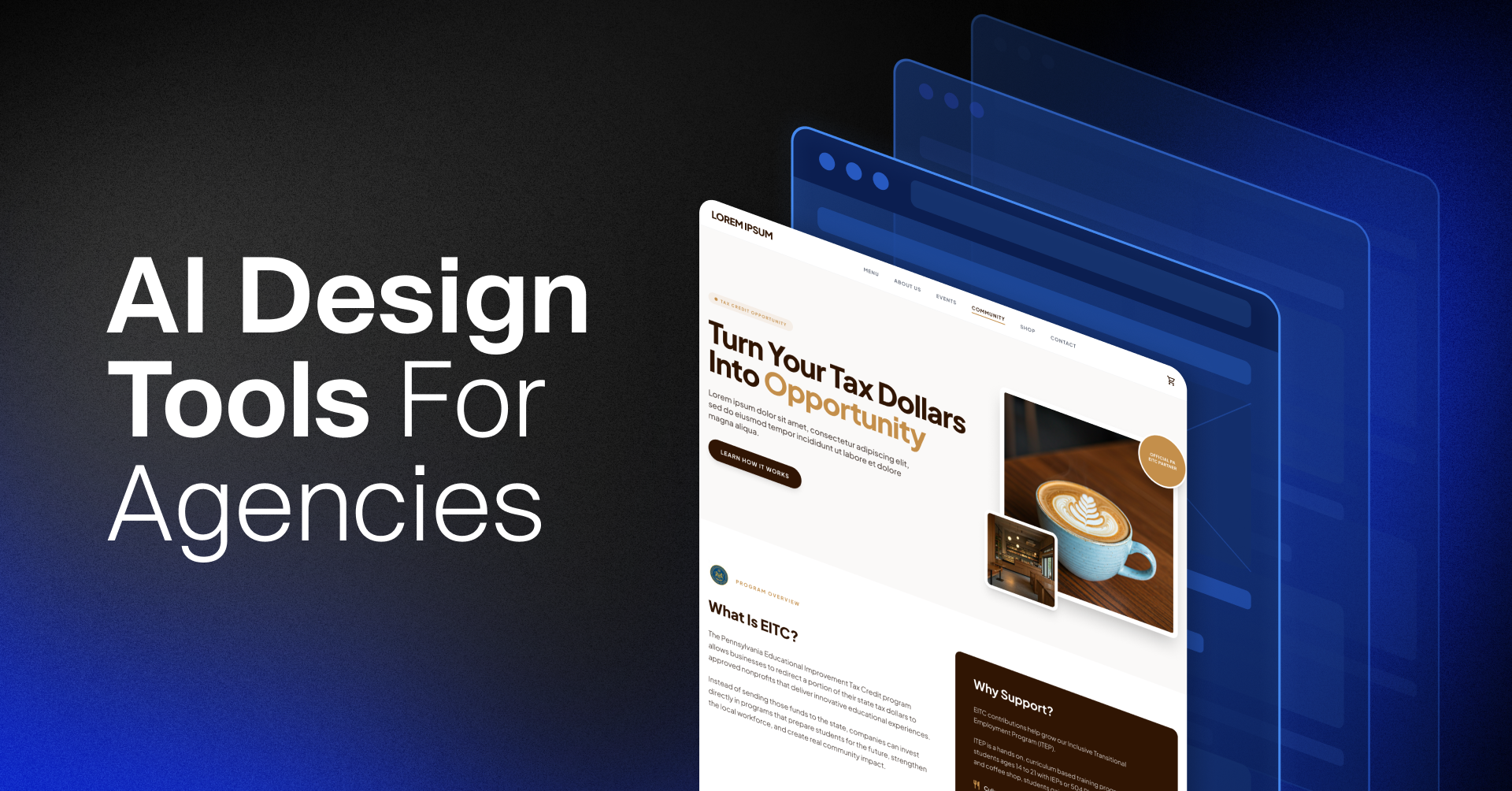
The real opportunity isn’t faster mockups. It’s a smarter delivery model with interactive prototypes, where clients review working, clickable experiences before the white label web development project begins.
TL;DR
• E2M moved from a single static mockup to AI-powered web designs with multiple interactive HTML prototypes, so agencies and their clients can evaluate real experiences early instead of imagining them from screenshots.
• Across recent website design projects, this cut early concept time from ~12 hours to ~6, dropped revision rounds from ~5 to ~2, and shortened approval by roughly 50%. (E2M Internal delivery data; results vary by project scope.)
• Approved prototypes become the foundation for the WordPress build, not a reference that web developers rebuild from scratch.
• AI is the accelerator. E2M’s AI-skilled designers and white label WordPress development specialists team owns strategy, UX, website dev and design accessibility, SEO structure, and QA with an ongoing WP maintenance task.
AI changed how websites get designed, reviewed, and built. For agencies, though, the headline isn’t mockups, but faster. It’s the chance to rebuild the delivery model around something a client can actually use early: a working, clickable prototype design.
The traditional Website design and development approach still produces good websites. But it leans on flat mockups, long review cycles, and a hard wall between design and build. As you scale, that wall gets expensive.
Based on our internal white label web design agency delivery observations across recent agencies’ WordPress projects, the prototype-first workflow has cut early concept creation from roughly 12 hours to about 6, lowered revision cycles from around 5 rounds to 2, and shortened design approval by roughly 50%.
Those numbers move with scope, content readiness, client responsiveness, and technical complexity. The AI-Powered Web Workflow holds, though: when clients review real experiences earlier, decisions get faster and more confident.
01. The Challenge: Why Traditional Web Design Breaks at Scale
Every successful website creation begins with understanding the bigger business picture. Before creating any design concepts, we focus on the core fundamentals:
- Business objectives & competitor positioning
- Target audience & user experience requirements
- Content structure & brand direction
That discovery work has always mattered. The challenge is what happens after the strategy is defined.
In a traditional workflow, those insights lead to a single design concept that moves through a rigid line:
Requirements → Design mockup → Client review → Revision cycles → Final approval → Development → Launch
What does that actually cost an agency owner
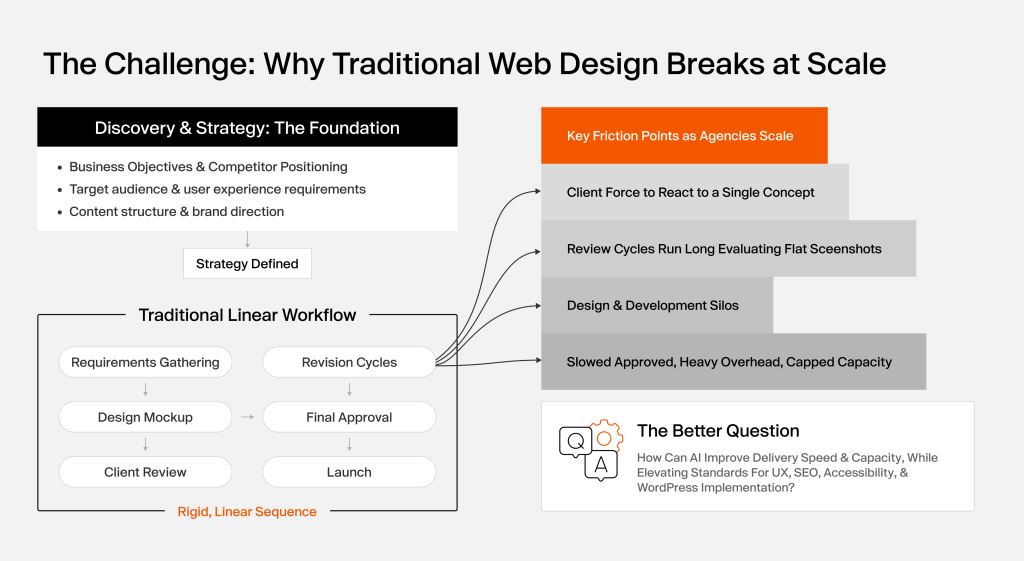
Delivery delays rarely come from one big failure. They come from small points of friction that compound: a client who can’t visualize a static mockup, feedback that arrives as vague comments, a revision that spawns new questions, a build that can’t start until approval, and then has to recreate the design from scratch. Multiply that across a full project list, and you get slower approvals, heavy revision overhead, unpredictable timelines, and capped capacity.
So we asked a sharper question: how do we use AI to improve delivery speed and capacity while actually raising our standards for UX, SEO, accessibility, and clean WordPress implementation?
02. How E2M’s AI-assisted White Label Web Design Process Works
Instead of a single static concept followed by rounds of revisions, we built a Web Design workflow around interactive experiences and collaborative decisions. The sequence looks like this:
Evolved Website Workflow with AI Design Tool
- Strategic discovery and research
- Structured prompt design
- Multiple interactive concepts
- Interactive feedback and refinement
- Early stakeholder alignment
- Approved HTML foundation
- WordPress implementation
- Accelerated launch
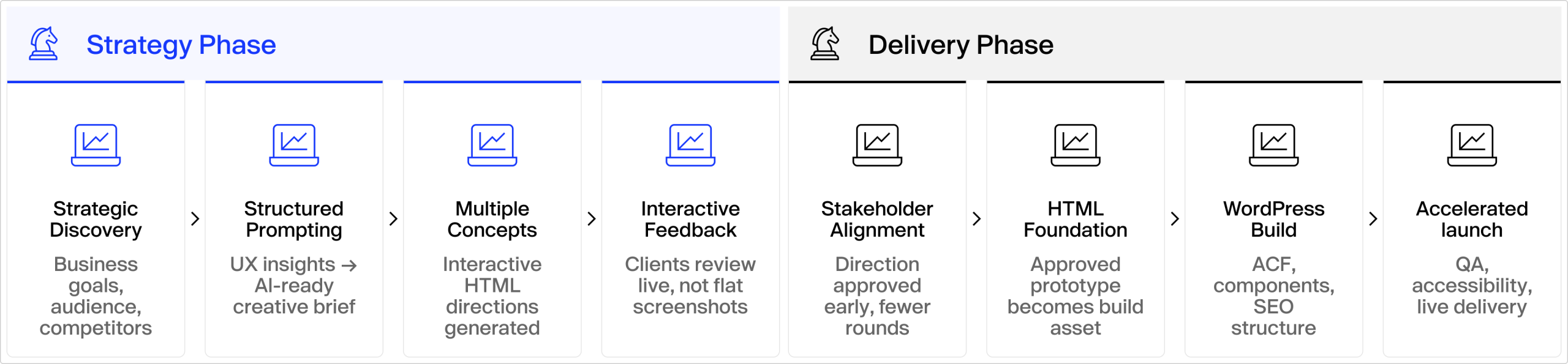
This approach lets Agency owners and their clients compare multiple realistic website directions early in the design process. They can see how the website may actually feel, interact, not just how it may look from the front side.
The biggest shift was not simply creating Web Prototype concepts faster.
The biggest shift for Agencies was allowing clients to experience and evaluate multiple realistic Prototype solutions before white label WordPress development begins.
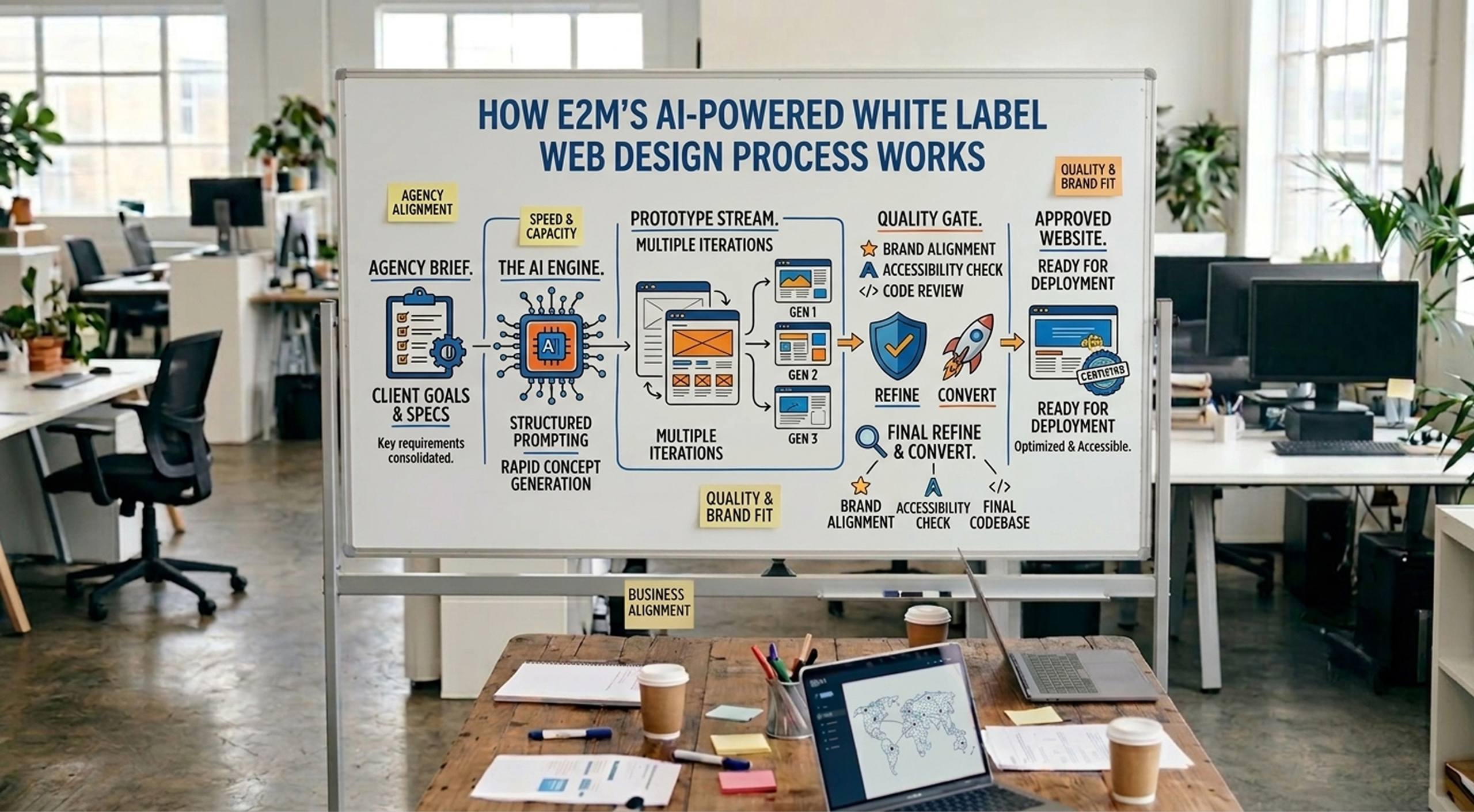
When clients can compare real options earlier, uncertainty drops. Feedback becomes more specific. Decisions become stronger ad approved design direction is easier to carry into development.
FOR AGENCY PARTNERS
The AI layer improves speed. Our white label web design delivery team protects quality, brand fit, accessibility, SEO structure, and development feasibility. You own the client relationship. We stay invisible behind it.
Why this matters for Web and Digital agency owners
The prototype-first model means more confident client conversations, faster approvals, and more delivery capacity, without immediately hiring designers or developers. Once a direction is approved, the prototype becomes a stronger foundation for production rather than a loose visual reference for a developer to interpret.
Related → How to Profitably Sell White Label Web Development and Scale Your Agency Without Hiring
03. Static Mockups vs Interactive Prototypes
Moving from static mockups to interactive prototypes was the single most impactful change we made in E2M Web Delivery.
Static designs are fine for a visual gut-check, but they force the client to imagine the important parts: how content flows, how users navigate, how sections interact, how the layout responds across devices, and how the calls to action read in context. Prototypes remove most of that guesswork.
Instead of reviewing screenshots, the client experiences content flow, user journeys, section hierarchy, layout structure, and interactive elements. Feedback gets more meaningful because it’s grounded in a real experience, not an assumption. The result is faster reviews, better collaboration, and stronger stakeholder confidence.
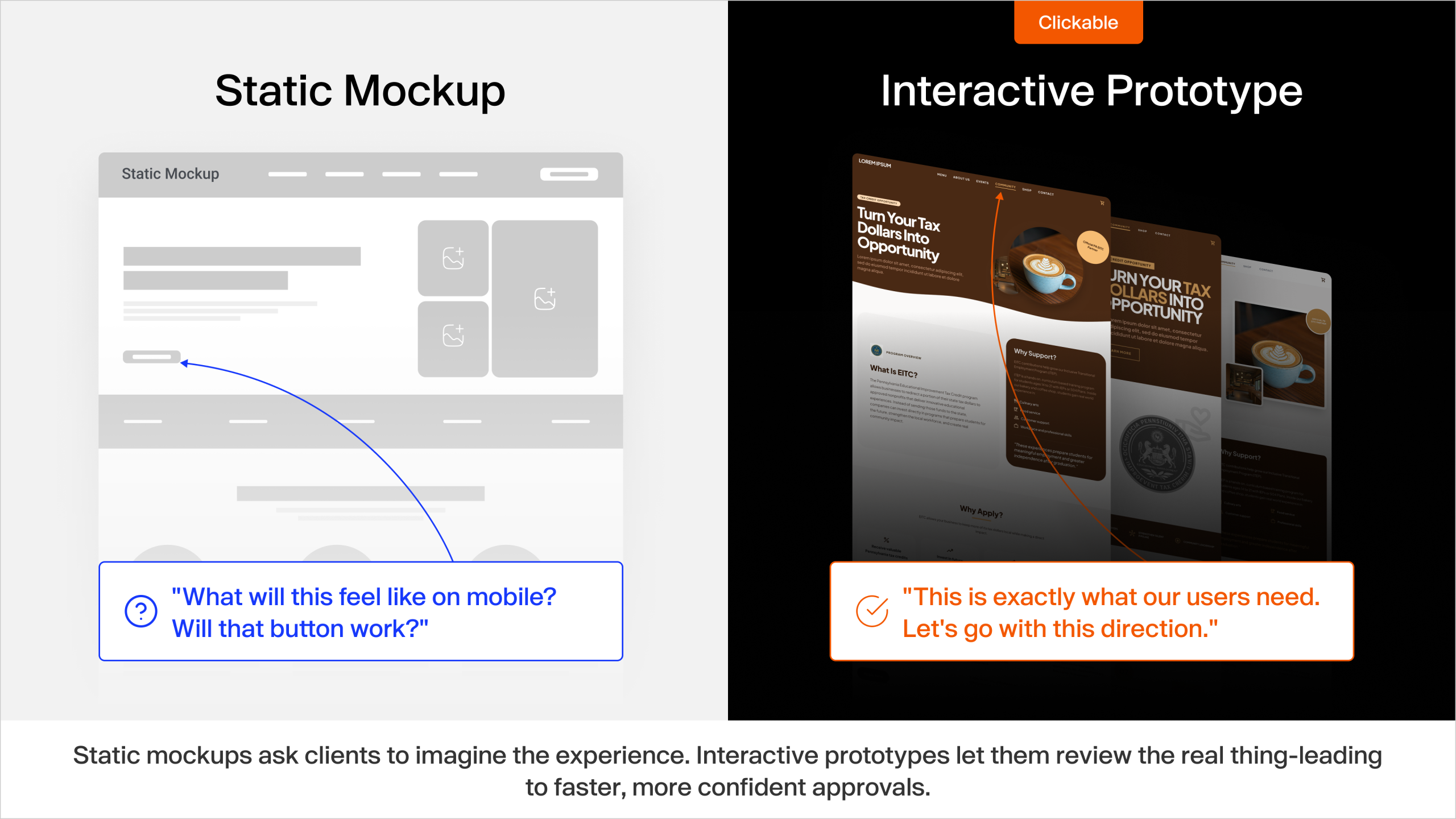
“An interactive website prototype is a clickable, experience-led version of a website concept that lets stakeholders review user flow, navigation, layout behavior, and content hierarchy before full development begins. For agencies, prototypes reduce vague feedback and speed up approval because clients review the experience instead of imagining it from a static mockup.
STATIC MOCKUP VS INTERACTIVE PROTOTYPE VS PRODUCTION-READY HTML
| Area | Static mockup | Interactive prototype | Production-ready HTML |
|---|---|---|---|
| What the client sees | A flat visual layout | A clickable experience | A functional front-end foundation |
| Best for | Visual direction | UX review and feedback | Faster design-to-dev handoff |
| Feedback quality | Often subjective | Specific, experience-based | Practical for building decisions |
| Development value | Must be recreated | Guides development | Can support the production build |
| Agency benefit | Shows the concept | Speeds alignment | Reduces handoff friction |
Three interactive concepts, side by side (Real interactive Prototypes Design Case Study)
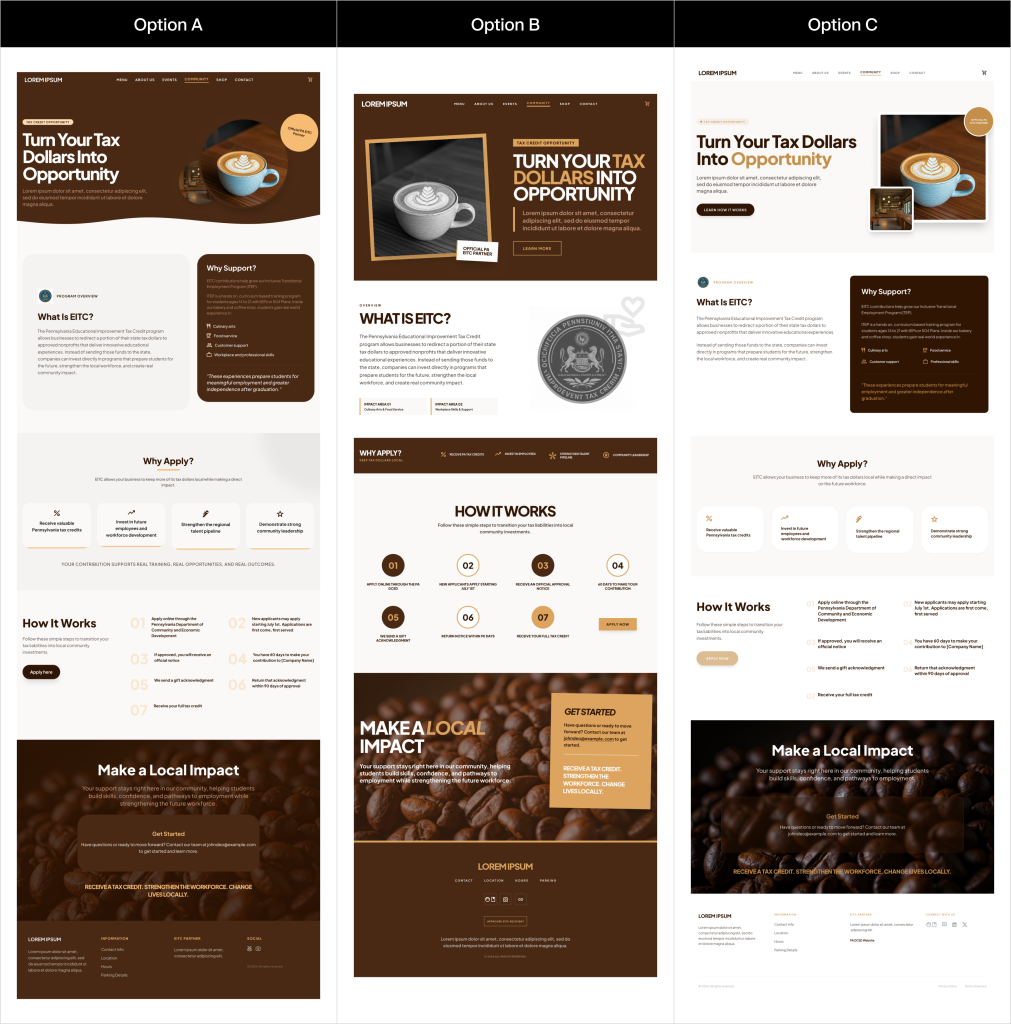
Multiple interactive concepts let stakeholders compare approaches, borrow strengths from each, and align on the strongest solution earlier in the project.
04. The Role of Strategic AI Prompting in Website Design Creation
A common misconception is that great AI design comes from a clever prompt. It doesn’t. AI accelerates execution, but meaningful output needs meaningful input.
Every Website design and development project still starts with the real analysis work:
- Business research
- Audience analysis
- Competitor evaluation
- Content planning
- UX strategy
- Conversion optimization
- Technical considerations
We translate those insights into structured prompts that steer the creative work toward specific business website outcomes. The goal isn’t faster concepts. It’s concepts that land close to the final solution on the first serious iteration.
The Inputs Behind a Strong Design Prompts
Our Web design prompts read less like design instructions and more like a structured creative brief. They’re shaped by the same inputs a strong strategist or UX lead would use before designing anything:
• Client business model and revenue goals
• Audience segments and decision triggers
• Competitor UX patterns and positioning gaps
• Page goals, conversion actions, and funnel stage
• Brand tone, visual direction, and credibility signals
• Content hierarchy and section priority
• Platform needs (WordPress, ACF, reusable components, CMS flexibility)
• Accessibility, performance, and SEO requirements
Put simply: technology accelerates the workflow, strategy drives the outcome.
05. AI is the Accelerator, Not the Designer
AI compresses execution. It does not supply strategy, UX judgment, conversion thinking, accessibility expertise, technical architecture, or accountability for the result. Anyone can generate a design from a prompt.
The real question for an agency is whether that design survives client review, development, search, accessibility, performance standards, and launch.
Inside our AI-powered web design workflow, experienced designers and WordPress specialists work with AI tools, including Claude Code and Cursur, to generate, refine, and validate concepts.
The tool produces working front-end experiences faster. People who understand design principles, user behavior, accessibility, Core Web Vitals, conversion, SEO, and WordPress architecture are what turn those starting points into client-ready sites.
Why Claude Code and Other AI Design Tools Became a Game Changer in 2026
Most AI design tools generate static visuals. Claude Code can generate working experiences: responsive layouts, functional HTML structures, interactive components, realistic user flows, and production-ready front-end foundations.
That changes the review. Stakeholders interact with something real instead of reviewing screenshots, so they can see how pages behave and how sections connect. More importantly, the generated HTML becomes an implementation asset, so the WordPress development team builds on the approved design prototype instead of rebuilding it from scratch. That closes a lot of the gap between approval and launch.
THE DISTINCTION THAT MATTERS
A tool can build the foundation faster. An experienced WordPress front-end and back-end team is what makes the final site reliable, accessible, and ready to rank.
06. How Multiple Prototype Design Concepts Lead to Better Decisions
Exploring several directions used to require serious design hours, so most projects shipped a single concept. Now we can put multiple approaches in front of stakeholders early, without stretching the timeline.
Agencies can:
- Compare design options side by side
- Evaluate ideas more effectively
- Identify preferred directions sooner
- Combine strengths from multiple concepts
- Make decisions with greater confidence
This makes the web process more collaborative and productive.
It also changes the client conversation. Instead of asking, “Do you like this design?” the agency can ask, “Which direction best supports the business goal?”
That is a stronger conversation. It moves the review away from personal preference and closer to strategy, user experience, and conversion.
07. From Approved Prototype to WordPress Production Workflow
The biggest downstream win is that approved prototypes become implementation foundations.
For white label WordPress projects, approved HTML concepts get rebuilt into dynamic, maintainable solutions using Advanced Custom Fields, flexible content layouts, reusable components, structured field groups, content-driven templates, responsive front-end patterns, and SEO-friendly page structures.
The approved prototype becomes the starting point for production rather than a reference that developers have to interpret and recreate.
Interactive HTML prototype → Approved concept → Development architecture → Reusable components → WordPress experience → Live website
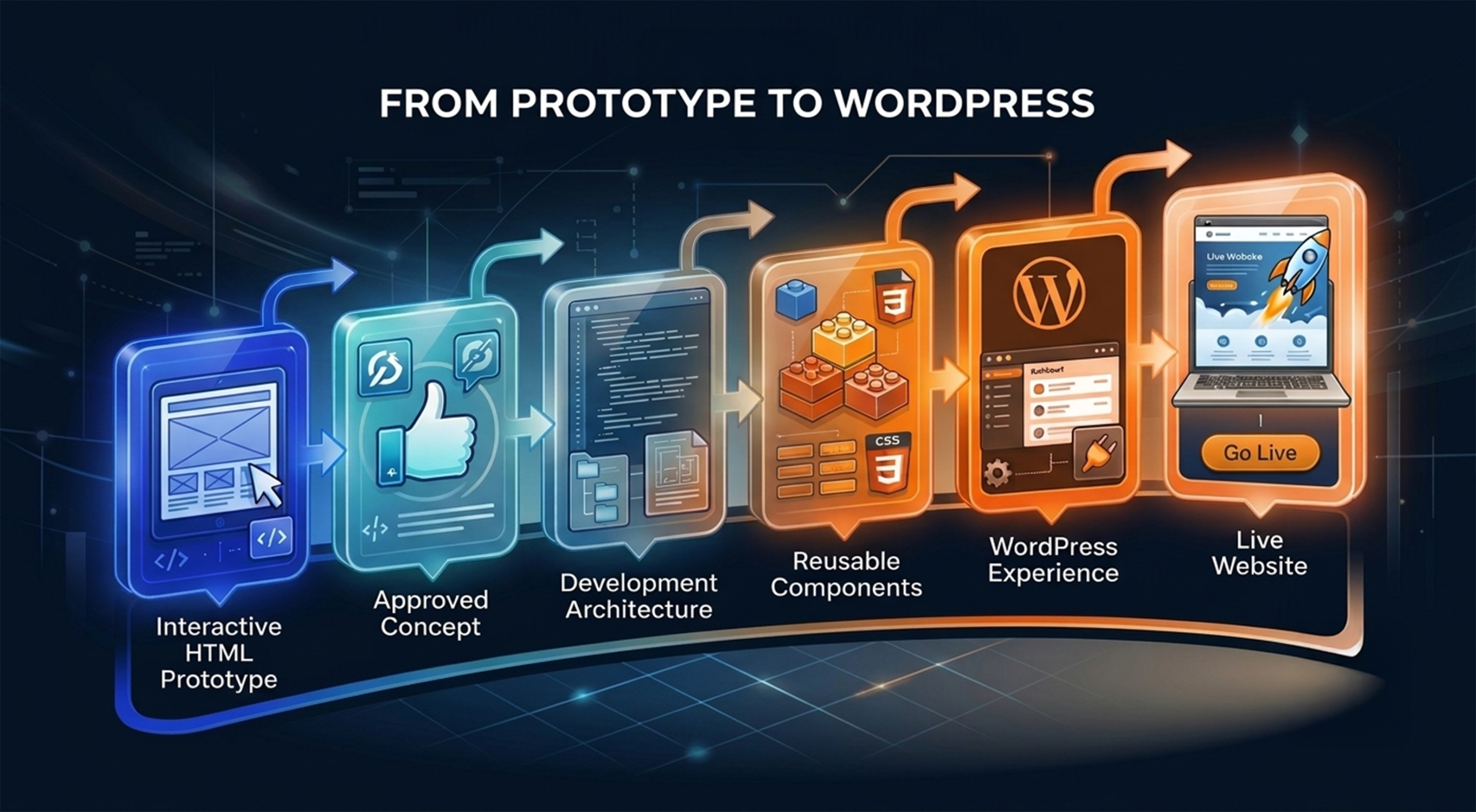
How Our White Label WordPress Team Rebuilds it Properly
After a Design prototype is approved, our WordPress web team turns the front end into a maintainable build. That typically includes:
• ACF field groups for editable content sections
• Flexible content layouts for reusable page blocks
• Component-based front-end patterns and global style controls for brand consistency
• An SEO-ready heading hierarchy with internal-linking opportunities
• Responsive checks across desktop, tablet, and mobile
• An accessibility review of navigation, contrast, labels, and interaction states
• A performance pass to avoid bloated front-end output
This is the step that turns a fast prototype into a site an agency can confidently hand to a paying client.
08. How to Maintain Quality in AI-Assisted Web Design
Every AI-assisted concept goes through human QA review before it’s client-ready and delivered to the agency.
Our team checks the work for:
- Brand alignment
- UX clarity
- Responsive behavior
- Accessibility considerations
- Core Web Vitals considerations
- SEO structure
- WordPress feasibility
- Component reusability
- Content management requirements
- Launch readiness
We don’t hand off whatever the tool produced. We use AI to reach stronger options faster, then apply expert judgment before anything moves into production. In white-label work, that quality layer is the whole point: partners need speed and the confidence that the final site reflects their standards.
Quality-control checklist for agency partners
• ✓ Does the page support the client’s business objective?
• ✓ Is the content hierarchy clear?
• ✓ Are the CTAs visible and contextually placed?
• ✓ Does the layout hold up across common breakpoints?
• ✓ Can the design be translated into WordPress cleanly?
• ✓ Are key sections reusable for future pages?
• ✓ Does the structure support SEO and internal linking?
• ✓ Are accessibility and Core Web Vitals risks addressed early?
• ✓ Does the final experience feel like the agency’s brand standard?
That’s why the workflow isn’t just AI-powered. It’s AI-assisted, human-led, and agency-ready. E2M, as white label web agency partner, stays invisible to the client but accountable for the work behind the scenes.
How Expertise Still Drives the Outcome?
Technology has dramatically accelerated concept generation, but website development and design creation expertise remains the most important part of the process.
Every successful Website development concept is influenced by:
- UX best practices
- Conversion-focused thinking
- Competitor analysis
- Content strategy
- Technical feasibility
- Brand positioning
- Accessibility standards
- SEO requirements
- Industry experience
AI accelerates execution. Experts provide direction.
The combination of strategic thinking, design expertise, and implementation knowledge allows E2M to create solutions that are visually engaging, technically practical, and aligned with business objectives.
Human Expertise + AI Framework
Business Strategy + UX Expertise + Prompt Engineering + AI Tools + WordPress Expertise = Production-Ready Experience
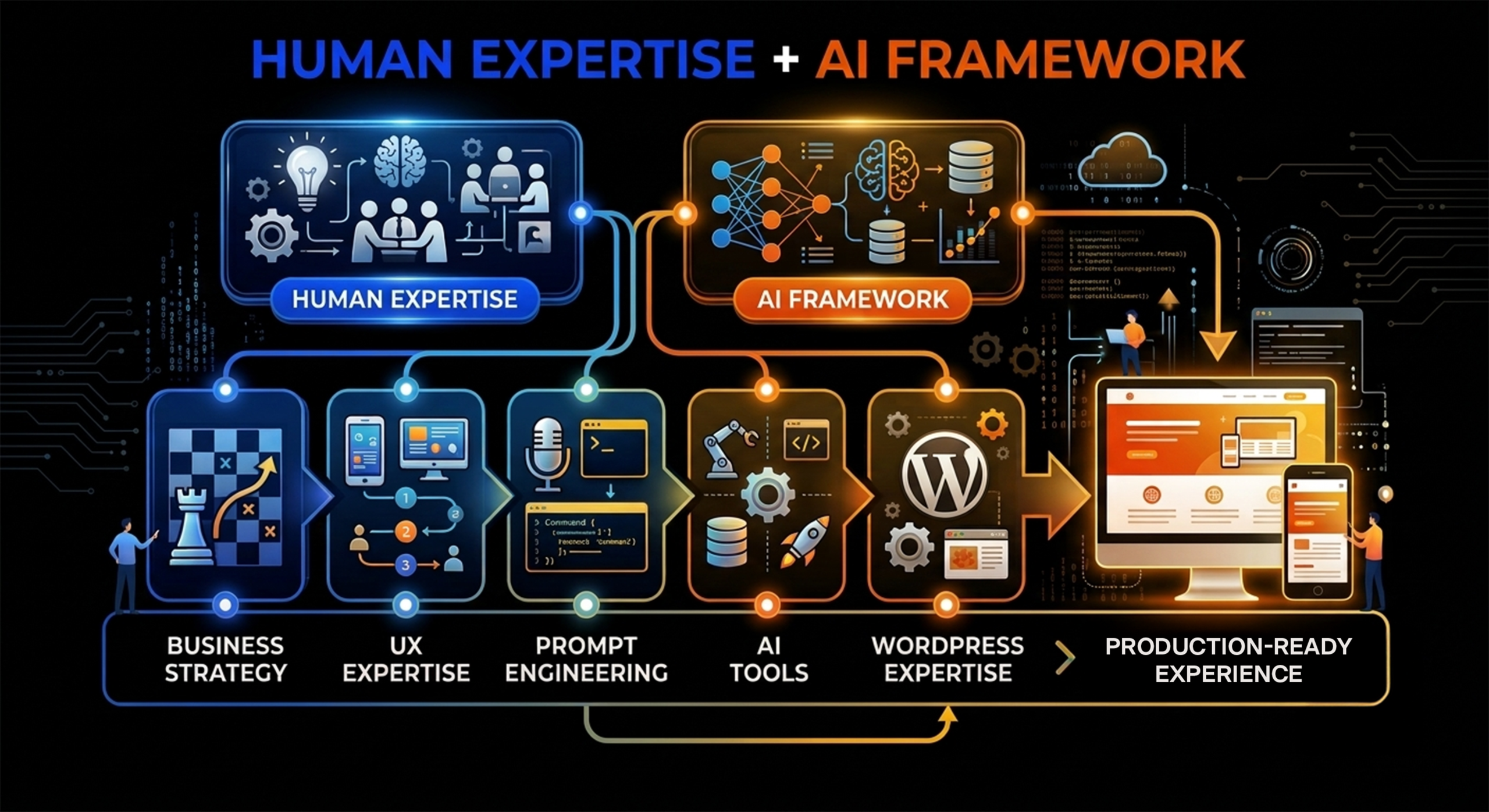
The tool is only one input. The people and process around it determine whether the output is ready for real client work.
09. Who Does This AI-powered White Label Design Model Fit
Behind the process is a team of around 230 web design and development specialists working across WordPress, Webflow, GoHighLevel, Duda, Shopify, WooCommerce, and BigCommerce (part of E2M’s 350+ specialists overall). It’s a strong fit for:
• Web design agencies that need more production capacity
• SEO Agencies: adding web design and development to retain clients
• Digital marketing agencies that need landing pages, sites, and funnels built faster
• Creative agencies that want development support under their own brand
• Small and mid-sized agencies that want to scale without a full internal team
• Agencies that need WordPress, Webflow, Shopify, WooCommerce, BigCommerce, Duda, or GoHighLevel support
The common thread is simple: grow delivery capacity while keeping the client relationship, brand experience, and margin under your control. A closer look at when agencies start using white label services.
10. The Results, and the Honest Caveats of Using Interactive Prototypes
Based on our internal web delivery observations, the prototype-first workflow produced measurable gains across design, approval, and implementation.
| CONCEPT CREATION 6h ↓ from ~12h | REVISION ROUNDS 2 ↓ from ~5 |
|---|---|
| APPROVAL TIMELINE ~50% ↑ faster | CONCEPTS AT THE START Multiple ↑ from 1 |
BEFORE AND AFTER: INTERNAL WEB DELIVERY OBSERVATIONS
| Area | Before | After |
|---|---|---|
| Initial concept creation | Approx. 12 hours | Approx. 6 hours |
| Revision cycles to approval | Approx. 5 rounds | Approx. 2 rounds |
| Design approval timeline | Baseline | Approx. 50% faster |
| Concepts available at the start | Usually 1 | Multiple |
Design efficiency. Initial concept creation dropped from roughly 12 hours to about 6, and multiple concepts are available from the start.
Approval. Revision cycles fell from around 5 rounds to 2, and approval timelines shortened by roughly 50%, largely because stakeholders review interactive experiences earlier.
Implementation. Approved prototypes become implementation foundations, which support faster WordPress, websites, landing pages, email templates, and marketing assets builds and reduce design-to-development translation effort.
The overall effect is better collaboration, more visibility before development begins, and more predictable execution.
METHODOLOGY
These figures come from E2M’s internal delivery tracking across recent web projects, not a controlled study. Actual results depend on project scope, content readiness, client responsiveness, platform, integrations, and QA requirements. We share them as a directional benchmark, not a guarantee of specific outcomes.
11. Key Takeaways
By combining strategic planning, interactive prototyping, structured prompting, AI design tools, and WordPress expertise, we’ve built a static-to-interactive process that delivers faster execution, stronger collaboration, better decisions, fewer revisions, and more efficient implementation.
The lesson is simple: AI isn’t replacing expertise. The advantage comes from knowing how to apply it. AI accelerates exploration and helps generate working HTML faster, but the quality of the final website still depends on strategy, UX, content planning, accessibility, SEO, WordPress architecture, and human accountability. Technology accelerates the workflow. Expertise drives the result.
WHAT THIS MEANS FOR YOU
If you run an agency in web, digital, eCommerce, beauty & fashion, Law, real estate, or any other specific niches, the practical Prototype multiple designs win is weboperational: deliver faster without lowering quality, present multiple concepts without ballooning effort, cut revision overhead, raise client confidence during reviews, and increase capacity on a more predictable timeline.
The real advantage isn’t that we use AI. Plenty of teams can say that now. It’s that E2M built AI into a disciplined White label website delivery services model: discovery, UX, structured prompting, interactive prototypes, WordPress implementation, accessibility review, SEO structure, launch QA, and ongoing maintenance. That’s what lets agencies move faster without turning quality into a risk.
12. Frequently asked questions
E2M works as an invisible delivery partner for agencies. You bring the client, brief, and brand relationship. We handle the design and WordPress development behind the scenes, under your agency’s brand, with experienced specialists managing quality at each stage.
Agencies use AI to accelerate concept creation, interactive prototyping, responsive layout exploration, and front-end foundations. The strongest workflows keep humans in charge of strategy, UX, accessibility, SEO, content planning, WordPress architecture, and final QA.
No. AI speeds up execution, but it doesn’t replace design judgment, UX expertise, conversion thinking, accessibility knowledge, technical planning, or accountability. The best outcomes come from experienced designers and developers using AI as an accelerator.
A static mockup shows what a page looks like. An interactive prototype shows how the page behaves, how users move through it, and how sections work together. Prototypes produce better feedback because stakeholders review the experience instead of imagining it from a flat screenshot.
AI speeds up concepting and approval, but total website timelines still depend on scope, content readiness, complexity, platform, integrations, and QA. In our workflow, early concept creation has dropped from roughly 12 hours to about 4 hours in observed projects.
Agencies scale by reducing revision cycles, improving approval speed, reusing proven development systems, and partnering with a white-label team that delivers under their brand. AI accelerates parts of the workflow, but the delivery model matters most.
Pricing depends on scope, page count, platform, design complexity, content needs, and development requirements. For agencies, the bigger question is margin: can the partner deliver consistent quality under your brand while protecting your profitability and timelines?
Check whether the Web workflow includes a human strategy with an expert team with dedicated Project manager with, UX review, responsive testing, accessibility checks, SEO structure, performance review, CMS planning, and final QA. AI can speed up delivery, but quality still depends on the process around it.
We combine AI-assisted prototyping with human-led discovery, UX strategy, WordPress development, accessibility review, SEO planning, and launch QA. AI helps the team move faster, while experienced specialists stay responsible for the final client-ready outcome.