

If you run an eCommerce agency, you already know the ceiling.
> You build Shopify stores.
> You develop and customize WooCommerce websites.
> You manage stores post-launch theme updates, app integrations, CRO tweaks, SEO fixes, performance optimization, and ongoing support.
At first, this model works.
More clients → more projects → more revenue.
Then reality hits. Client revenue scales. Headcount follows. Margins shrink.
You hire to keep up, and suddenly you’re managing people instead of building the business.
That’s the trap most eCommerce agencies are stuck in right now.
And it’s exactly the problem AI agents for eCommerce agencies are built to solve by E2M
Winning agencies are already deploying AI solutions today, automating Shopify and WooCommerce operations, selling AI retainers, and repositioning themselves from delivery vendors to operational partners.
Join the Agency Growth Hub for frameworks, playbooks, and systems used by scaling agencies.
They’re moving from: “We build and manage your store.” to “We run intelligent systems that grow your store.”
And that shift changes everything.
Here’s how they’re doing it and how you can too.
Table of Contents
- What AI Agents for eCommerce Agencies?
- Why eCommerce Agencies Are Investing in AI Agents Right Now?
- How Do Agencies Build AI Agents for Shopify and WooCommerce?
- The 5 AI Agent Use Cases for eCommerce Agencies
- How Agencies Are Monetizing AI with High-Margin Retainers?
- White-Label AI Development vs. Building In-House
- How E2M Helps Agencies Deploy AI Agents for eCommerce?
- The Agencies Winning Right Now Aren’t Waiting
- Frequently Asked Questions
1. What are AI Agents for eCommerce Agencies?
AI agents for eCommerce agencies are autonomous, goal-driven systems that handle multi-step Shopify and WooCommerce workflows such as customer support, order management, returns, cart recovery, review responses, and inventory monitoring without requiring human involvement for routine tasks.
Unlike basic chatbots or rule-based automation, AI agents operate as intelligent operational systems, not scripted tools.
AI agents are designed to:
- Interpret customer intent using large language models (LLMs)
- Retrieve real-time data from Shopify, WooCommerce, and connected tools
- Execute actions across systems (refunds, shipping, inventory, CRM)
- Apply deterministic business rules and brand policies
- Escalate only when human judgment is required
- Log actions for monitoring, QA, and optimization
The Critical Difference: Automation vs AI Agents
Traditional automation is trigger-based.
It fires when predefined conditions are met.
AI agents are goal-based.
They pursue an outcome, adapt to real-world context, and handle the “messy middle” where scripted workflows fail.
- Automation follows rules.
- AI agents make decisions within guardrails.
This distinction is what makes AI agents production-ready operational infrastructure, not experiments, chatbots, or brittle workflows.
Know more about the Top AI Agent Framework list, Shortlist for Agencies.
2. Why eCommerce Agencies Are Investing in AI Agents Right Now?
eCommerce agencies are investing in AI agents because manual delivery models can no longer scale profitably. AI agents eliminate high-volume operational inefficiencies across Shopify and WooCommerce stores, allowing agencies to improve margins, retain clients, and grow without hiring.
The economics are already proven.
- Global cart abandonment averages ~70%
- WISMO (“Where Is My Order?”) tickets consume 30–50% of support volume
- A 5% increase in retention can lift profits by 25–95%
For agencies, these are not one-off problems. They’re system-level inefficiencies repeating across every Shopify and WooCommerce client.
Three compounding pressures are forcing this shift:
1. Margin compression
Flat retainers don’t absorb hiring costs. Every new support hire reduces margin. Manual scaling has a hard ceiling.
2. Clients are demanding AI
eCommerce brands are being pitched AI from every direction. Agencies that can’t explain and deploy eCommerce AI automation are losing positioning to competitors who can.
3. Workflow automation is breaking
Zapier and rule-based automation fail on edge cases, lack context, and collapse when requests don’t fit predefined scripts.
AI agents eliminate all three pressure points at once.
3. How Do Agencies Build AI Agents for Shopify and WooCommerce ?
Agencies build AI agents for Shopify and WooCommerce by combining LLM-based intent detection, real-time platform APIs, workflow execution logic, deterministic business rules, and human escalation controls.
Most production-grade AI agents are deployed in 8-12 weeks using a white-label AI development partner, rather than built in-house.
This approach allows agencies to sell AI retainers without hiring AI engineers or maintaining complex infrastructure.
A scalable, production-ready AI agent architecture includes the following layers:
-
- Intent layer
An LLM classifies customer intent (order status, return, refund, complaint, subscription change). - Data retrieval layer
The agent pulls real-time data via Shopify Admin API, WooCommerce APIs, carrier APIs, and subscription platforms. - Workflow execution layer
Based on intent and data, the agent executes actions: refunds, shipping labels, inventory updates, and confirmations. - Rules enforcement layer Business logic is deterministic return windows, VIP handling, fraud flags, and policy compliance.
- Escalation layer Edge cases route to humans with full context attached.
- Intent layer
This layered architecture is what makes AI agents production-ready infrastructure, not experiments.
See how you can leverage E2M’s AI Automation team
4. The 5 AI Agent Use Cases for eCommerce Agencies
eCommerce agencies monetize AI by deploying production-ready AI agents that automate high-volume, high-cost Shopify and WooCommerce workflows. These use cases are not experimental; they are already being sold as recurring AI retainers.
Below are the five AI agent use cases agencies are actively monetizing today.
1. WISMO Automation (Order Intelligence)
What it does:
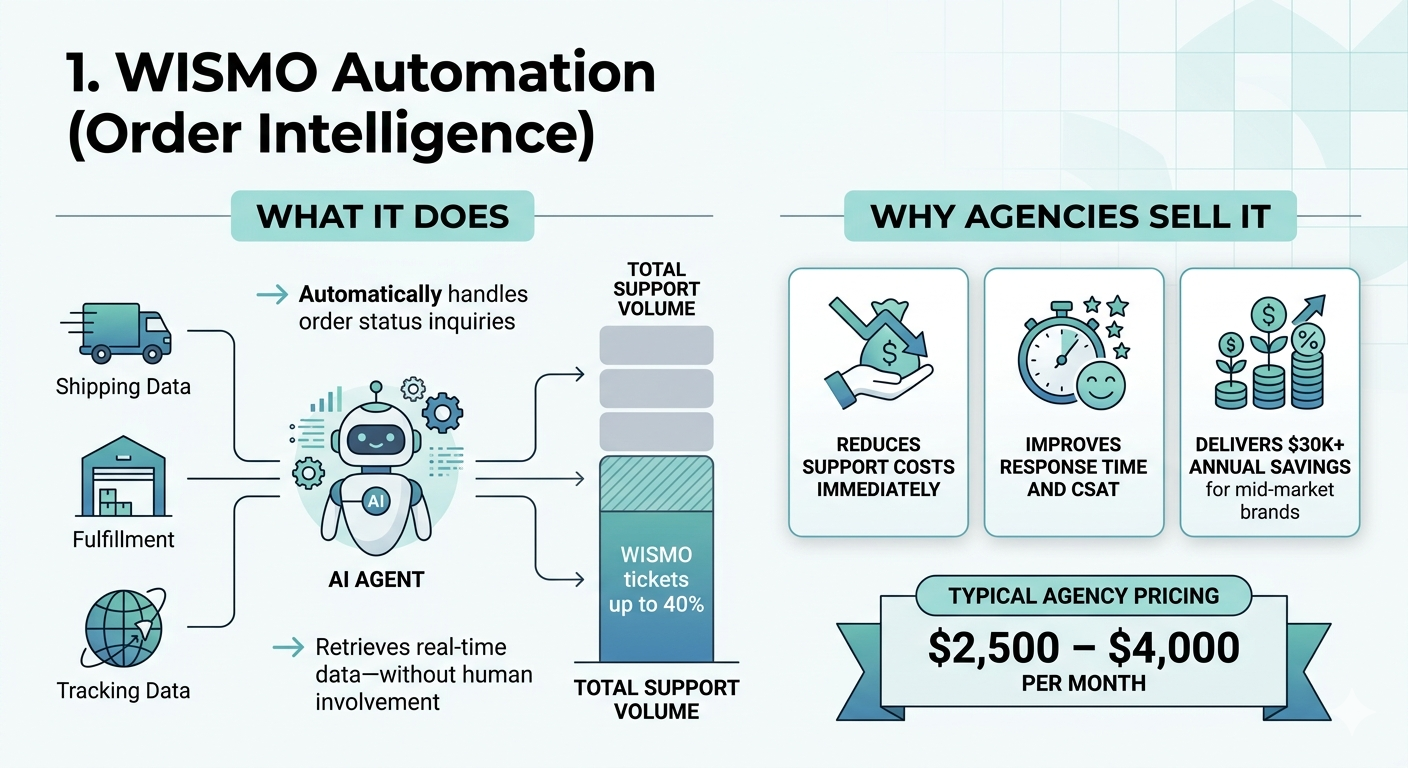
WISMO (“Where Is My Order?”) AI agents automatically handle order status inquiries by retrieving real-time shipping, fulfillment, and tracking data—without human involvement.
WISMO tickets can account for up to 40% of total support volume.
Why agencies sell it:
- Reduces support costs immediately
- Improves response time and CSAT
- Delivers $30K+ in annual savings for mid-market brands
Typical agency pricing:
$2,500–$4,000 per month
2. Returns & Refund Orchestration
What it does:
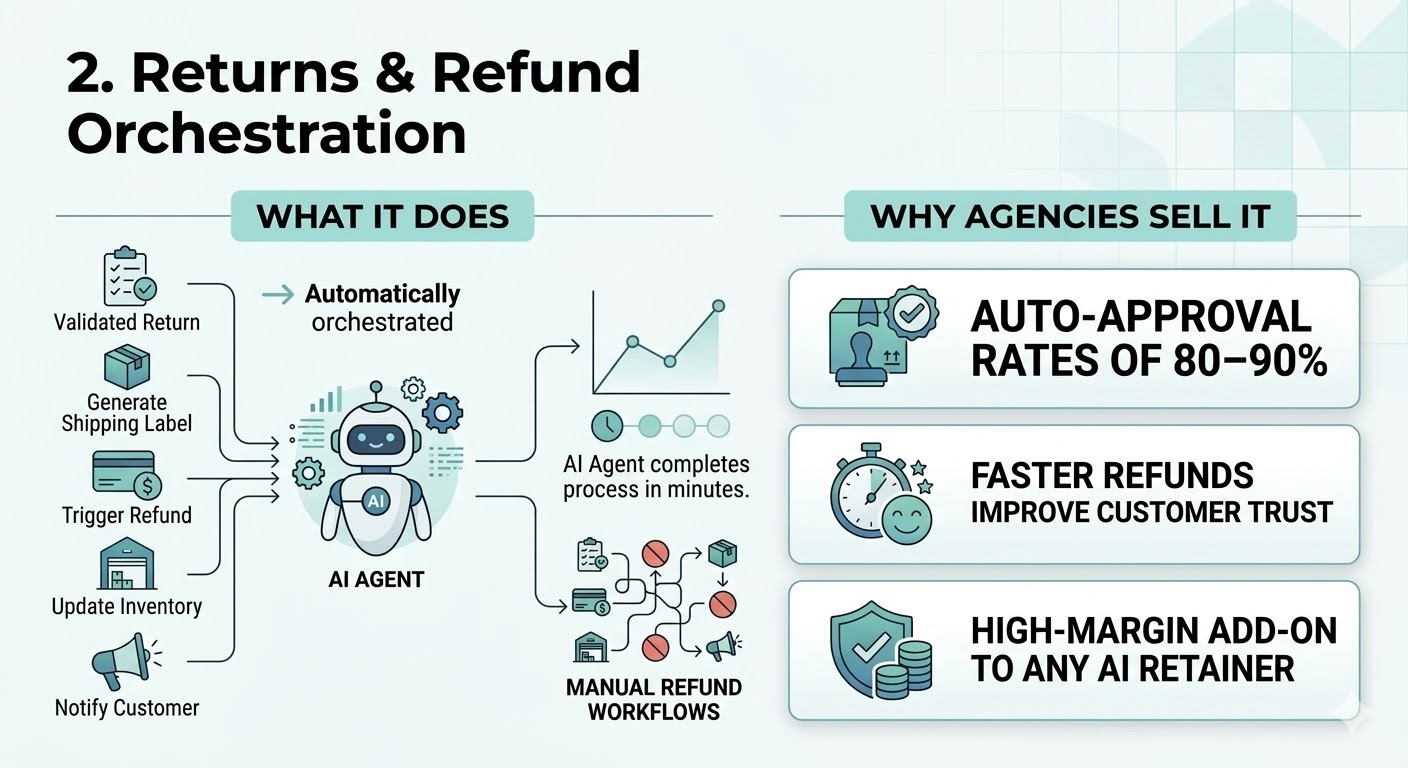
Returns and refund AI agents validate return policies, generate shipping labels, trigger refunds, update inventory, and notify customers automatically.
Manual refund workflows typically touch 4–6 systems. AI agents complete the same process in minutes.
Why agencies sell it:
- Auto-approval rates of 80–90%
- Faster refunds improve customer trust
- High-margin add-on to any AI retainer
3. Abandoned Cart Recovery
What it does:
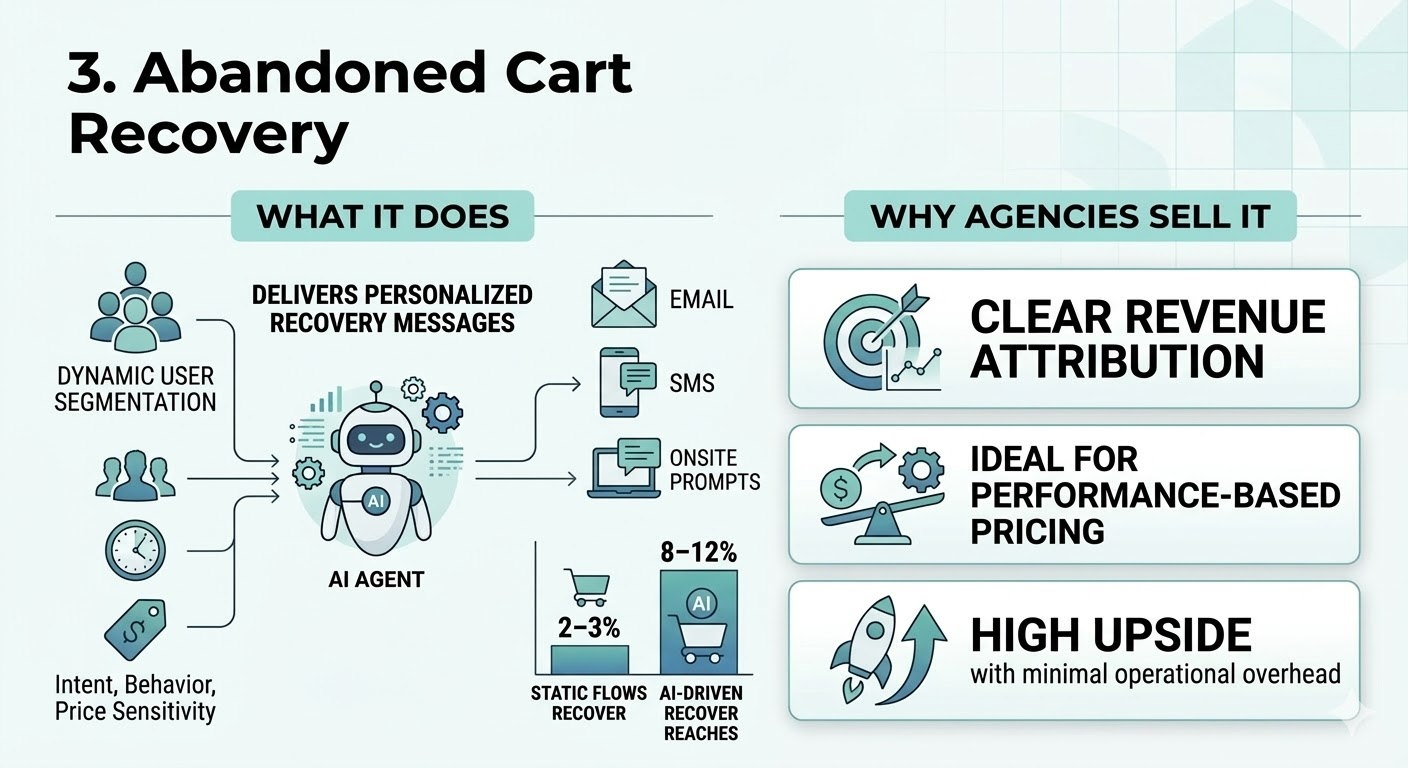
Abandoned cart AI agents dynamically segment users by intent, behavior, and price sensitivity, then deliver personalized recovery messages across email, SMS, and onsite prompts.
Static flows recover 2–3%.
AI-driven recovery typically reaches 8–12%.
Why agencies sell it:
- Clear revenue attribution
- Ideal for performance-based pricing
- High upside with minimal operational overhead
4. Review Response Automation
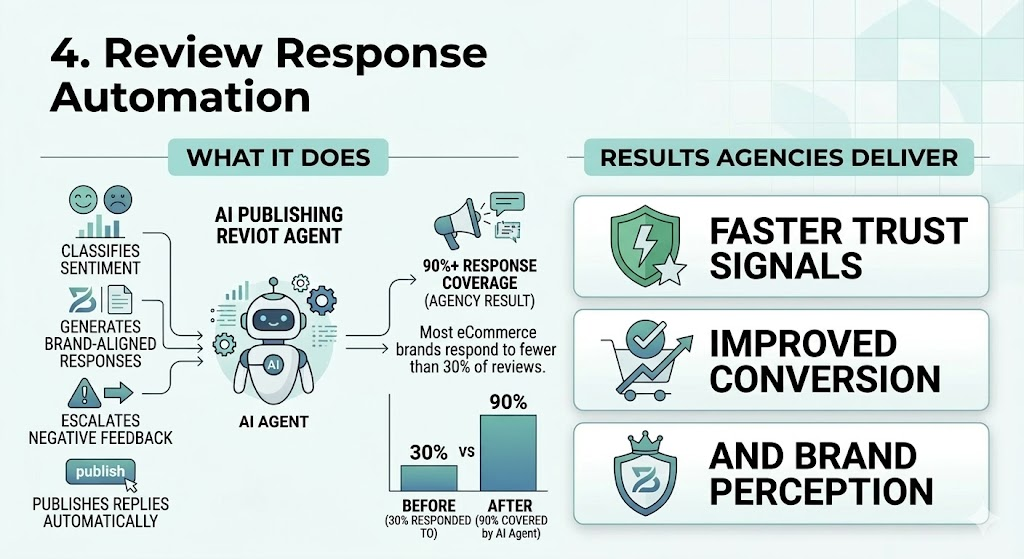
What it does:
Review response AI agents classify sentiment, generate brand-aligned responses, escalate negative feedback, and publish replies automatically.
Most eCommerce brands respond to fewer than 30% of reviews.
Results agencies deliver:
- 90%+ response coverage
- Faster trust signals
- Improved conversion and brand perception
Theme choice shapes delivery. But is your full Shopify delivery model built to scale?
5. Inventory Intelligence
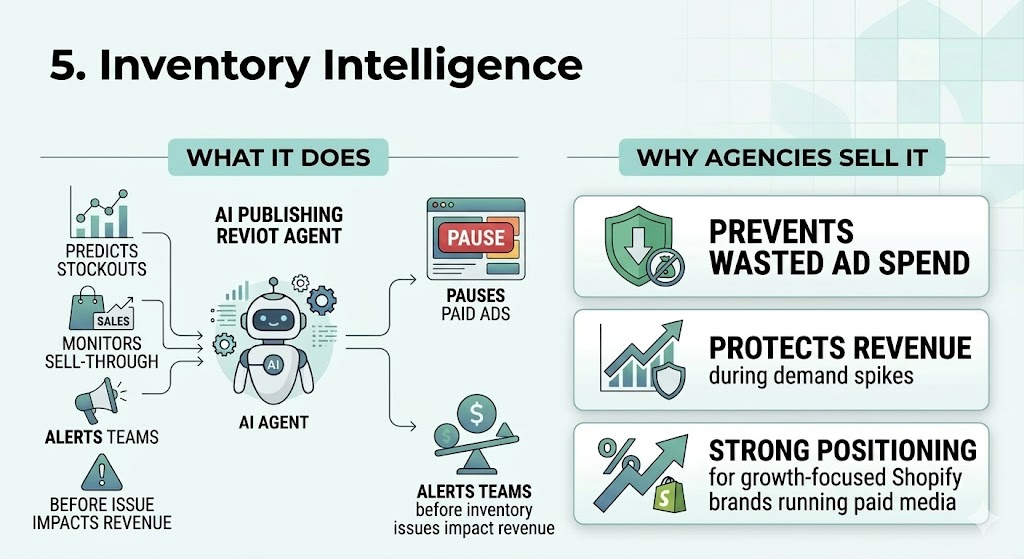
What it does:
Inventory AI agents predict stockouts, monitor sell-through, pause paid ads, and alert teams before inventory issues impact revenue.
Why agencies sell it:
- Prevents wasted ad spend
- Protects revenue during demand spikes
- Strong positioning for growth-focused Shopify brands running paid media
Want to learn more about AI Agents? Check our Free 80+ AI Use Cases Bonus Stack here get hands-on ideas you can apply right away
5. How Agencies Are Monetizing AI with High-Margin Retainers?
eCommerce agencies monetize AI services by replacing project-based pricing with recurring AI retainers and performance-based models. This allows agencies to generate predictable revenue, maintain high margins, and scale AI services without increasing headcount.
Agencies winning with AI typically use one or more of the following pricing models:
1. Setup + Retainer Model (Most Common)
This is the most widely adopted model for AI agents for eCommerce agencies.
- One-time AI agent setup: $3,000–$8,000 per agent
- Monthly AI infrastructure retainer: $1,500–$5,000+
Why it works:
Predictable recurring revenue, high margins, and strong client lock-in. Once AI agents are embedded into Shopify or WooCommerce operations, switching costs increase significantly.
2. Performance-Based Model (Revenue-Focused Use Cases)
This model is most commonly used for abandoned cart recovery AI agents.
- Pricing: 10–20% of recovered revenue
- Best for: High-volume eCommerce brands with measurable lift
Why it works:
The ROI conversation is simple, risk is low for the client, and upside is high for the agency.
Bundled AI Infrastructure Retainer
Agencies bundle multiple AI agents into a single infrastructure offering.
- 3–4 AI agents bundled together
- Monthly retainer: $4,000–$8,000+
Why it works:
You’re no longer selling isolated services; you’re selling operational infrastructure. This shifts the agency from vendor to long-term partner.
Ready to Scale Your Agency’s AI Services?
Stop worrying about AI Specialist capacity constraints and start building and selling AI Agents, automation.
See if We E2M white-label AI Agent development is the right fit for your agency.
6. White-Label AI Development vs. Building In-House
Most eCommerce agencies stall at this decision. The difference between agencies that ship AI and agencies that just talk about it often comes down to how they choose to build.
In practice, most agencies deploy AI agents using a white-label AI development partner instead of building in-house. The reason is simple: speed, cost, and risk.
| Factor | Build In-House | White-Label AI Partner |
| Time to deploy | 3–6 months | 4–8 weeks |
| Cost | $150K–$300K+ (engineering salaries) | Fraction of in-house cost |
| Risk | Fully yours | Shared with the delivery partner |
| Optimization | Requires an internal AI team | Managed continuously |
| Client brand | Yours | Yours |
Why Most Agencies Choose White-Label AI Development
Building AI agents in-house requires hiring AI/ML engineers, maintaining infrastructure, and managing long-term optimization, all before selling the first AI retainer.
White-label AI development allows agencies to:
- Launch production-ready AI agents in weeks
- Sell AI services under their own brand
- Avoid hiring and managing AI engineers
- Reduce technical and financial risk
- Focus on sales, strategy, and client relationships
Unless you already operate an AI engineering team, white-label AI development is faster, more cost-efficient, and significantly lower risk than building in-house.
eCommerce agencies choose white-label AI services because it lets them sell AI services quickly, profitably, and under their own brand, without building internal AI infrastructure.
7. How E2M Helps Agencies Deploy AI Agents for eCommerce?
E2M Solutions is a full-service white-label AI development partner built specifically for eCommerce and digital agencies.
Agencies work with E2M to:
- Offer AI agents for Shopify and WooCommerce clients as part of their service stack
- Build and sell AI services under their own brand without technical infrastructure risk
- Avoid hiring full-time AI engineers and the associated recruitment overhead
- Launch production-ready AI systems in weeks, not months
E2M designs the underlying architecture, builds integrations, manages guardrails, and handles ongoing optimization all invisibly behind your agency brand.
Your client sees you.
You own the retainer.
E2M runs the AI infrastructure.
Our fractional AI consulting services for agencies ready to adopt AI at scale. Their AI strategists work closely with agency leadership to identify high-impact automation opportunities, create custom blueprints, and implement AI agents tailored to real operational workflows, so your team wins internal efficiency, and you gain new revenue streams to sell to clients.
8. The Agencies Winning Right Now Aren’t Waiting
eCommerce brands are moving operational infrastructure, customer support, order management, retention, and inventory to AI. As a result, they are choosing agency partners who can design, deploy, and manage AI agents for Shopify and WooCommerce.
Agencies that adopt AI agents now gain a measurable competitive advantage.
Agencies using AI agents:
- Command premium AI retainers instead of flat service fees
- Reduce delivery costs by replacing manual workflows with autonomous systems
- Increase client lock-in by becoming operational infrastructure, not just a vendor
- Sell AI services at scale without increasing headcount
AI agents for eCommerce agencies are not a future trend.
They are the current competitive edge separating scalable agencies from delivery-bound ones.
The only real question is this:
Will your agency be the one deploying AI for clients or the one explaining why a competitor already did?
9. Frequently Asked Questions About AI Agents
Q1. What are AI agents for eCommerce?
A1: AI agents for e-commerce are autonomous systems that interpret customer intent, retrieve real-time data from platforms like Shopify or WooCommerce, execute multi-step workflows, and apply business rules, resolving support, operations, and revenue tasks without human involvement for routine cases.
Q2: How do agencies build AI agents for Shopify and WooCommerce?
A2: Agencies build Shopify AI agents and WooCommerce AI agents by combining LLM-based intent detection with platform API integrations, workflow execution logic, hardcoded business rules, and human escalation controls. Most production-grade agents are deployed in 4–8 weeks using a white-label AI development partner.
Q3: What is white-label AI development for agencies?
A3: White-label AI development means an agency partners with an AI engineering team that designs, builds, and maintains AI infrastructure under the agency’s brand. The agency owns the client relationship and retainer; the partner manages technical delivery.
Q4: Should agencies build AI agents in-house or white-label?
A4: Unless you already have an engineering team, white-labeling is faster, lower-risk, and more cost-efficient. Building in-house typically requires 3–6 months and $150K+ in engineering costs before the first deployment. A white-label AI partner can launch in weeks.
Q5: How much does AI agent development cost for agencies?
A5: Implementation typically ranges from $3,000–$8,000 per agent. Monthly AI infrastructure retainers run $1,500–$8,000, depending on complexity and agent count. Performance-based models are common for revenue-focused use cases like cart recovery.
Q6: Are AI agents better than traditional automation for e-commerce?
A6:For complex or variable workflows, yes. Traditional automation is trigger-based and breaks on edge cases. AI agents are goal-based, context-aware, and orchestrate across multiple systems, making them effective for the majority of real-world support and operations scenarios.



With over 7 years at E2M and extensive experience in global sales, customer success, and AI transformation, Khushbu specializes in simplifying complex operations, designing repeatable systems, and helping agency leaders turn AI into a competitive advantage. She also works closely with prospects, partners and agencies to implement tailored AI solutions that drive measurable results.
A Computer Engineering graduate, she brings together technical expertise, sales acumen, and people-first leadership. Outside of work, Khushbu is a bookworm, an amateur tennis player, and a coffee enthusiast who’s always up for a good story and a good laugh.