

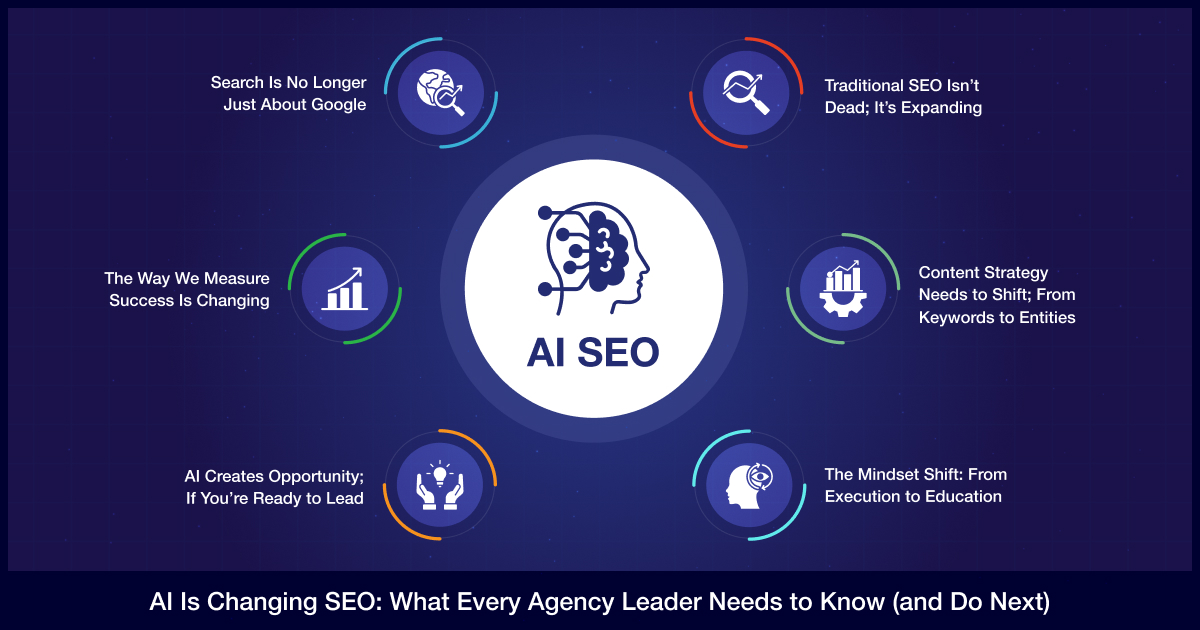
The Next SEO Evolution Has Already Begun
Search is changing faster than most agencies realize.
For years, we’ve optimized for Google by chasing rankings, building backlinks, and mapping keywords to pages. But that SEO playbook is being completely rewritten as we speak.
Artificial intelligence is reshaping how people find information. Platforms like ChatGPT, Perplexity, and Gemini no longer just index the web; they interpret it. And that changes everything about how agencies should approach visibility and trust online.
Get the AI SEO playbook agencies are using to modernize delivery and protect margins
> Download the Playbook
Table of Contents
- The Next SEO Evolution Has Already Begun
- 1. Search Is No Longer Just About Google
- 2. Traditional SEO Isn’t Dead; It’s Expanding
- 3. Content Strategy Needs to Shift; From Keywords to Entities
- 4. The Way We Measure Success Is Changing
- 5. AI Creates Opportunity; If You’re Ready to Lead
- 6. The Mindset Shift: From Execution to Education?
- Final Thoughts: AI Isn’t Replacing SEO; It’s Redefining It
- FAQs on AI Search Audits & Optimization (AIO)
In my recent Podcast with Jason Swenk, we unpacked what this shift means for agencies and how to stay ahead of it. Here’s what every digital agency leader needs to know about how AI is changing SEO.
1. Search Is No Longer Just About Google
Search used to mean: type a query, scan ten blue links, and click.
Now, users ask a question, and AI gives them an answer.
AI Mode, Large language models (LLMs) like ChatGPT and Claude pull data from sources all over the web: websites, podcasts, Reddit threads, and even PDFs. Your goal as an agency isn’t just to rank anymore; it’s to make sure your client’s brand is understood and referenced by these AI systems.
This shift from traditional SEO to AI search optimization means rethinking how you build visibility for clients across AI-powered platforms like ChatGPT, Perplexity, and Google’s AI Overviews.
“You’re not optimizing for one search engine anymore, you’re optimizing for how the internet talks about you.”
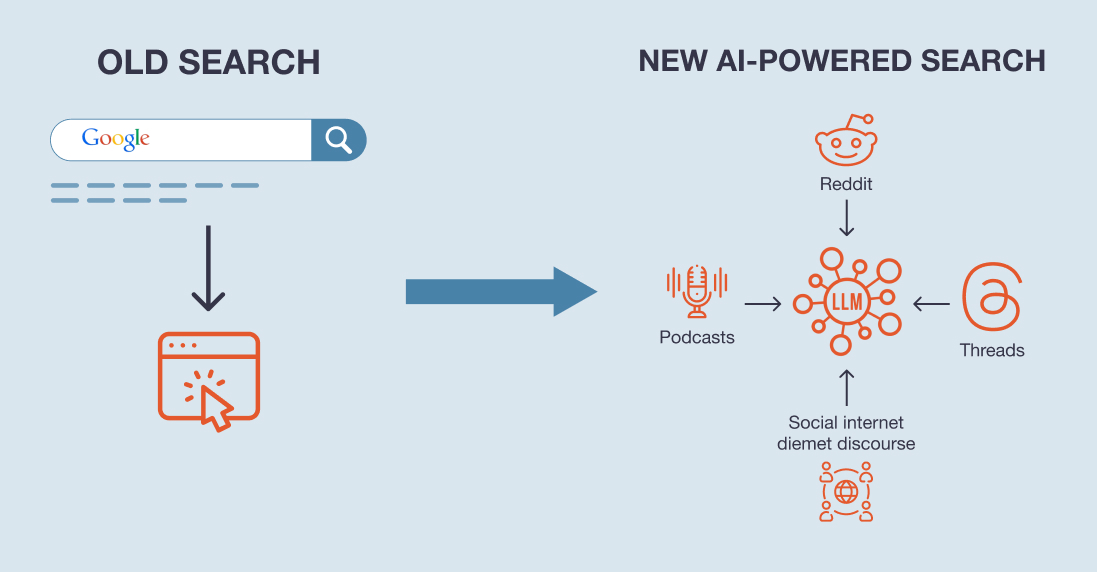
That means building visibility across every digital surface where your audience and AI might find you.
2. Traditional SEO Isn’t Dead; It’s Expanding
The foundation of SEO still matters. Your website needs to be fast, technically sound, and accessible. But that’s the baseline, not the differentiator.
Your site now acts as your source of truth, the authority AI platforms rely on when generating answers. If your content doesn’t clearly address your audience’s real questions, it won’t appear in those AI summaries.
We call this SEO evolution AI Search Optimization (AIO), the practice of helping your brand become more recognizable, credible, and retrievable by AI systems.
What is AI Search Optimization (AIO)?
AIO is the practice of structuring your content, brand signals, and digital presence so AI systems (like ChatGPT, Gemini, and Perplexity) can easily understand, extract, and cite your expertise when generating answers.
It combines traditional on-page SEO with entity-based SEO strategy, structured data optimization, and E-E-A-T for AI search principles to ensure your content is the most authoritative and extractable source for AI-powered search engines.
What is Generative Engine Optimization (GEO)?
GEO is a newer term that specifically focuses on optimizing for generative AI search engines, platforms that create answers rather than just linking to them. This includes Google’s AI Overviews (formerly SGE), Bing Copilot, Perplexity AI, and ChatGPT search.
Think of it this way:
Traditional SEO gets you seen.
AIO gets you understood.
GEO gets you cited as the source.
In short, traditional SEO gets you seen. AI search optimization gets you understood.
| Factor | Traditional SEO | AI Search Optimization (AIO) |
| Primary Goal | Rank high on SERPs | Become the cited source in AI answers |
| Optimization Focus | Keywords, backlinks, technical SEO | Entities, E-E-A-T, structured data |
| User Behavior | Click and explore | Get immediate AI-generated answer |
| Measurement | Rankings, traffic, CTR | AI citations, entity visibility, brand mentions |
| Content Style | Keyword-optimized pages | Authoritative, extractable, multi-format |
| Platforms | Google, Bing | ChatGPT, Gemini, Perplexity, Google AI Overviews |
This table shows the fundamental shift agencies need to make when building visibility strategies for clients in the AI era.
3. Content Strategy Needs to Shift; From Keywords to Entities
Old SEO was about finding the right keyword.
Modern AI SEO for agencies is about owning the right entity, the people, topics, and expertise your brand represents.
To optimize for ChatGPT search and other AI platforms, focus on:
- Depth over density. Create expert-driven content that answers questions completely.
- Structured data. Use schema and entities to help AI understand your content contextually.
- E-E-A-T principles. Show your experience, expertise, authority, and trustworthiness across every asset.
- Multichannel visibility. Publish across formats, podcasts, video, and social since AI pulls from them all.
“The goal is to appear wherever your audience searches — not just Google.”
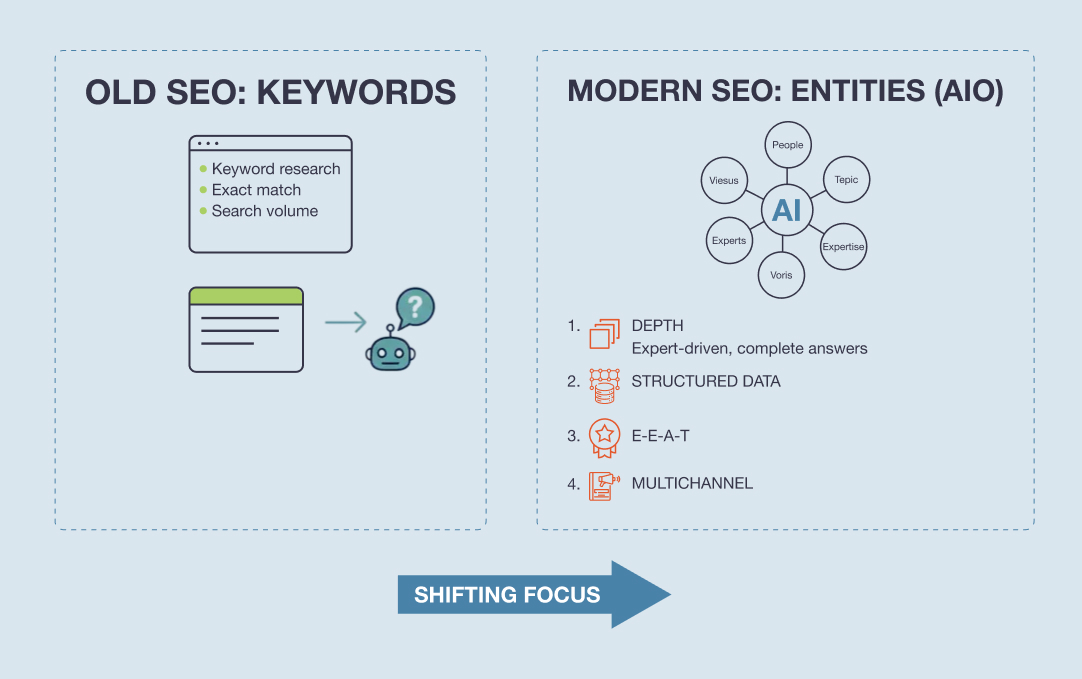
That’s the mindset shift agencies need to embrace.
📌 Agency leaders: If you’re managing multiple clients and need scalable AI SEO execution, See how your agency can leverage E2M to grow AI SEO
> Talk to our team
4. The Way We Measure AI SEO Performance Is Changing
Rankings and organic traffic will always matter, but they’re no longer the full picture.
In the AI SEO era, your performance is measured by how visible and trustworthy your brand is across intelligent systems, not just how often someone clicks your link.
Start tracking metrics like:
- AI citations: How often your brand, content, or team members are referenced in ChatGPT, Gemini, Claude, and Perplexity responses when users search for topics in your niche.
- Entity visibility: Whether AI systems correctly identify your brand, expertise, products, and key team members when relevant queries are made.
- Cross-platform mentions: Brand visibility in Reddit threads, YouTube transcripts, podcast episodes, LinkedIn posts, and forums where AI systems pull contextual information.
- AI Overview impressions: How often your content appears in Google’s AI-generated summaries at the top of search results (trackable in Google Search Console’s new AI Overview filter).
- LLM optimization for websites referral traffic: Direct visits from Perplexity AI, ChatGPT search, Bing Copilot, and other AI-powered platforms that link to sources.
It’s not about clicks anymore; it’s about credibility.
🔍 Curious how your clients rank in AI search? Book a call for AI Search Audit to benchmark their visibility and uncover quick wins.
5. AI Creates Opportunity; If You’re Ready to Lead
AI isn’t the end of SEO. It’s the start of a smarter, more strategic phase.
At E2M Solutions, we’ve introduced an AI Search Audit to help brands and agencies understand how visible they are across AI-driven search platforms like ChatGPT, Perplexity, and Gemini.
The AI Search visibility audit reveals:
- Where your brand appears (and doesn’t) in AI-generated results
- How your content structure impacts AI recognition
- What actions can strengthen your brand’s visibility and authority
This AI search audit is designed specifically for AI SEO services for agencies looking to scale AI SEO services without building in-house expertise from scratch.
This is where agencies can lead the next wave by becoming strategic advisors who help clients adapt to how AI reshapes the discovery process.
“If you’re not already having these conversations with your clients, someone else will.” — Jason Swenk
6. The Mindset Shift: From Execution to Education
Your role as an agency isn’t just to deliver, it’s to demystify.
AI is complex, and most clients lack the time and expertise to understand it. They need clarity, not jargon. They need a partner who translates technology into opportunity.
“Business owners don’t have time to learn all this. They want someone they trust to handle it.”
That’s your edge: becoming the partner who makes AI simple, strategic, and actionable.
What Happens After an AI Search Audit?
Here’s what agencies can expect:
1. Visibility Benchmark — See where your clients currently rank across AI platforms
2. Gap Analysis — Identify content, entity, schema, and E-E-A-T optimization opportunities that will improve AI citation rates.
3. Action Plan — Get a prioritized roadmap for AI optimization with specific tactics ranked by impact and effort.
4. Ongoing Support — Optional: white-label execution with monthly reporting
This isn’t a one-time report. It’s the start of a strategic partnership that positions your agency as a leader in the future of SEO with AI.
The AI SEO training every agency needs as AI reshapes search
> Watch the Training
Final Thoughts: AI Isn’t Replacing SEO; It’s Redefining It
AI isn’t taking SEO away. It’s giving it a bigger stage.
The question is whether agencies are ready to evolve fast enough to stay relevant in it.
This is the moment to lead and build strategies that connect data, technology, and human creativity. Because in the AI era, expertise still matters. It just speaks a new language.
Ready to see how your brand performs across AI search?
Explore E2M Solutions‘ AI Search Audit and White Label AI SEO Services to start building your next advantage.
See how one Digital Fitness SEO agency’s client achieved 462% organic traffic growth in 6 months
> See the case study
FAQs on AI Search Audits & Optimization (AIO)
Q1. How is AIO different from SEO?
Traditional SEO aims for high keyword rankings to attract the user’s click. AI Search Optimization (AIO) uses SEO as a base, but optimizes content structure (E-E-A-T for AI search, entities) to be the most authoritative and extractable source for Google AI Overviews, AI Mode and LLMs, aiming to be the source that AI cites to win the answer.
Q2. What is an AI Search Audit?
An AI Search Audit is a specialized review that assesses a website’s readiness for AI-driven search. For agencies, it involves checking content parseability, E-E-A-T signals, and structured data to uncover optimization opportunities specific to AI-generated results.
Q3. How do I measure AI visibility?
AI visibility is measured by tracking AI citations in SEO (how often your brand is mentioned by LLMs like ChatGPT or Gemini), AI Overview impressions, and referral traffic from LLMs (e.g., Perplexity) rather than just traditional keyword rankings.
Q4. What must agency leaders know about AI SEO?
Agency leaders need to understand that AI expands, not replaces, SEO. It transforms the goal from just ranking high to achieving multi-platform visibility and becoming the trusted “source of truth” that LLMs rely on. The focus shifts from traffic volume to brand credibility and conversion quality.
Q5. How to structure content for AI Overviews?
Structure content for AI Overviews by:
- Providing a direct, one-sentence answer at the start of each section.
- Using clear, query-based H2/H3 headings.
- Using bulleted/numbered lists and tables for clarity.
- Implementing Schema markup (FAQ, HowTo) for easy data parsing.
Q6. How do agencies scale SEO services in the AI era?
Agencies can scale AI SEO services by leveraging white label AI SEO partnerships, implementing systematic audits across client portfolios, and positioning themselves as strategic advisors who translate AI complexity into measurable client results without building in-house expertise from scratch.
Q7. Why hire an AI SEO agency?
Hiring a Best AI SEO agency gives businesses access to specialized expertise in optimizing for AI-driven platforms like ChatGPT, Perplexity, and Google AI Overviews. White label AI SEO company for agencies, understand how to structure content for AI citations in SEO, implement entity-based SEO strategy, and measure success across emerging AI visibility metrics.
Q8. How is AI helping marketing agencies in doing SEO for their clients?
AI is helping marketing agencies deliver more strategic SEO by automating technical audits, identifying content gaps, analyzing entity visibility, and scaling content creation. The biggest opportunity lies in positioning agencies as AI search optimization experts who help clients achieve visibility where traditional SEO alone falls short.



Vishal studied at Federation University Australia and has managed multi-million-dollar campaigns and actively participates in global industry events, including BrightonSEO and MavCon Live. His expertise spans technical SEO, content marketing, PPC optimization, and agency partnership development.
Outside of work, he enjoys traveling, playing cricket, and exploring new trends.