Shoppers are asking ChatGPT, Perplexity, and Google’s AI Mode to find and compare products before they ever touch a search results page.
Ecommerce AI SEO is the discipline of making a client’s product catalog retrievable, understandable, and transactable by those systems, not just rankable in classic search.
TL;DR
This is the playbook for how to get an ecommerce store visible across ChatGPT, Perplexity, and Google AI, written for the agency doing the work rather than the merchant.
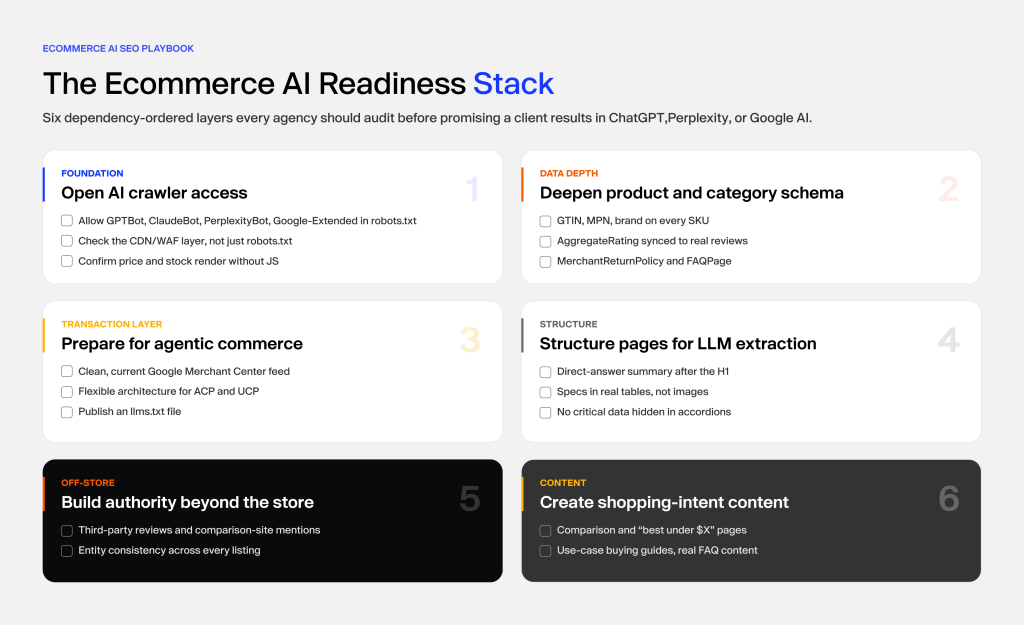
For agencies, that means six things: open AI crawler access, deepen product/category schema, prepare for agentic checkout (ACP, UCP, merchant feeds), restructure pages for machine extraction, build off-store authority and reviews, and publish shopping-intent content.
Below is the full breakdown, an audit you can run on any client store this week, and how to deliver it profitably without hiring a new specialist team.
If you’d rather have it delivered for you, Section 8 below covers the why white-label ecommerce AI SEO service E2M runs for agencies solving exactly this problem today.
1. What Is Ecommerce AI SEO?
Ecommerce AI SEO is the practice of shaping an online store’s product data, category pages, technical infrastructure, and off-site reputation so that large language models (LLMs) and AI-powered shopping surfaces can find it, represent it correctly, and ultimately recommend or transact with it. Think of it as generative engine optimization (GEO) built for product entities instead of general content: same discipline, sharper target.
That’s a different job entirely from “AI SEO” for a services business or a media site. A B2B software company mostly needs its content cited. An ecommerce store needs its product data cited, priced correctly, in stock, and, increasingly, checkout-ready inside the AI surface itself. The unit of optimization shifts from the page to the SKU.
Three shopping surfaces now sit between your client’s store and the buyer:
- AI Overviews and AI Mode inside Google Search, which pull from indexed pages, Merchant Center feeds, and structured data
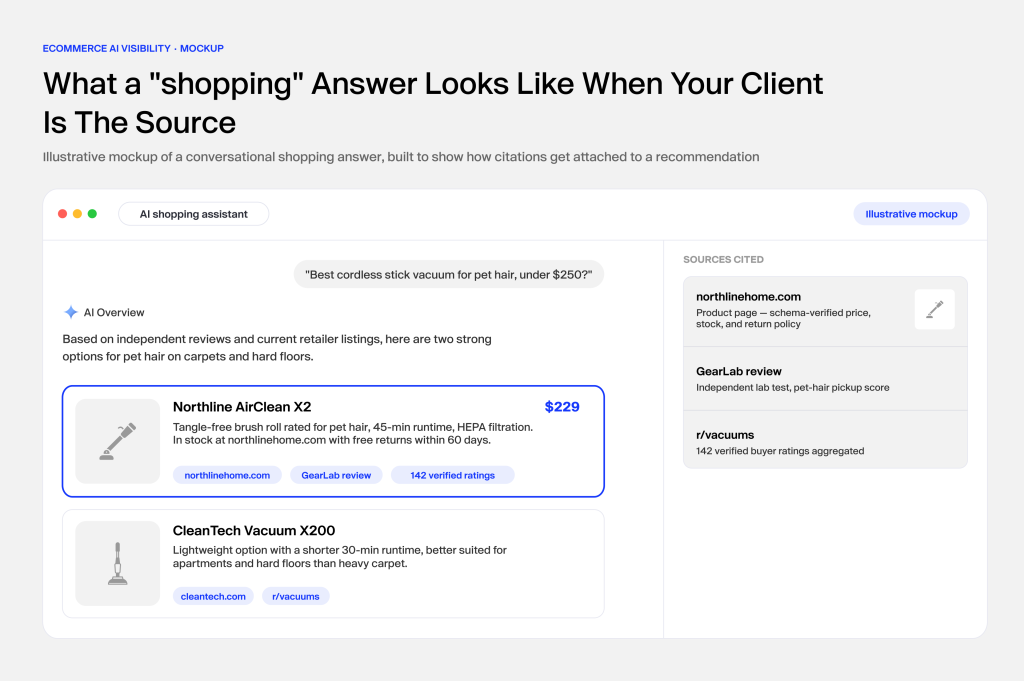
- Conversational assistants (ChatGPT, Perplexity, Gemini, Claude), which answer product questions directly and, in some cases, complete a purchase without ever sending the shopper to the store
- Agentic shopping flows: autonomous or semi-autonomous AI shopping agents that browse, compare, and check out on a buyer’s behalf using protocols like OpenAI’s Agentic Commerce Protocol (ACP) and Google’s Universal Commerce Protocol (UCP)
Get the AI SEO playbook agencies are using to modernize delivery and protect margins
If a client’s store isn’t legible to all three, it’s invisible for a growing share of purchase-intent queries, regardless of how well it ranks in classic blue links. For an agency owner, that’s the whole problem in one sentence: your ecommerce client has an AI visibility problem, whether or not they know to call it that yet, and the six layers in Section 4 are how you fix it.
Related read: For the technical AI SEO fundamentals that apply to any client site (crawler access, index parity, entity consistency), see our Technical AI SEO Blueprint for Agencies. This guide builds on that foundation and goes deep on what’s unique to product catalogs and checkout flows.
2. How Ecommerce AI SEO Differs From Traditional Ecommerce SEO
Traditional ecommerce SEO chases rankings and click-throughs.
Ecommerce AI SEO chases extraction and action: an LLM has to be able to lift a fact (price, availability, return window, fit) out of a page and use it in an answer, or hand it to an agent that completes a purchase.
| Dimension | Traditional Ecommerce SEO | Ecommerce AI SEO |
|---|---|---|
| Primary goal | Rank the page, earn the click | Get the product cited, recommended, or purchased directly |
| Unit of optimization | Page / URL | SKU / product entity, synchronized across page, feed, and schema |
| Content format | Long-form copy, keyword density | Direct-answer blocks, tables, structured lists, FAQs |
| Technical signals | Core Web Vitals, crawlability for Googlebot | Same, plus AI crawler access (GPTBot, ClaudeBot, PerplexityBot), server-side rendering, feed freshness |
| Trust signals | Backlinks, domain authority | Reviews, editorial mentions, comparison-site citations, entity consistency across the web |
| Data infrastructure | Sitemap + basic Product schema | Deep Product/Offer/Review schema, GMC feed, llms.txt, agentic commerce readiness |
| KPIs | Rankings, organic sessions, ROAS | Share of AI citations, AI-referred sessions and conversions, checkout-agent completion rate |
| Content depth needed for AIO resilience | Broad, top-of-funnel | Mid/bottom-funnel comparison and buying-guide content (less disrupted by AI Overviews) |
The gap between the two Ecommerce AI SEO vs Traditional Ecommerce SEO is that Merchant feed data, schema, and on-page copy have to say the same thing. A mismatch between the price in Google Merchant Center and the price on the page is exactly the kind of inconsistency that erodes an LLM’s confidence in citing a source at all.
3. The Business Case: Why This Belongs on Every Ecommerce Client’s Roadmap Now
Digital Agency owners don’t need another “AI is changing everything” argument. They need numbers they can put in front of a client. Here’s what the current data shows:
- Roughly 44% of consumers now use AI-powered tools at some point in their product research
- AI-referred ecommerce traffic has grown at triple-digit rates year over year through early 2026, even as it remains a smaller slice of total traffic than organic search
- Shoppers who arrive via AI assistants convert at higher rates than average organic traffic, since they’ve already done their comparison-shopping inside the conversation before they click through
- AI Overviews now appear on roughly one in five Google searches, and the CTR drop for the #1 organic position is steep when one is present, which raises the stakes for also being the source AI cites, not just the page a human clicks
- Purchase-intent queries hold up better against AI Overview disruption than broad informational searches do, which is exactly the content agencies should prioritize first
None of this means classic SEO is going away. It means the scope of “ranking” has expanded to include a client’s visibility inside a conversation the client will never see happen.
Agencies that can show up in that conversation, and prove it, have a defensible new line item to sell alongside the SEO retainer they already have. If you want the category-agnostic version of this argument for non-ecommerce clients too, our Six-Position AI search Framework for getting clients cited in LLMs lays out the same opportunity for service businesses and local brands.
4. The Ecommerce AI Readiness Stack: 6 Layers Every Client Store Needs
Think of this as a dependency AI readiness stack, not a to-do list in random eCommerce task order. A store/website with good copy content but a robots.txt that blocks GPTBot is invisible regardless of how good layer 4 is.
Work top-down.
Layer 1: AI Crawler Access
Before anything else can work, the AI systems have to be able to reach the pages. Run this check on every client store before promising results on anything else.
What to check:
- robots.txt directives. Each AI company runs multiple, separately-named bots: allowing one does not allow the others. A common client mistake is blocking “ChatGPT” generically and assuming that covers everything.
| Company | Crawler(s) | Purpose |
|---|---|---|
| OpenAI | GPTBot, OAI-SearchBot, ChatGPT-User | Training, search indexing, live user fetch |
| Anthropic | ClaudeBot, Claude-SearchBot, Claude-User | Training, search indexing, live user fetch |
| Perplexity | PerplexityBot, Perplexity-User | Retrieval and live user fetch |
| Google-Extended | AI training/grounding for Gemini and AI Overviews |
The AI SEO training every agency needs as AI reshapes search
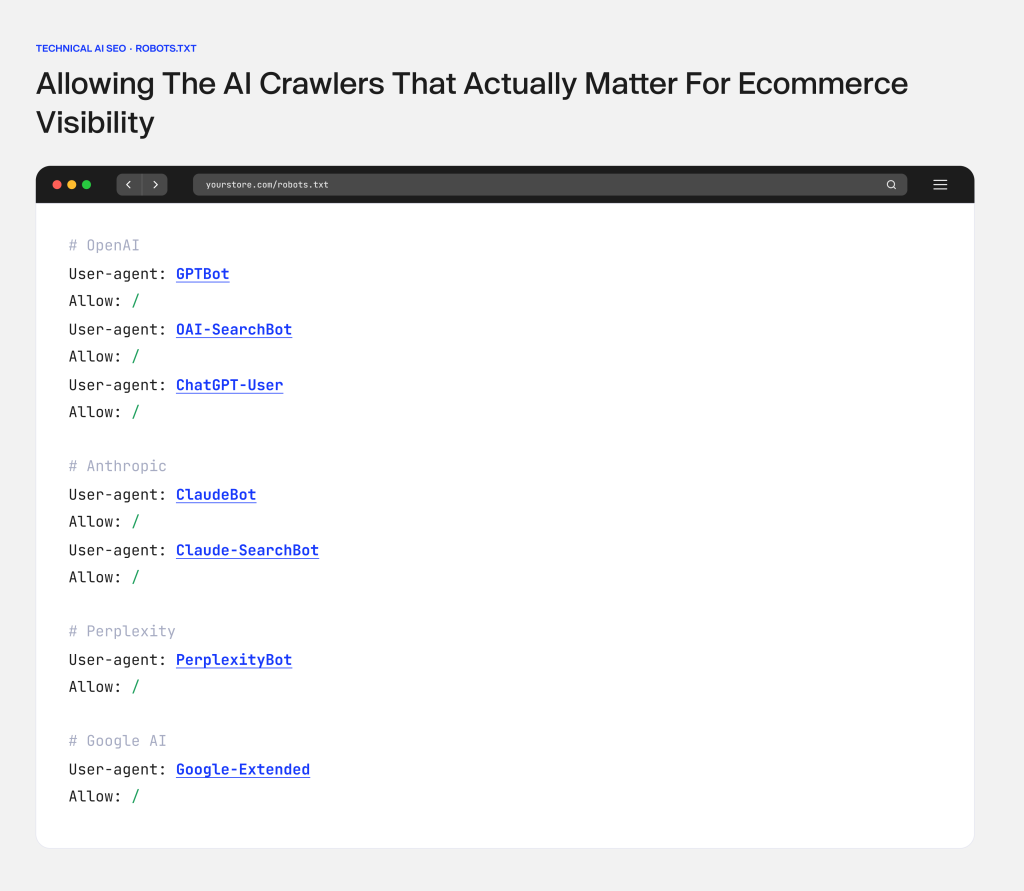
A minimal, permissive baseline looks like:
Agency Warning: Blocking Access by Accident. Many ecommerce platforms and CDNs (Cloudflare, Sucuri, Akamai) ship with bot-blocking rules turned on by default at the WAF/firewall level, completely separate from robots.txt. A client’s robots.txt can be wide open while their CDN silently 403s every AI crawler. Check both layers; a robots.txt audit alone is not a crawler-access audit.
- Server-side rendering. If pricing, availability, or specs only render after client-side JavaScript executes, some AI crawlers will see an empty shell. Confirm critical product data is present in the initial HTML response, not just the rendered DOM.
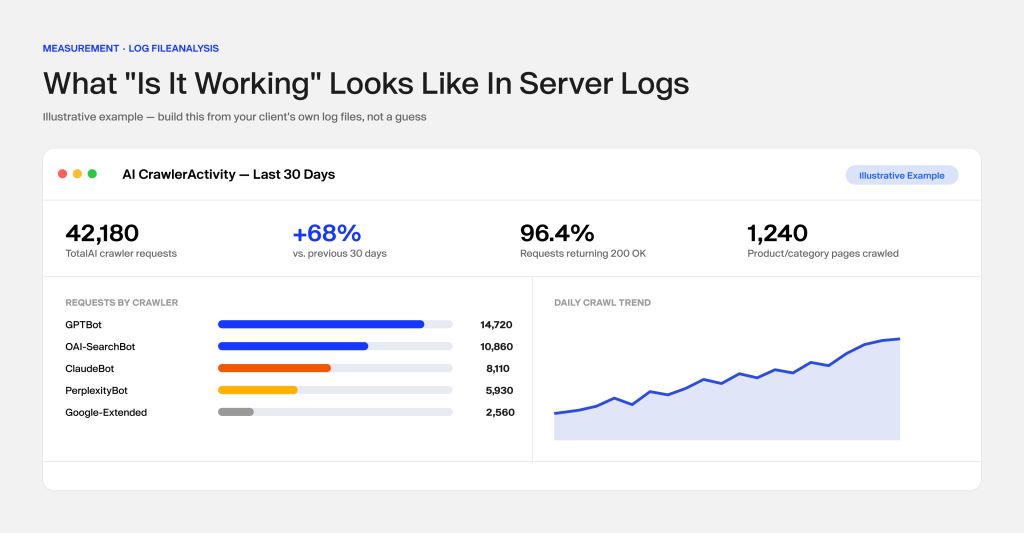
- Log file evidence. Don’t just check policy; check behavior. Download server logs (or use a tool like Screaming Frog’s Log File Analyser) and confirm GPTBot, ClaudeBot, and PerplexityBot are actually hitting product and category URLs, getting 200s, and not erroring out.
Layer 2: Deepen Product and Category Schema
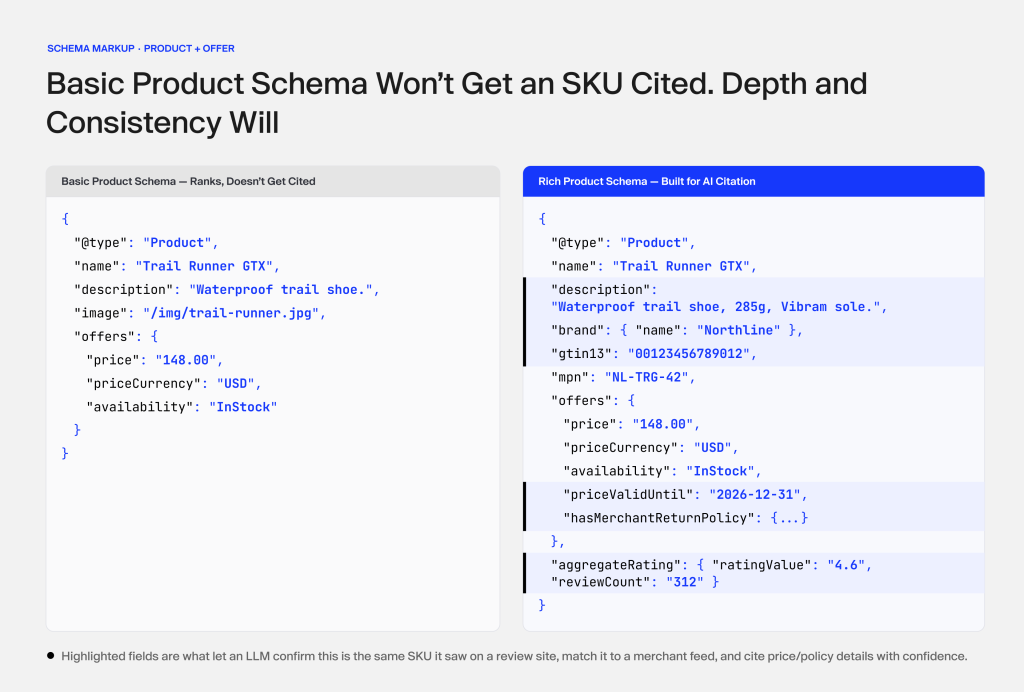
Basic store Product schema (name, price, image) is table stakes and won’t differentiate a client’s store. LLMs and AI shopping surfaces reward completeness and consistency of structured data far more than they reward any single tag being present.
Priority schema types for ecommerce, beyond the basics:
- Product + Offer: price, currency, availability (using the correct schema.org state: InStock, OutOfStock, PreOrder, LimitedAvailability), priceValidUntil
- GTIN / MPN / brand: the identifiers that let an LLM confidently match your client’s SKU to the same product referenced elsewhere on the web (a review site, a manufacturer page, a competitor). Without these, an AI system may simply be unable to confirm it’s looking at the same product a shopper asked about
- AggregateRating + Review: synced to the actual review count and score shown on the page, never inflated relative to what a human sees
- MerchantReturnPolicy: return window, fees, and method; increasingly used as a decision factor AI assistants surface directly
- FAQPage: for genuine product-level and policy-level Q&A, not filler
- BreadcrumbList: reinforces category hierarchy and helps an LLM understand where a SKU sits in the catalog
- VideoObject: for product demos, which AI shopping surfaces are beginning to reference in multimodal answers
The rule that matters most:
Every value in your schema has to match what a human sees on the rendered page, and match the merchant feed. If a page says “In Stock” but the feed says otherwise, don’t be surprised when an AI assistant either declines to cite it or gets it visibly wrong in front of a customer.
If a client’s schema implementation predates 2024, treat this as a rebuild, not a patch.
Our Comprehensive Guide to Schema Markup for E-Commerce covers implementation mechanics. Product, Review, Article, and Video schema in more depth if your team needs a refresher before starting.
Layer 3: Prepare for Agentic Commerce
This is the transaction layer most agencies are still ignoring. It’s the one that will separate “did AI SEO” from “actually ready for how shopping works in 2026 and beyond.”
What’s actually happening right now:
- OpenAI’s Agentic Commerce Protocol (ACP) powers ChatGPT’s Instant Checkout. It lets ChatGPT discover products from a merchant’s product feed and complete a purchase inside the chat, using single-use, time-bound, amount-restricted payment tokens. The merchant remains the seller of record, responsible for fulfillment, refunds, and chargebacks exactly as they are today. If a client wants to go deep on ChatGPT specifically (feed formats, refresh cycles, the exact submission process). We cover that separately in How to Get Your Products Discoverable on ChatGPT, including the current scale of the opportunity.
- Google’s Universal Commerce Protocol (UCP) is Google’s answer, deployed across AI Mode, the Gemini app, and Google Shopping.
- Perplexity’s Merchant Program and Shopify’s agentic storefront work are extending similar capability to a broader base of independent stores.
See how your agency can leverage E2M to grow eCommerce AI SEO services
What agencies should actually do about it, in order:
- Get the product feed right first. Every one of these protocols reads from a merchant feed (Google Merchant Center being the most universal starting point). If a client’s feed has gaps, stale prices, or missing GTINs, none of the downstream agentic-commerce work can function. This is where most engagements should start.
- Don’t try to integrate every protocol simultaneously. Build a payment and feed architecture flexible enough to support more than one, and prioritize based on where the client’s actual customers are already searching (a DTC brand with a young audience should weight ChatGPT/Instant Checkout differently than a B2B supplier whose buyers live in Google).
- Publish an llms.txt file. This emerging convention gives AI systems a plain-language map of what a site sells, how its catalog is organized, and where its canonical product and policy pages live: a lightweight complement to schema, not a replacement for it.
- Treat this as infrastructure, not a campaign. Agentic commerce readiness is closer to a technical SEO project (feed hygiene, API access, payment integration) than a content project. Scope and price it that way.
The Client Question You’ll Get Asked: “Can ChatGPT actually buy from my store right now?” The honest answer in most cases is: not yet, unless the client is already integrated with Instant Checkout or a comparable program.
But the groundwork (feed quality, schema, GTINs) is exactly the work that also improves AI Overview and Perplexity visibility today.
Frame this as “get ready” work with immediate SEO payoff, not a bet on a future that hasn’t arrived.
Layer 4: Structure Product and Category Pages for LLM Extraction
An LLM building an answer is skimming for facts it can lift cleanly. Pages built for that job look different from pages built purely to persuade a human scrolling on a phone.
What to fix, in priority order:
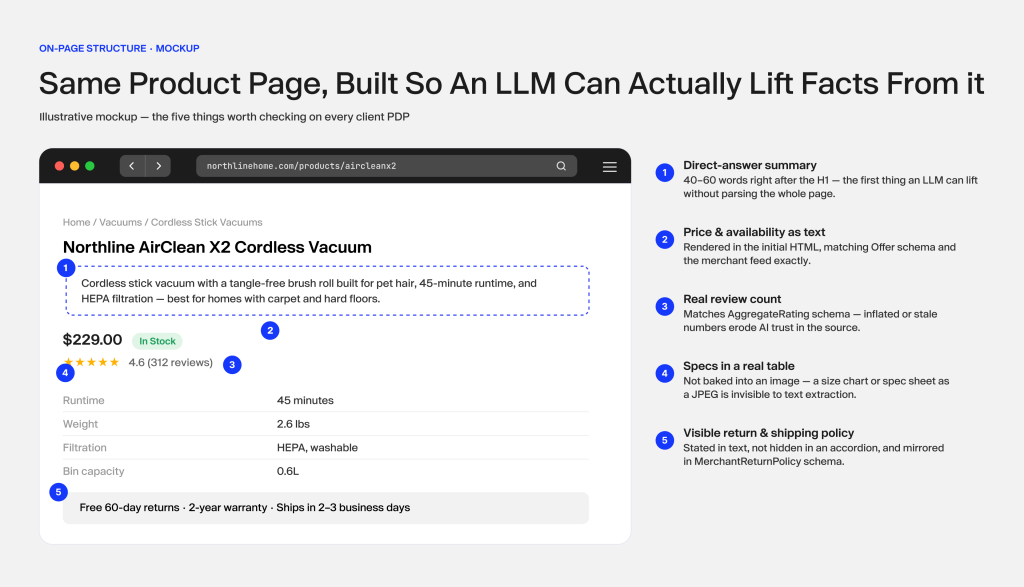
- Put the direct answer first. A 40 to 60 word summary immediately after the H1 (what the product is, who it’s for, the price band) gives an LLM something extractable before it has to parse the rest of the page.
- Move specs out of images. Size charts, ingredient lists, and comparison specs baked into a JPEG are invisible to text-based extraction. Rebuild them as real HTML tables.
- Use semantic HTML, not div soup. Headings, lists, and tables that follow document structure (not just visual styling) are dramatically easier for an LLM to parse correctly.
- Treat accessibility compliance as a free AI SEO win. Descriptive alt text, proper heading order, and ARIA labels exist to help screen readers parse a page, and they help an LLM parse the same page for the same reason. If a client already has an accessibility remediation project underway, that work directly improves ecommerce AI SEO too; it doesn’t need to be sold as a separate line item.
- Write FAQs around the questions buyers actually ask, not the questions marketing wants to answer. Pull real phrasing from support tickets and product-question widgets rather than guessing. Our guide on getting the best product page content for an ecommerce website covers the copywriting side of this in more depth.
- Don’t hide critical content behind tabs, accordions, or infinite-scroll without also making it available in the initial page load: the “index parity” problem, where what a human sees after interacting doesn’t match what a crawler sees on first load.
| Before | After |
|---|---|
| Specs shown only in a size-chart image | Specs in a real <table>, plus alt text on the image |
| “Learn more” accordion hides shipping/returns info | Shipping and returns policy in visible text with matching schema |
| Generic meta description | Meta description that states category, key differentiator, and price band |
| Reviews rendered client-side via JS widget after scroll | Reviews server-rendered or pre-rendered in initial HTML |
Layer 5: Build Authority Beyond the Store Itself
LLMs weigh third-party corroboration heavily. A claim the store makes about itself is worth less than the same claim appearing on an independent review site, a “best of” roundup, or an editorial mention. This is the layer most ecommerce clients underinvest in because it doesn’t feel like “their” website.
Where to focus:
- Third-party review platforms relevant to the client’s category (not just on-site reviews)
- “Best of” and comparison content on other sites: digital PR and outreach specifically aimed at getting the product included in third-party buying guides
- Entity consistency: the same product name, category, and key claims stated identically everywhere the brand appears online. Inconsistent descriptions across the client’s own site, its Amazon listing, and its Google Business Profile actively work against AI confidence
- Editorial and press mentions, pursued the same way a digital PR team would pursue backlinks, because functionally, that’s what these citations are
Layer 6: Create Shopping-Intent Content Clusters
Broad, top-of-funnel informational content is the most exposed to AI Overview cannibalization. Purchase-intent content is comparatively protected, and it’s exactly the content an LLM needs when a shopper asks it to compare or recommend.
Content types to prioritize:
- Product-vs-product comparison pages (“[Product A] vs. [Product B]: Which Should You Buy”)
- Budget-tier roundups (“Best [category] Under $150”)
- Use-case-specific buying guides (“Best [category] for [specific need]”)
- Genuinely useful, non-templated FAQ content tied to real purchase objections (fit, durability, compatibility, return experience)
5. eCommerce AI Search Auditing a Client Store in Under an Hour: A Quick Diagnostic
Run through this before scoping any ecommerce AI SEO engagement. It won’t replace a full audit, but it will tell you in under an hour whether a client’s biggest problem is crawler access, schema, content structure, or reputation, which changes everything about how you price and sequence the work.
PROMPT BLOCK: copy/paste into ChatGPT, Perplexity, and Gemini to spot-check real-world visibility:
Act as a shopper. I'm looking for [product category] under [$ budget] for [specific use case]. Recommend 3–5 options with brief reasoning, and tell me where I could buy each one.Run it three times, once per platform, and note whether the client’s product appears at all, whether the price/availability stated is correct, and whether the store is named as a place to buy, not just the product.
Then check, in this order:
- robots.txt: are GPTBot, ClaudeBot, PerplexityBot, and Google-Extended all explicitly allowed?
- CDN/WAF bot rules: is the platform (Cloudflare, Sucuri, etc.) silently blocking what robots.txt allows?
- Rich Results Test on 3 representative product pages: does Product/Offer/Review schema validate cleanly?
- Feed vs. page vs. schema: do price and availability match in all three places, right now?
- Are specs, size charts, and shipping/return info present as real text, or trapped in images/behind accordions?
- Search the brand + product name on a review aggregator and one comparison site: does independent, matching corroboration exist?
Whichever of these six fails first tells you where to start the engagement, and gives you a concrete, screenshot-able finding to open the client conversation with.
See how this could work for your agency
6. Measuring and Reporting AI Visibility to Ecommerce Clients
Clients will ask “is this working” long before organic AI-referred revenue is large enough to show up cleanly in standard analytics. Set expectations and reporting cadence up front.
What to actually track:
- Citation/mention rate: how often the brand or specific SKUs appear when you run representative prompts across ChatGPT, Perplexity, and Gemini (manually at first; tools like Semrush’s AI Visibility Toolkit, Ahrefs Brand Radar, or similar platforms automate this at scale)
- AI-referred sessions and conversions: segment chatgpt.com, perplexity.ai, and similar referrers in GA4; these are still a small slice of total traffic for most stores, but the conversion rate on this segment is usually the more interesting number early on
- Crawler activity in server logs: rising, consistent hits from GPTBot/ClaudeBot/PerplexityBot on product pages is a leading indicator that precedes citation growth
- Feed health: error and disapproval rates in Google Merchant Center, which affect both AI Overviews and Shopping visibility simultaneously
Report this the same way you’d report early-stage SEO: leading indicators (crawler activity, feed health, schema coverage) monthly, and lagging indicators (citation rate, AI-referred revenue) quarterly, so the client isn’t judging a multi-month infrastructure project against a single month of traffic data.
7. Common Mistakes Agencies Make Getting Ecommerce Stores Visible in LLM
- Treating it as a content-only project. Copy improvements without fixing crawler access or feed accuracy produce nothing measurable.
- Allowing one AI crawler and assuming the rest are covered. Each bot needs its own explicit robots.txt line; there is no wildcard shortcut across companies.
- Letting schema drift from the live page. Schema is graded on accuracy, not presence. Stale schema is worse than no schema, because it actively teaches the AI system to distrust the source.
- Ignoring the CDN/WAF layer. A clean robots.txt means nothing if the firewall in front of it is blocking the same bots.
- Chasing agentic commerce integration before feed hygiene is solved. ACP, UCP, and llms.txt all depend on accurate underlying product data; sequencing this backwards wastes budget.
- Measuring success only in classic rankings. A store can hold its organic positions and still be losing the AI-assisted share of its category if competitors are being cited and it isn’t.
8. Why Agencies Are White-Labeling Ecommerce AI SEO Instead of Building In-House
Everything above is real, billable scope, and none of it is a weekend project. Crawler audits, schema rebuilds, feed hygiene, agentic-commerce prep, and content clusters each require a slightly different skill set, and most agency SEO teams were staffed for classic ecommerce SEO, not this.
The agencies moving fastest on this aren’t necessarily hiring a dedicated AI SEO specialist. Many are white-labeling the execution (technical audits, schema implementation, GEO content, and reporting) while keeping the client relationship and strategy in-house. That’s exactly the white label ecommerce AI SEO service model agencies lean on us for.
That’s the model E2M runs for 400+ agencies today: a dedicated, invisible-to-the-client team that handles the ecommerce SEO and AI/GEO execution, delivered under your agency’s brand, with no long-term contract and onboarding measured in days, not months.
Whether you’re looking for a white-label ecommerce SEO agency to quietly staff the execution, ecommerce SEO consultants for a single client engagement, or a full white-label ecommerce SEO agency to sit behind your brand permanently, it’s the same team and the same delivery model.
If ecommerce clients are also asking about AI agents for their own operations (inventory, customer service, merchandising) rather than just AI search visibility, our related guide on AI Agents for eCommerce Agencies covers that adjacent opportunity.
9. FAQ: Ecommerce AI SEO for Agency Owners
Ecommerce AI SEO is the practice of shaping an online store’s product data, technical infrastructure, and off-site reputation so that AI systems like ChatGPT, Perplexity, Gemini, and Google AI Overviews can find, accurately represent, and recommend its products, and, increasingly, complete a purchase through agentic checkout protocols.
Run the six-layer AI search eCommerce audit in Section 5 before writing a single word of content. Most ecommerce stores fail on crawler access or schema long before they fail on content quality, so a few hours of technical diagnosis tells you more than a content brief would. Once you know which of the six layers is weakest, scope and price around that layer first rather than trying to fix all six at once. If you’d rather have this run for you than run it yourself, that’s the exact AI ecommerce SEO service E2M delivers white-label for agencies.
Three things have to be true, in this order. First, the AI has to actually be able to reach the page (its crawlers aren’t blocked by robots.txt or the site’s firewall). Second, once it’s there, the product details have to be accurate and consistent everywhere the AI looks (the page, the schema markup, and the merchant feed all have to say the same price, stock status, and specs). Third, the same claims need to show up on independent sites too, like reviews or comparison articles, so the AI has more than just the store’s own word for it. Most stores that never show up in AI answers are failing on the very first one and don’t realize it.
GEO is the broader discipline of preparing any content for generative AI systems. Ecommerce AI SEO is GEO applied specifically to product catalogs: it adds product schema depth, merchant feed accuracy, GTIN/MPN identifiers, and agentic commerce readiness on top of the content and authority work that GEO covers for any business.
Yes: GPTBot, ClaudeBot, PerplexityBot, and Google-Extended (among others) actively crawl ecommerce sites, provided robots.txt and the CDN/WAF layer both allow it. Server log analysis is the most reliable way to confirm this for a specific client, rather than assuming policy settings reflect actual behavior.
More directly than most agencies realize. Descriptive alt text, correct heading hierarchy, and ARIA labels exist to help screen readers parse a page, and an LLM parsing that same page benefits from the same structure. If a client is already funding accessibility remediation for ADA or WCAG compliance, that work should count toward the ecommerce AI SEO foundation rather than getting scoped as a separate line item.
Be cautious of any agency selling “AI-powered link building” as a standalone ecommerce AI SEO service. Building authority beyond the store’s own site matters, but for ecommerce it’s built through genuine third-party reviews, comparison-site inclusion, and editorial mentions, not volume link placement. Look for a partner that treats link building as one part of a six-layer technical and content program rather than the whole program; that’s how E2M builds it into white-label ecommerce SEO and GEO delivery instead of selling links in isolation.
There’s no single “best,”; there’s a best fit for how technical a store’s problems are versus how much content and authority work it needs. If you’re an ecommerce brand evaluating agencies directly, ask each one to run the Section 5 audit on your store during the sales conversation; the ones that can show you your crawler-access and schema gaps on the spot, live, are the ones doing this work. If you’re an agency getting asked this question by your own clients, E2M’s white-label ecommerce AI SEO and GEO services are built to be that answer, delivered under your brand rather than ours.
Yes, though most agencies that call themselves “full-service” for classic ecommerce SEO haven’t yet built out the AI-search-specific layers (agentic commerce readiness, AI crawler monitoring, GEO content) covered in this guide. E2M runs both sides, classic ecommerce SEO and the newer AI and GEO layer, as a single white-label engagement, which is what “full-service” should mean going into 2026.
The audit in Section 5 (robots.txt, CDN/WAF rules, schema validation, feed accuracy) is the core of it, and it isn’t region-specific; the same crawler-access and schema checks apply whether the store and its agency are based in the UK, the US, or anywhere else. E2M runs this audit for agencies globally, including UK-based teams, as part of its white-label ecommerce SEO and GEO services.
Prioritize tools that verify claims against the live site (crawler-access checks, schema validation, citation tracking) over tools that just generate content, since generated content isn’t the bottleneck for most stores. If you’re deciding whether to build this in-house or bring in an white label ecommerce AI SEO agency to execute it white-label, the honest test is capacity: can your current team run a technical audit, rebuild schema, and monitor AI citations across every client store this quarter, on top of what they’re already doing? If not, that’s the gap a white-label partner is built to fill.
Bottom Line for Agency Owners
Every ecommerce client on your books has some version of the same problem right now: an AI visibility problem, whether they’ve noticed it yet or not.
Shoppers are already asking ChatGPT, Perplexity, and Google AI to find and compare products for them, and a store that isn’t crawlable, schema-complete, and corroborated off-site doesn’t exist in that conversation. The six-layer audit in this guide is how you find out how bad it is for a given client in under an hour, and how you scope the fix once you know.
Running that fix in-house, at scale, across every ecommerce client is the hard part. That’s the exact gap E2M’s white-label ecommerce AI SEO service is built to close: your agency owns the client relationship and the win, we run the crawler audits, schema rebuilds, agentic-commerce prep, and GEO content behind the scenes.