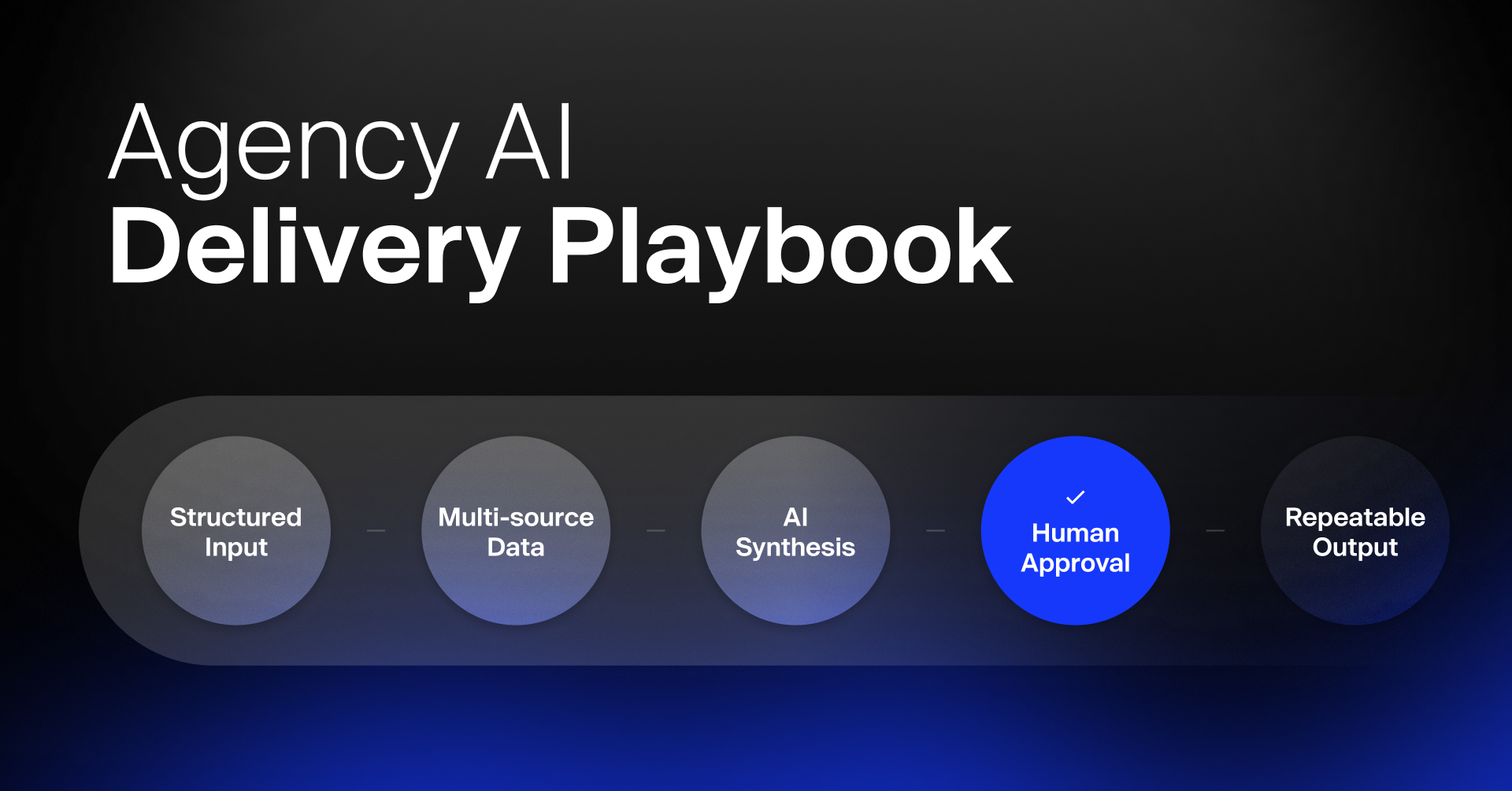
TL;DR
88% percent of organizations are now using AI somewhere in their operations.
Most agencies think AI adoption means using more tools. It doesn’t.
The agencies creating meaningful gains from AI are redesigning how delivery works.
This shift is happening right now across digital agencies: human-heavy execution models are moving to AI-enabled operating systems where workflows are structured, repetitive work is automated, and humans move toward judgment, QA, and strategic oversight.
At E2M, we’ve spent the last two years rebuilding parts of our internal delivery model across WordPress, SEO, onboarding, QA, and operational workflows.
Some experiments failed. Some created marginal gains. A few fundamentally changed how work gets delivered.
This article expands on my keynote from the Vistara AI Event 2026 and breaks down:
- The three phases of agency AI adoption
- Why most AI projects fail
- The operational framework behind workflows that actually work
- Real examples from inside E2M
- How agencies should think about AI over the next 24 months
By the end, you’ll know exactly where your digital agency sits, which AI workflow to rebuild first, and what the next 60 days should look like.
The Meeting Most Agency Owners Are Having Right Now
You sat through it last quarter. Maybe last month. The leadership team has a slide showing margin trending in the wrong direction. Someone on the ops side has been quietly using ChatGPT, Claude, and three different Figma plugins.
Your senior people are tired. Your junior people are anxious. A client asked last week whether you were “using AI for this.”
You’ve already tried things. You ran an AI workshop. You added some Zapier flows. Maybe you brought in a fractional consultant for a month. Some of it stuck. Most of it didn’t move the number you actually care about, the one on the margin slide.
You’re not alone in this. According to McKinsey’s State of Organizations 2026 report, 88% of organizations are now deploying AI in some part of their operations, but roughly the same percentage report no significant bottom-line impact. That’s the gap. And it’s not a tooling problem.
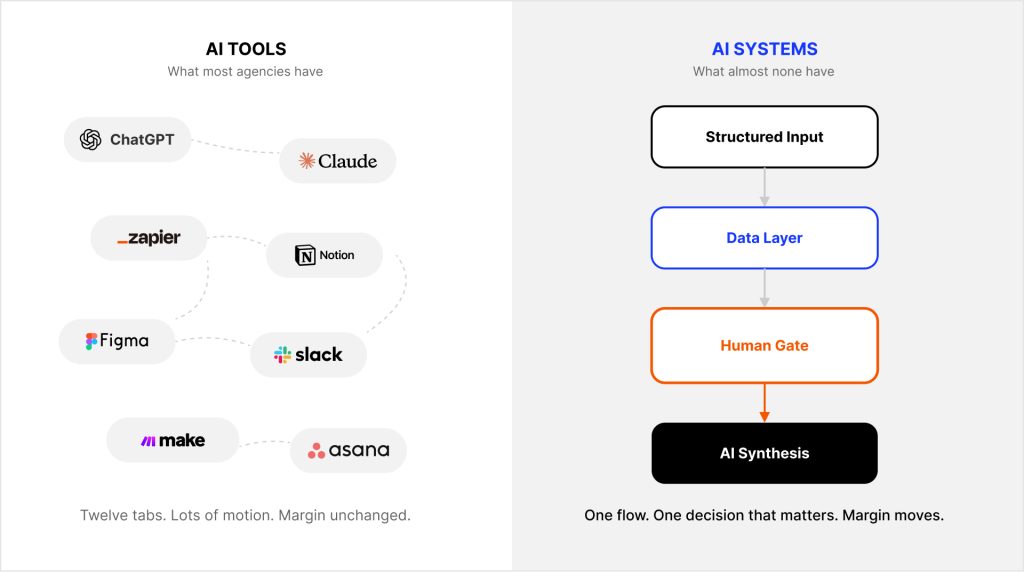
Here’s what almost no one will tell you directly: the problem isn’t that you don’t have AI.
The problem is that you have AI tools instead of AI systems. The first one makes existing work slightly faster. The second one rebuilds how work gets done, and only the second one changes the margin slide.
At E2M, we learned this the hard way.
“We had AI tools. But not AI systems.”
This article details what we presented at the Vistara 2026, the in-person AI event. E2M host for digital agency leaders.
It’s written for the agency owner running 15 to 40 people, managing client volume, and trying to figure out what to actually change in the next two quarters.
How Are Digital Agencies Actually Using AI in 2026?
Most agencies are operating in one of three phases. The phase determines the result.
We’ve worked with or studied delivery models at 1,100+ agency partners across the US, Canada, UK, Ireland, and Australia. The pattern is consistent enough that we mapped it as three phases on the Vistara AI Event. 2026 mainstage.
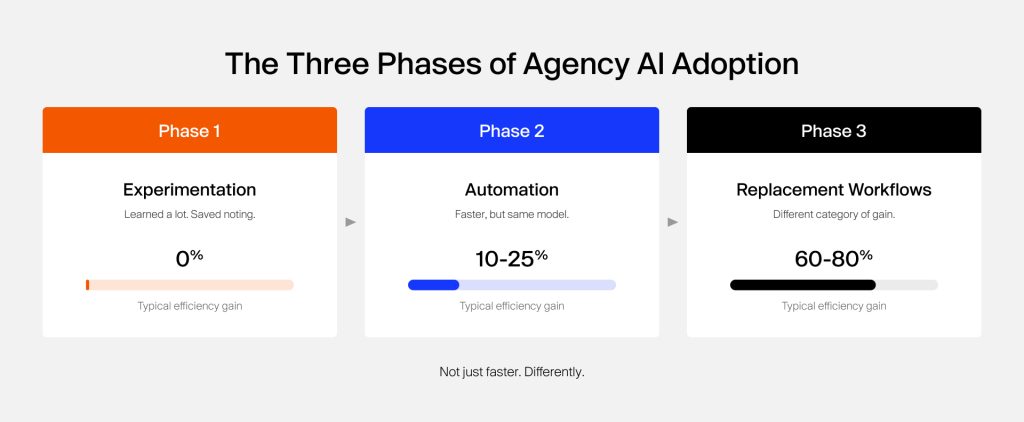
The Three Phases of Agency AI Adoption
Over the last two years, we’ve seen most agencies move through three distinct phases.
Phase 1: AI Experimentation (Two Years Ago)
This is where almost everyone started. Teams began using:
- ChatGPT
- Claude
- GPTs
- Perplexity
- Midjourney
- AI plugins
- Prompt libraries
The result? Learning increased dramatically. Productivity barely moved. People spent time testing prompts, comparing outputs, rewriting inconsistent drafts, and figuring out which tools worked best. Useful for learning. Not transformational for operations.
Result: learned a lot, saved nothing.
Phase 2: AI Automation (Last Year)
This is where many agencies sit today. Tools became connected:
- Zapier
- Make.com
- n8n
- Custom GPTs
- Reporting automations
- AI-generated briefs
- Workflow triggers
This phase creates real gains. Most agencies see faster execution, reduced repetitive work, and fewer manual steps. But there’s a catch. The underlying delivery model remains the same. Humans still drive the process. AI simply accelerates parts of it.
Result: faster, but same model.
Phase 3: AI Replacement Workflows (Now, 2026)
This is where things become operationally different. Instead of adding AI into existing workflows, the workflow itself gets redesigned from scratch.
What we refer to as “The Agentic Agency” begins to take shape, a model where structured systems, custom AI agents, automation, Agentic AI workflows, and human expertise work together as a coordinated operating system.
Structured inputs replace scattered communication. Systems handle repetitive execution. Humans shift toward judgment, QA, approvals, strategy, and edge-case decisions.
The gains here are not incremental. They become structural. We’ve seen workflows move from weeks to days, thousands of manual tasks to automated systems, and inconsistent outputs to repeatable delivery.
Result: different categories of gain.
Most agencies in the $1M to $5M range are sitting in late Phase 1 or early Phase 2. A handful have one workflow in Phase 3. Almost none are operating in Phase 3 across multiple service lines. The agencies that get there first won’t just be more efficient. They’ll be operating a fundamentally different business model than the ones that don’t.
See exactly how this can work inside your agency (and for your clients)
 Book an AI Strategy Call
 Why Most Agency AI Projects Fail
Most AI projects fail before prompting even matters. The biggest issue is not the model.
It’s the workflow.
Agencies typically try to keep existing processes, add AI on top, and expect transformation. That rarely works because AI struggles inside messy operational systems.
Common failure patterns include:
- Inconsistent inputs
- Scattered communication
- Undefined approval processes
- No structured data flow
- Humans reviewing everything manually
- AI is making decisions where deterministic systems should exist
The result: inconsistent outputs, low trust, heavy QA overhead, and minimal margin improvement.
The lesson we learned internally was simple: AI won’t fit your old process. That forced us to redesign workflows from the ground up.
The 5-Part Framework Behind Every AI Workflow That Worked for Agencies
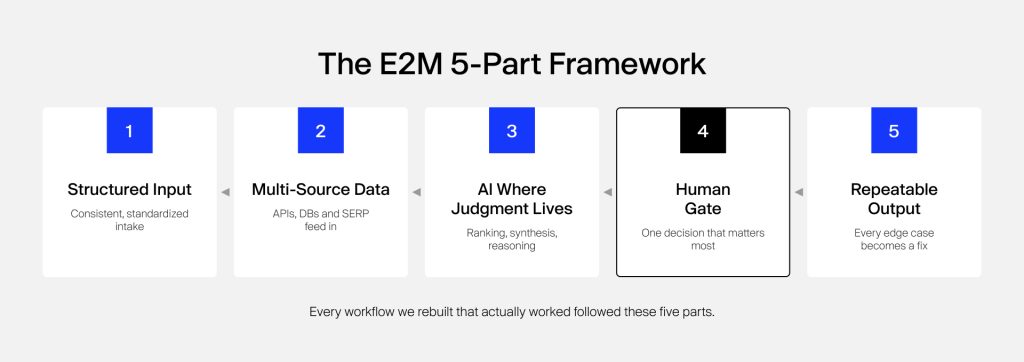
Across every successful AI workflow we rebuilt, the same structure appeared repeatedly.
1. Structured Input Layer (Standardized Intake)
AI engines perform optimally only when inputs are entirely uniform and predictable. An efficient workflow cannot begin with unstructured client assets or scattered communication.
Instead, the architectural foundation requires standardized intake forms, template libraries, and strictly defined data structures to prevent messy inputs from breaking the system.
2. Multi-Source Data Layer (Deterministic Programmatic Integration)
An advanced AI workflow does not rely on an LLM to collect raw information. The system must programmatically ingest data from external APIs, live databases, SERP data trackers, and internal platforms. Traditional, rule-based systems gather the information, while the AI is reserved solely to synthesize and prioritize it.
3. Cognitive AI Synthesis Layer (AI Where Judgment Lives)
Many digital agencies use AI in the wrong places. AI is best used for ranking, synthesis, pattern recognition, summarization, and contextual reasoning, not for deterministic execution, database logic, structured calculations, or repeatable rule systems.
One of the biggest workflow improvements came from asking: “Does this step require judgment or execution?” If it required execution, we automated it traditionally. If it required interpretation, AI became useful.
4. Human Approval Gate Layer (The High-Leverage Strategic Quality Gate)
One of the most valuable AI workflow discoveries is that humans should review the decision, not every task. Reviewing every AI output creates bottlenecks and removes much of the efficiency AI provides.
The goal is to place a single approval gate at the highest-leverage point in the workflow.
For example, an SEO strategist approves the final content roadmap after AI completes research and clustering, a content lead approves messaging after AI drafts content, a developer approves the final implementation before deployment, and an agency strategist validates client recommendations before delivery.
AI accelerates analysis and execution. Humans provide business context, risk assessment, and final judgment. One well-placed approval gate often delivers higher quality and faster outcomes than multiple review layers throughout the process.
5. Repeatable Output Layer (Operational Compounding)
Every successful AI workflow improves over time because edge cases become operational fixes.
Every failed output reveals missing structure, missing rules, unclear inputs, or process gaps. Over time, the workflow becomes stronger. That operational compounding matters more than prompting.
How Much Time Can AI Realistically Save an Agency?
The honest answer depends on the workflow.
Here are three actual examples from inside E2M, with the numbers attached.
Case Study 1: SEO Topic Research Automation, 600+ Hours Recovered Per Month
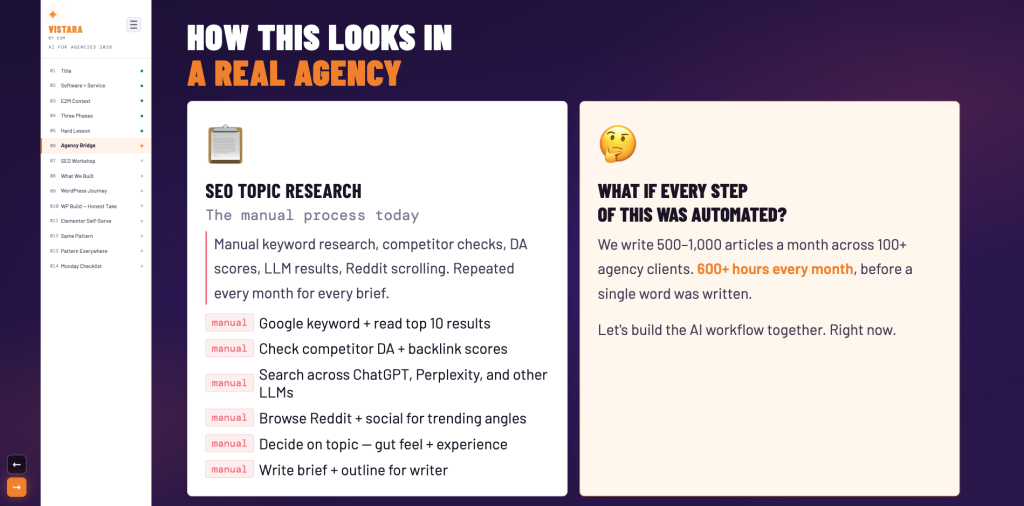
E2M’s white label content writing team supports 100+ agency partners and delivers 500–1,000 articles every month. Before we rebuilt the workflow, the team was spending 600+ hours per month on manual topic research, SERP analysis, and content brief writing.
Google keyword searches, competitor DA and backlink checks, scrolling Reddit for trending angles, cross-checking results across ChatGPT and Perplexity, writing the brief, before a single word of any article was written.
The Reengineered AI Workflow:
We built an automated AI system that ingests,
- Input: seed keyword (one consistent input, every time)
- Data layer: keyword and SERP data via API, social signals from Reddit and forums, competitor analysis pulled programmatically
- AI layer: synthesizes the data into a ranked shortlist of topic candidates, scored by opportunity
- Human gate: the writer selects the final topic from the shortlist
- Output: a structured brief generated automatically once the writer selects
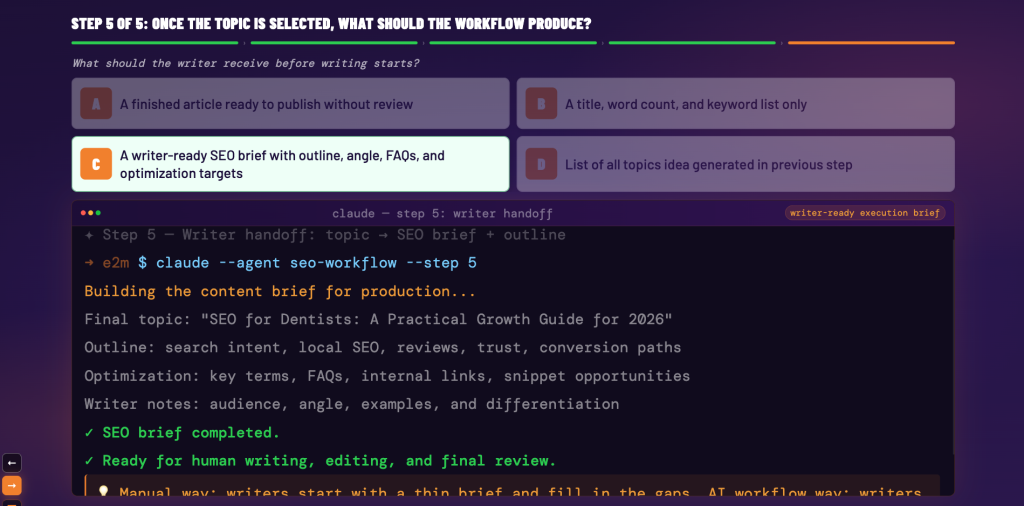
Result: Nearly 600+ Hours recovered per month. The writer’s time moves from research to writing, the higher-judgment work. Brief quality is more consistent because the inputs are standardized.
Case Study 2: Figma to WordPress AI Pipeline, 20% to 70% Automation
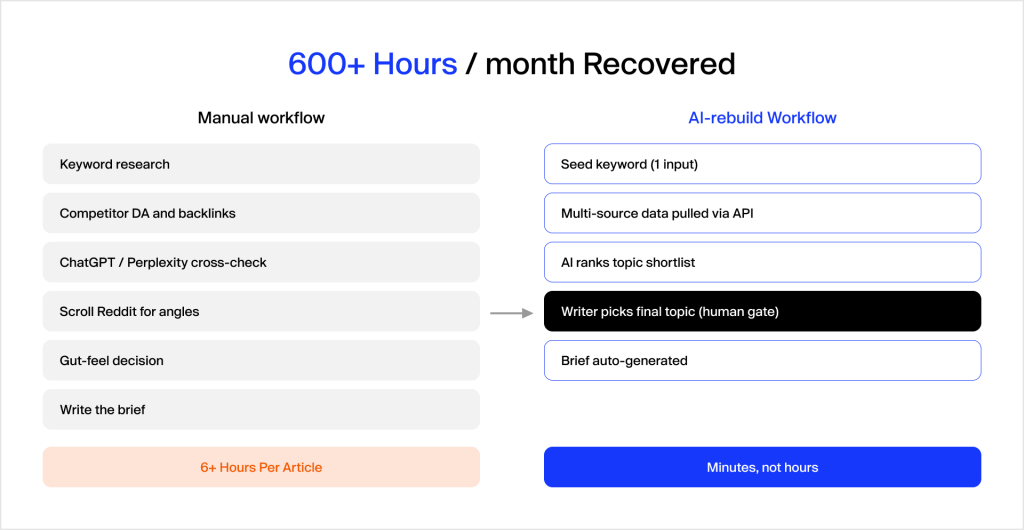
Across a team of 150+ White Label WordPress developers. For years, every client project followed the same flow: client sends a Figma file, PM reviews it, developer interprets it manually, estimates hours, and hand-codes from scratch.
Every site. Thousands of developer hours per month.
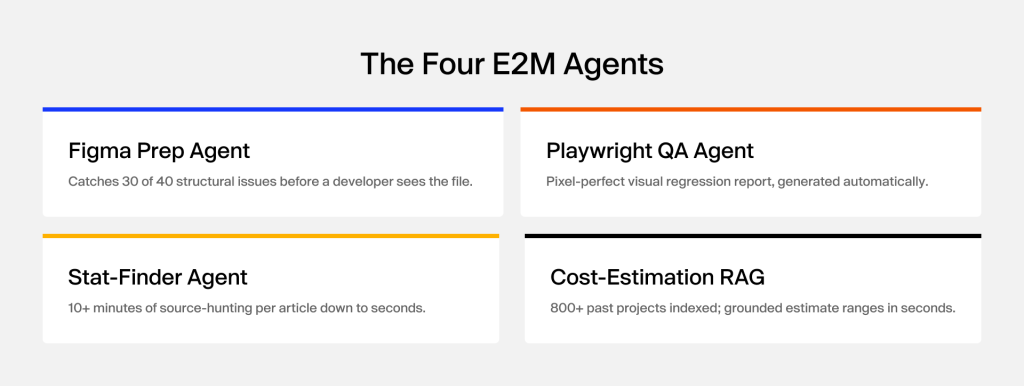
We reengineered a custom orchestration pipeline using Claude Code custom skills for Advanced Custom Fields (ACF) and Elementor, a specialized Figma Prep Agent to fix structural design issues, and a Playwright-based pixel-perfect QA agent that compares the live build against the original design.
See exactly how this can work inside your agency (and for your clients)
In active production, 50% to 60% of a standard WordPress build is fully automated by AI agents, crossing over 70% on streamlined builds.
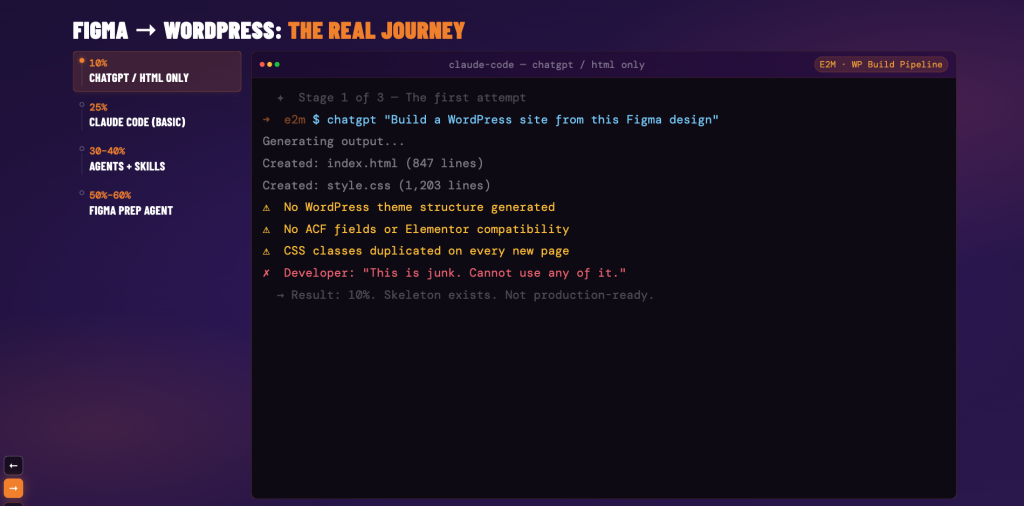
The numbers behind the AI Automation pipeline:
- The Figma prep agent catches 30 of 40 typical structural issues before a developer ever sees the file
- 5 to 6 hours of agent runtime saves 20+ hours of developer rework per site
- The Playwright QA agent generates an annotated visual regression report automatically; the QA team reviews findings instead of executing tests
“Volume matters. It isn’t required. We have the WordPress volume to justify it. Find your equivalent repeatable work.” Ronik Patel, Vistara AI Event 2026
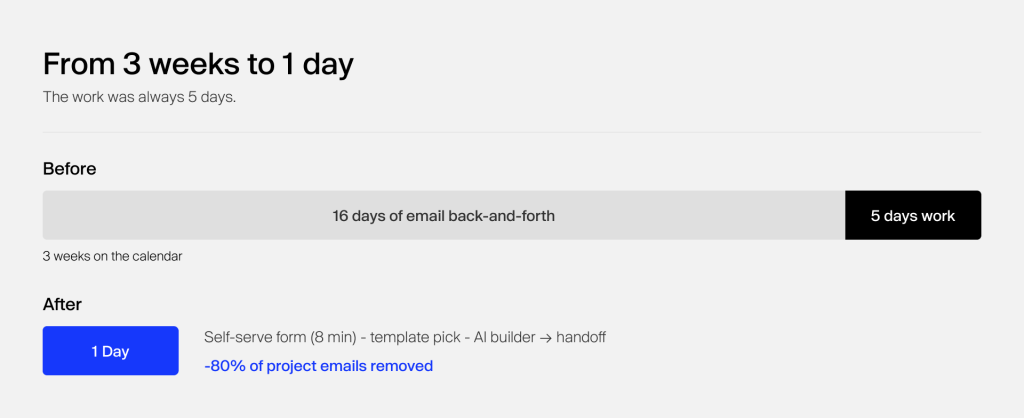
Case Study 3: Project Onboarding Automation, 3 Weeks to 1 Day
Every WordPress rebuild used to start with 2 to 3 weeks of back-and-forth before a developer wrote a single line of code. Should we keep the same logo? How many contact forms? What’s the homepage color direction? Plus eighteen more questions, asked one at a time, over email.
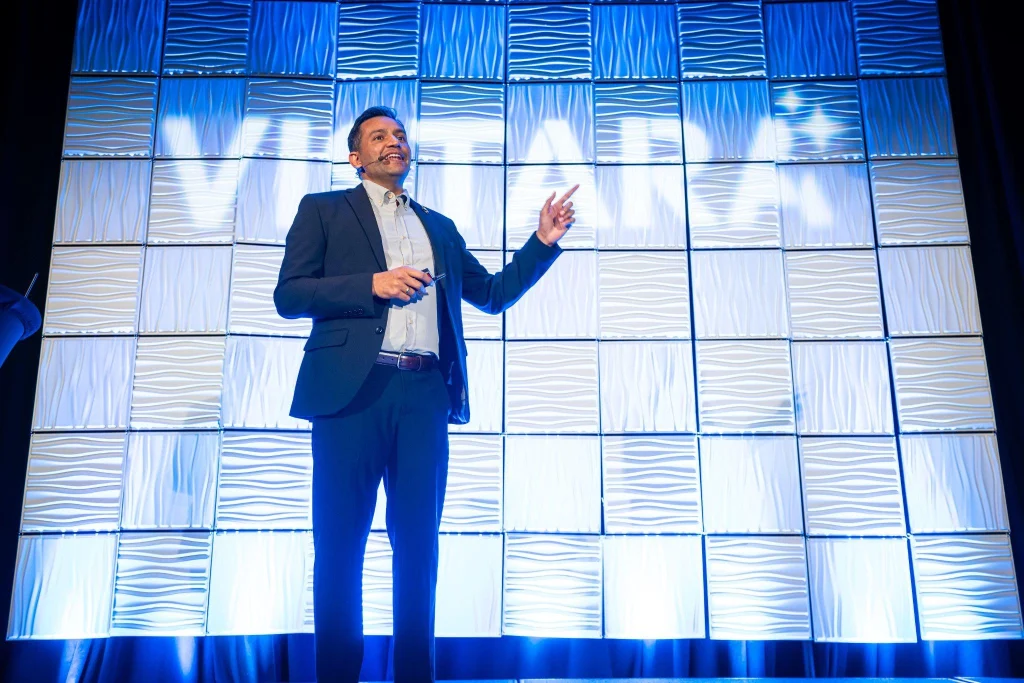
“The work was always 5 days. The project took 3 weeks. The 16 days in between were emails.” Ronik Patel, Vistara AI Event 2026
The reengineered onboarding workflow:
- Self-serve onboarding link sent at scoping, not three weeks later
- Four questions, about 8 minutes for the agency partner to complete
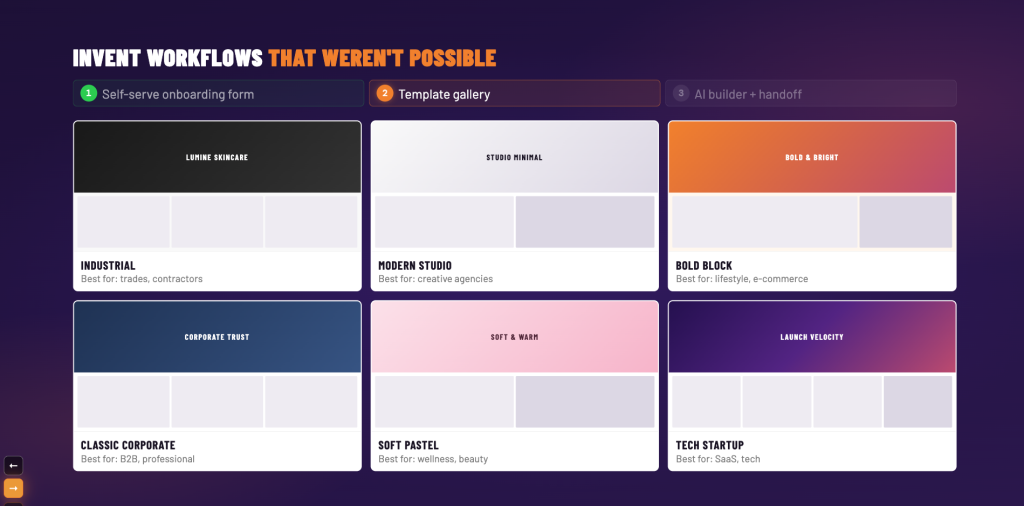
- Template gallery with six families: Industrial, Modern Studio, Bold Block, Classic Corporate, Soft Pastel, Tech Startup
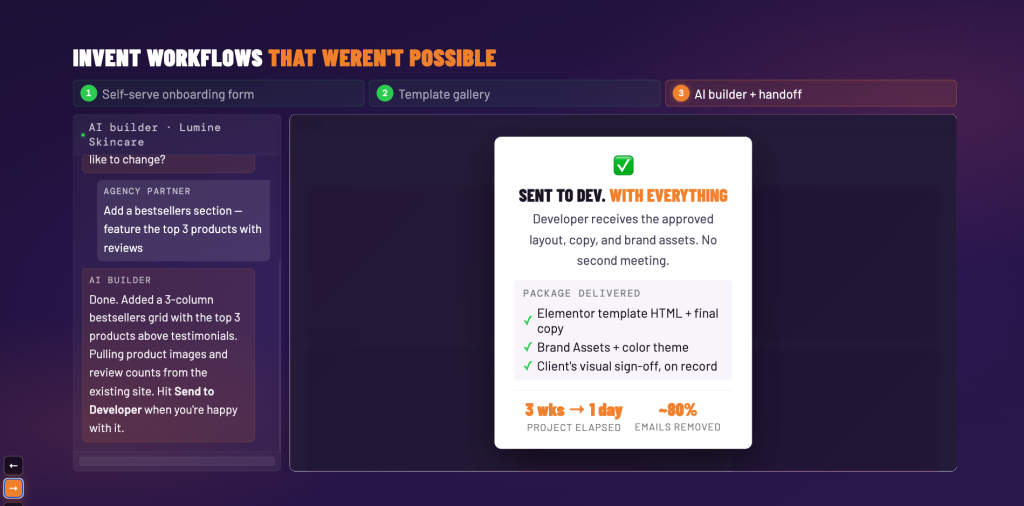
- AI builder populates the chosen template with the client’s existing content, updates brand colors automatically, and rewrites copy to match the new context
- Handoff package ships to the developer with the Elementor template HTML, final copy, brand assets, and the client’s visual sign-off on record
Result: 3 weeks to 1 day on the calendar. About 80% of project emails have been removed. The actual work is still 5 days. The 16 days of email-tag are gone.
Ready to transform your agency’s delivery model?
Book a Growth Call with E2M today to explore how our White Label AI Services can future-proof your business.
Which Agency Workflows Can Actually Be Automated with AI?
The pattern works across every service line. We’ve now rebuilt or are actively rebuilding workflows across:
WordPress
Figma-to-WordPress builds with ACF and Elementor. The same pipeline now applies to other WordPress page builders. And before rolling new builds or updates across a client portfolio, it’s worth reviewing what agencies should check before upgrading client sites to WordPress 7.0 “Armstrong”.
Webflow
Figma-to-Webflow conversion is structurally similar but less forgiving of messy input. Auto-layout frames become flexbox components, design tokens map to Webflow styles, and the prep step matters even more because Webflow expects a clean structure.
Agencies running Webflow as their primary stack are seeing 40 to 50% reductions in build time when the workflow is properly designed.
HighLevel
GoHighLevel’s API-first architecture makes it especially well-suited to AI-assisted delivery. Template-driven multi-location and franchise sites are the highest-leverage use case we’ve seen on the platform.
One template, intelligently customized per location, dozens of sites shipped in the time it used to take to ship one. Getting the underlying connections — WordPress, Shopify, Zapier, n8n right is what makes that repeatable; see the setup patterns behind those GHL integrations.
Shopify and WooCommerce
Storefront customization, product description generation at scale, review response, inventory anomaly detection, WISMO support, and abandoned cart recovery are all now production-ready in the agent territory.
Agencies are productizing these as recurring AI retainers: high-margin, no headcount added.
SEO and AI Search Optimization
Topic research is one workflow. Programmatic SEO, internal linking automation, schema generation, AI-overview optimization, and ongoing site audits are others.
PPC and Paid Media
Campaign launch, creative variant generation, anomaly detection, dashboard, budget pacing, and reporting. The high-judgment work (strategy, brand narrative, audience frameworks) stays human. Most of the rest doesn’t need to.
Content Production
Beyond topic research: outline generation, first-draft writing, statistic sourcing, internal linking, and final QA. Our internal stat-finder agent replaced 10+ minutes per article of credible source-hunting with a few seconds of agent runtime. Times 500 to 1,000 articles a month, that’s a category of work that essentially disappeared.
QA and Visual Regression
The Playwright-based pixel-perfect QA agent works on any platform where a design exists in one place, and a build exists in another: WordPress, Webflow, Duda, and Shopify.
Cost Estimation and Scoping
We indexed 800+ past projects in a RAG database. New project specs go in. Estimated cost ranges come back, grounded in actual delivery data from comparable work. Replaces hours of PM estimation per project, and the estimates are more consistent because they’re based on real history instead of intuition.
The point isn’t that you should automate all of these tomorrow. The point is that every category of agency delivery has at least one workflow that fits the framework, and that workflow is the right place to start.
Ready to transform your agency’s delivery model?
Book a Growth Call with E2M today to explore how our White Label AI Services can future-proof your business.
The E2M Playbook: Six Steps to Building Your Agentic Agency
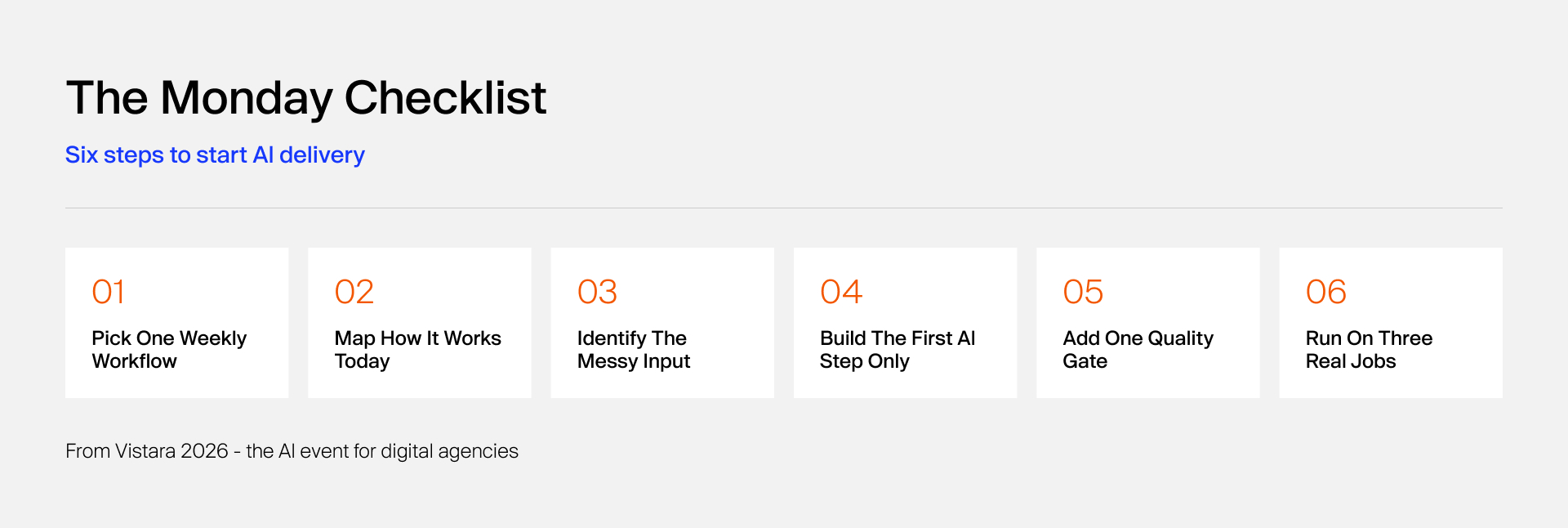
Transitioning to an AI-driven operating model doesn’t happen overnight. Pick one workflow. Map it. Identify the messy input. Build one AI step. Add one quality gate. Run it on three real jobs. That’s the entire on-ramp.
Step 1: Pick One Weekly Workflow
The most repeatable, highest-volume, most time-consuming work your team does. Not the most exciting. The boring, weekly work. That’s where the leverage is.
Step 2: Map How It Works Today
Step by step. Manually. Most agencies skip this. The map almost always reveals that the workflow you thought you had isn’t the one you actually have.
Step 3: Identify the Messy Input
Scattered files, inconsistent formats, “whatever the client sends.” That’s your first blocker. Until the input is structured, no amount of AI will help.
Step 4: Build the First AI Step Only
One step. Get it working. Then add the next. The temptation to design the whole pipeline end-to-end is exactly how AI projects fail. Ship small.
Step 5: Add One Quality Gate
Choose the one decision that matters most, and put a person on it. Everything else can be automated. The gate is where your agency’s expertise concentrates.
Step 6: Run on Three Real Jobs
Log what breaks. Not pilot data. Real client work. Real data reveals what prompts never will. Every breakage becomes a fix. After three jobs, you’ll know if you have a workflow or a science project.
“Real data reveals what prompts never will.” Ronik Patel, Vistara AI Event 2026
Join the Agency Growth HubGet the frameworks, playbooks, and systems used by scaling agencies. Pricing guides, workflow templates, sample SOPs, and the operational material we share with agency leaders moving through Phase 1, Phase 2, and Phase 3.
Partnering for the Future: White Label AI Solutions with E2M
Building these AI systems in-house requires significant technical expertise, time, and resources, luxuries many agencies don’t have. This is where E2M steps in as a strategic partner.
E2M offers comprehensive White Label AI Solutions designed specifically for digital agencies. Whether you need to automate your internal operations or want to offer cutting-edge AI services to your clients under your own brand, E2M provides the execution muscle.
Why Choose E2M for White Label AI Services?
Expertise at Scale
With over 50+ in-house AI specialists and a track record of delivering 100+ custom AI automations, E2M has the depth of experience to handle complex agentic workflows.
The Black Label Standard
E2M goes beyond typical white label services. Their “Black Label Standard” guarantees premium quality, proactive communication, and strategic thinking, ensuring your agency delivers exceptional value to clients.
Flexible Engagement
E2M offers month-to-month agreements with no long-term contracts, allowing you to scale your AI capabilities up or down as needed.
Comprehensive Support
From pre-sales strategy and custom app development to ongoing optimization and performance tracking, E2M acts as a seamless extension of your team.
By partnering with E2M, agencies can bypass the steep learning curve of AI implementation and immediately start reaping the benefits of an agentic operating model. You maintain full ownership of the client relationship and control your margins, while E2M handles the complex technical execution behind the scenes.
Conclusion: Embracing the Agentic Future
The insights shared at Vistara AI Event 2026 make one thing clear: the future of agency delivery is agentic.
Web and Digital Agencies that cling to the old model of scaling solely through headcount will find themselves outpaced by those who embrace AI systems and automated workflows.
The transition requires a fundamental shift in mindset, from using AI as a mere tool to redesigning processes where systems do the heavy lifting and humans provide strategic guidance.
By following the practical steps outlined in the E2M playbook and leveraging the expertise of a best white label service partner like E2M, your agency can navigate this transformation successfully, unlocking new levels of efficiency, scalability, and profitability.
If you want to talk through how an AI-enabled white label AI services partnership would work for your specific service mix, we’ll set up a 30-minute call with a senior partner, not a sales rep. No deck, no pitch. We’ll look at your delivery model honestly and tell you where the leverage is.
Ready to scale your agency’s Web, Marketing, and AI delivery?
Talk to an E2M growth partner, no pitch, no pressure, just a real conversation.
FAQs About Agency AI Delivery
An Agentic Agency is a digital agency operating model where structured systems, multi-source data layers, and autonomous AI agents automate repetitive delivery workflows while human professionals serve as strategic quality gates. Instead of using disconnected AI tools to speed up manual tasks, an agentic agency completely redesigns its workflows from scratch, allowing systems to manage execution and shifting human talent toward judgment, QA, and strategic oversight.
The primary difference lies in workflow integration: AI tools (such as ChatGPT, Claude, or Zapier) are used individually by team members to make existing manual tasks marginally faster, leaving the underlying execution model unchanged. Conversely, AI systems are end-to-end engineered workflows that combine structured inputs, automated data layers, and AI synthesis to replace entire categories of repetitive work, fundamentally altering agency profit margins.
With dedicated AI automations, workflows, and systems with the team, focus, 6 to 12 months for the first workflow. Faster after that, because the team learns how to design replacement workflows the second time. Most agencies that try to do it without a dedicated focus take 18 months or more, and many stall in Phase 2 indefinitely.
The most repeatable, highest-volume, most time-consuming work your team does for the agency. Not the most strategic. Not the most exciting. The boring, weekly work. That’s where the leverage is, and the framework works best on workflows you run frequently enough to iterate on.
High volume helps because it justifies the upfront design work, but it isn’t required. The discipline of designing a replacement workflow improves outputs even at lower volume. Smaller agencies often partner with a white-label delivery partner that’s already done the design work, so they get the operating leverage without the build cost.
Yes. The platform changes the implementation details, but the 5-Part Framework (structured input, multi-source data, AI for judgment, human gate, repeatable output) applies to every platform and every service line we’ve worked with. The framework isn’t platform-specific. The execution is.
Most agency AI projects fail because operators attempt to overlay AI tools on top of messy, inconsistent operational processes. AI workflows require deterministic, standardized environments to succeed; common failure points include inconsistent client inputs, scattered communication, lack of defined human approval gates, and using AI for calculations where rigid, rule-based automation should exist.
Vistara is E2M’s in-person event for digital agency leaders, focused on operational AI delivery. The 2026 edition ran from May 11 to 13 in Austin, Texas. Sessions covered AI workflow design, white label delivery, agency margin protection, and workflow case studies from agencies already operating in Phase 3. The 2027 event registration is open.
White label AI solutions allow digital agencies to immediately leverage production-ready AI agents and optimized workflows without the steep time and financial investments required to build them in-house.
By partnering with a white label service provider like E2M, agencies can deploy advanced AI delivery capabilities under their own brand, protecting their service margins while focusing entirely on client strategy and acquisition.