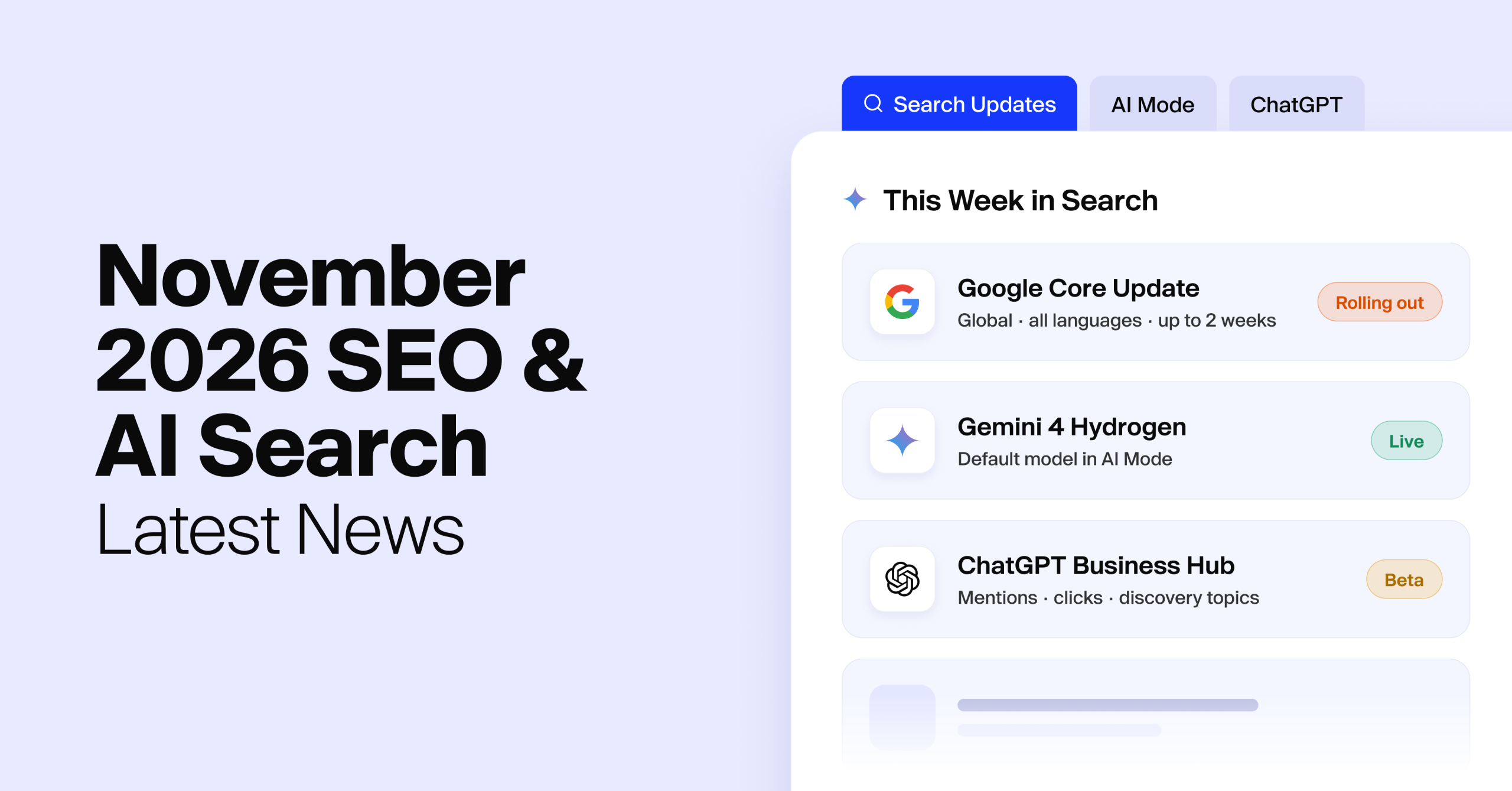
Between November 10 and 12, 2026, three developments highlighted how quickly the search landscape is evolving.
Google began rolling out a new core update, introduced Gemini 4 Hydrogen as the default model in AI Mode, and OpenAI launched a beta dashboard that helps businesses understand how they appear in ChatGPT.
While each announcement affects a different part of the search ecosystem, they point to the same broader shift: business visibility is no longer measured by traditional search rankings alone.
Digital Growth Agencies also need to understand how their clients appear in AI-generated answers, which sources AI platforms reference, and whether those experiences lead users back to their websites.
At E2M, we work with agency partners on white label SEO and AI Search strategies. This November 2026 SEO & AI Search News breaks down what happened, what is confirmed, what remains unknown, and what agencies should prioritize as these changes unfold.
TL;DR:
- Google November 2026 core update: The rollout began November 10, applies globally to all languages, and may take up to two weeks to complete. It is Google’s third core update of 2026.
- Black Friday overlap: The post-rollout evaluation period will likely overlap with Thanksgiving, Black Friday, and Cyber Monday. Agencies working with retail and ecommerce clients should account for seasonal demand when interpreting performance changes.
- Gemini 4 Hydrogen: Became the default model in Google AI Mode worldwide on November 12. Google also uses it to handle the hardest questions in AI Overviews. The company says it improves query fan-out and can surface a broader range of helpful links.
- ChatGPT Business Hub (beta): OpenAI launched Businesses in ChatGPT on November 10. Eligible, verified businesses can access insights covering the previous 28 days, including ChatGPT mentions, website clicks, and discovery topics.
Google November 2026 Core Update is Rolling Out
Google began rolling out its November 2026 core update on November 10, 2026, at 10:06 a.m. PT, according to the Google Search Status Dashboard.
The update applies globally and to all languages. Google says the rollout may take up to two weeks, which means it could finish around November 24 if it takes the full period.
As of November 17, the update is still active. Until Google confirms its completion, ranking and visibility changes should be treated as preliminary rather than final results.
“Released the November 2026 core update, which applies globally and to all languages. The rollout may take up to 2 weeks to complete.”
In its LinkedIn announcement, Google added:
“This is a regular update designed to better surface relevant, satisfying content for searchers from all types of sites.”
Google has not announced any specific ranking factors or new update-specific guidance. Its existing core update documentation remains the primary reference for understanding how these updates work and how to assess their impact.
Quick Facts About Nov 2026 core update
| Detail | November 2026 core update |
|---|---|
| Start date | November 10, 2026 (10:06 a.m. PT) |
| Current status | Rolling out as of November 17 |
| Expected duration | Up to two weeks; potentially through November 24 |
| Scope | Global, all languages |
| Core updates in 2026 | Third, following the March and May updates |
| New update-specific guidance | None announced |
| Early ranking volatility | Third-party ranking tools showed movement on November 8–9, before the official announcement |
Early Search Ranking Fluctuations: Don’t Assume Every Change Is Update-Related
Some SEO & AI search tracking tools reported increased ranking volatility on November 8–9, before Google officially announced the November core update.
That timing matters. The confirmed rollout began on November 10, so ranking changes that started earlier cannot automatically be attributed to this update. Google has not confirmed whether the November 8–9 movement was connected to an unannounced ranking change, testing, or normal search fluctuations.
For agencies, the practical takeaway is simple: annotate these dates in client reports and avoid concluding short-term ranking movements alone. Look at when changes started, which pages and queries were affected, and whether the movement continued after the official rollout began.
What Agencies Should Do During the Core Update Rollout?
The most useful response during an active core update is careful monitoring, not reactive optimization changes.
Google recommends confirming that the rollout has finished and waiting at least one full week afterward before analyzing Search Console performance. It also recommends comparing the post-update period with the week before the rollout started.
For agencies, we recommend the following:
- Record a pre-update baseline. Save Search Console and analytics data from the period before November 10, including clicks, impressions, CTR, average position, organic sessions, and conversions.
- Annotate the important dates. Mark November 8–9 for reported ranking volatility, November 9–11 for the Generative AI report logging error, and November 10 as the official core update start date.
- Avoid reactive changes to performing pages. Don’t rewrite content, change URLs, or restructure important landing pages simply because rankings fluctuate during the rollout. Continue necessary technical fixes and planned improvements, but document significant changes.
- Separate organic and AI Search reporting. Review traditional Search performance independently from the Generative AI report, AI referrals, and ChatGPT visibility metrics.
- Evaluate the results after the rollout. Once Google confirms completion, wait at least one full week before making a post-update comparison. Review the affected pages and queries, and account for seasonal changes when evaluating retail and ecommerce clients.
The goal is to identify sustained changes that deserve investigation, not to react to every temporary movement in the rankings.
Did a client lose rankings in this update? E2M’s white label SEO team runs post-update analysis and recovery plans under your agency’s brand, so you can respond to clients with data, not guesses.
Gemini 4 Hydrogen: The New Default Model in AI Mode
On November 12, 2026, Google introduced Gemini 4 Hydrogen as the new default model in AI Mode worldwide. The model is also being used to handle some of the hardest questions in Google AI Overviews.
Robby Stein, VP of Product for Google Search, announced the change in a Google Search blog post and an X thread. He confirmed that Hydrogen is now the default in AI Mode and is “being used for your hardest questions in AI Overviews.”
The announcement came just two days after Google’s November core update began rolling out. That means agencies tracking AI Search visibility have two separate developments to account for during the same reporting period: a core ranking update and a change to the model powering AI Mode.
What Changed in AI Mode?
Google highlighted four major improvements with Gemini 4 Hydrogen:
- Better query fan-out: Hydrogen can break complex questions into related subtopics and run simultaneous searches across them. Google says this helps AI Mode connect users to a broader range of helpful links, including websites they might not have discovered otherwise.
- Improved understanding of complex queries: AI Mode can better handle multi-part questions, typos, highly specific requests, and instructions that require several steps.
- More visual and structured answers: Users may see more images, comparison tables, charts, maps, and customized tools within AI-powered responses.
- More nuanced language understanding: Google says the model provides more nuanced responses across all languages supported by AI Mode.
These changes are designed to make AI Mode more useful for complicated searches while giving users additional ways to explore information and discover websites. For a full checklist, see our guide on how to optimize for Google AI Mode.
Google has not published a specific number of additional links or websites users can expect to see.
Gemini 4 Hydrogen at a Glance
| Detail | What is confirmed |
|---|---|
| Default in AI Mode | Available globally from November 12, 2026 |
| AI Overviews | Used for some of the hardest questions |
| Previous default | Gemini 3.5 Flash was the previous default introduced in May 2026 |
| Alternative model | Gemini 4 Carbon is available as the “Most complex work” option for eligible Google AI Ultra subscribers |
| Speed benchmark | Google reports tasks completing 2.5x faster than Gemini 3.8 Flash at Hydrogen’s high default setting |
| Fabricated claims benchmark | Google reports more than 5x fewer fabricated claims compared with Gemini 3.8 Flash |
| Official announcement | Introducing Gemini 4 Hydrogen |
Source: Google Search, Google DeepMind, and Search Engine Journal.
A note on Google’s performance benchmarks: The speed and fabricated-claims figures come from Google’s model evaluation against Gemini 3.8 Flash. They are not measurements of faster Google Search results, improved AI Overview accuracy, or increased website citations. They should be understood as model-level claims, not guaranteed search performance improvements.
What Gemini 4 Hydrogen Means for SEO and AI Search Specialists
The most relevant change for SEO professionals is Google’s improved query fan-out capability.
Google’s own comparison shows the shift in practice. Both models got the same prompt: how to make a tiny studio feel like two rooms for under $200.
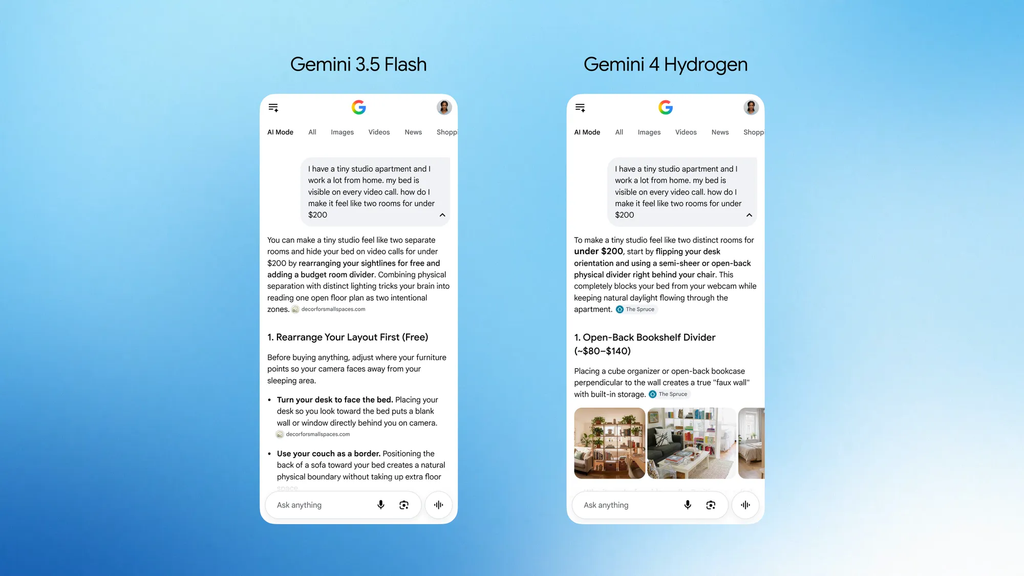
| Gemini 3.5 Flash | Gemini 4 Hydrogen | |
|---|---|---|
| Opening answer | General advice: rearrange sightlines and add a budget divider | A specific fix: flip the desk and place a divider behind the chair |
| First recommendation | “Rearrange Your Layout First (Free)” | “Open-Back Bookshelf Divider (~$80–$140)” |
| Source cited | decorforsmallspaces.com | The Spruce |
| Visuals | Text only | Image carousel of real examples |
Same prompt, different answer and different source: Gemini 3.5 Flash vs Gemini 4 Hydrogen in AI Mode. Image: Google.
The cited source changed when the model changed, even though the question stayed the same. Hydrogen went for a page with a concrete, priced, visual answer that matched the $200 budget exactly. This is one example from Google, not a study, but it shows why answer-ready, specific content matters more after November 12.
Traditionally, a user might search for a specific service, compare providers, and visit several websites to evaluate their options. AI Mode can now break a more complex question into related subtopics, search across them simultaneously, and bring together a wider range of useful sources in its response.
For example, someone researching a white label SEO provider might ask:
“Which white label SEO companies offer technical SEO, content optimization, and AI Search services for growing agencies?”
AI Mode may explore several related areas of that question, including service offerings, technical capabilities, pricing information, agency experience, and AI Search expertise.
This creates opportunities for websites that provide useful, specific information across these related topics not just pages targeting one exact keyword.
For agencies, the practical implications For AI Mode include:
- Build topical depth: Develop useful supporting content around services, industries, comparisons, pricing, and common buyer questions.
- Make information easy to extract: Use descriptive headings, concise explanations, comparison tables, and clearly structured service information.
- Strengthen credibility: Support important claims with relevant evidence, original insights, expert authorship, and trustworthy references.
- Monitor AI citations: Track whether client websites appear as sources in AI Mode and AI Overviews for relevant commercial and informational queries.
- Review discovery beyond rankings: Look at AI-driven referrals and assisted conversions alongside traditional organic search performance.
One important distinction: Google has described improvements to query fan-out and link discovery, but it has not confirmed that these changes guarantee more citations for any particular website or establish a new ranking factor.
What Agencies Should Monitor After Gemini 4 Hydrogen is now AI Mode’s Default Model?
Because Gemini 4 Hydrogen became the default model during the November core update rollout, agencies should record November 12 as a separate milestone in their AI Search reporting.
Recommend tracking for Search visibility:
- AI Mode citations: Monitor whether client websites appear in responses to a consistent set of relevant queries.
- AI Overview visibility: Track changes in source appearances for priority keywords and questions.
- Source diversity: Observe whether AI responses reference a wider range of domains or different pages from the same client website.
- AI referral traffic: Monitor visits from Google and other AI platforms separately wherever analytics attribution allows.
- Business outcomes: Evaluate whether AI-referred visitors contribute to leads, calls, and conversions.
This will help agencies distinguish potential changes in AI Search visibility associated with the November 12 model upgrade from broader organic ranking movements during the core update.
Want your clients cited in AI Mode and ChatGPT? E2M helps agencies deliver GEO and AI search optimization (content structure, entity signals and citation tracking) as a white-label service.
ChatGPT Business Hub: AI Visibility Data from OpenAI to Give Businesses Mention And Click Counts
On November 10, 2026, OpenAI launched Businesses in ChatGPT in beta, introducing Business Hub as a new way for companies to manage their business information and understand how people engage with them through ChatGPT.
For agencies & their clients, this is an important development in AI Search measurement. Eligible businesses can claim their profiles, manage key business details, and access aggregated insights showing how often they appear in ChatGPT responses, how many website clicks they receive, and which topics are associated with their visibility.
Business Hub provides three main visibility insights, along with profile management features:
| Metric | What it means |
|---|---|
| Mentions | How often the business appears in ChatGPT responses over the past 28 days |
| Website clicks | Recorded clicks on links to the business’s website. These clicks do not confirm actual website visits or conversions. |
| Discovery topics | Common themes across conversations where the business’s website is mentioned or cited |
| Business profile | Business information that can be managed and updated after the required claim and identity verification |
One important detail: OpenAI uses different mention definitions for online and local businesses.
For an online business, a mention counts when ChatGPT references its website. Simply mentioning the brand name without referencing its website does not count. For a local business, a mention counts when ChatGPT shows a result for that business’s location, even if the user doesn’t open the listing or visit the website.
This distinction matters when interpreting the numbers. Business Hub does not capture every instance of brand visibility in ChatGPT.
For an early example, Search Engine Journal’s Vahan Petrosyan reported that the publication received 353,356 mentions and 2,663 website clicks between October 14 and November 10, 2026, after submitting its business to Business Hub. These figures illustrate the difference between how often a business appears and how often users click through to its website.
Who Can Submit a Profile in ChatGPT Business Hub?
OpenAI’s eligibility rules vary depending on the type of business:
- Online businesses: Eligible businesses can claim their profiles in locations where ChatGPT is available, subject to OpenAI’s verification requirements.
- Local stores and restaurants: These businesses can currently claim only an existing U.S. listing.
- Business Agents: Eligible ecommerce and online service businesses in the United States can also create Business Agents, subject to separate business and industry requirements.
Business Agents are a separate feature from the business profile and its visibility insights. They allow customers to start a clearly labeled conversation with a business about its products or services.
How to Submit Your Website in ChatGPT Business Hub
Businesses can start the process through chatgpt.com/business-hub. The general process is:
- Sign in to ChatGPT: Open Business Hub and search for the business by name.
- Select the business: Choose the correct listing or check whether an eligible online business can be added.
- Verify ownership or authorization: Use one of the verification methods offered, such as a business phone, business email, website domain, or Shopify store.
- Wait for claim approval: OpenAI reviews the claim and may request additional information.
- Complete Persona identity verification: Once the claim is approved, complete the additional identity check. This may require a government-issued ID, business registration information, and proof that you are authorized to represent the business.
- Manage the business profile: After the required verification is approved, you can update business information and access available insights.
If another person has already claimed the business, an authorized representative can submit a dispute through the ownership process.
What ChatGPT Business Hub Means for Agencies and AI Search Reporting
Business Hub is one of the first direct measurement opportunities OpenAI has provided to businesses for understanding their presence in ChatGPT.
It is useful to think of it as a Search Console-style visibility dashboard for ChatGPT, but it is not a direct equivalent to Google Search Console. It does not provide individual prompts, complete keyword-level reporting, or a full picture of every time ChatGPT mentions a brand.
For agencies, the opportunity is to add another measurable layer to existing SEO and AI Search reporting.
E2M’s take: We recommend that agencies:
- Check client eligibility: Identify which online businesses and local clients can claim their profiles.
- Get client authorization: Obtain permission before claiming or managing a client’s business, and coordinate the required verification with an authorized representative.
- Complete profile verification: Ensure business details, website information, and relevant service or product information are accurate.
- Establish a baseline: Record the initial 28-day mentions, website clicks, and discovery topics where available.
- Retain monthly snapshots: Since the reporting window is limited, save monthly results to build a historical comparison.
- Report multiple visibility signals: Present Business Hub mentions and clicks alongside Google organic performance, AI Overview visibility, AI Mode citations, and referrals from other AI platforms.
The bigger opportunity is to move beyond asking whether a client ranks in Google and start measuring how that business is discovered, referenced, and visited across different AI-powered search experiences.
E2M’s Agency Action Plan for SEO & AI Search for November 2026
This is the action plan we’re following with our agency partners at E2M. It is built around one principle: make decisions based on reliable performance data, not temporary ranking fluctuations during a core update.
This Week (During the Rollout)
- ☐ Annotate client analytics and Looker Studio dashboards: Nov 10 (core update start), Nov 9–11 (GSC AI report bug), Nov 12 (Gemini 4 Hydrogen in AI Mode).
- ☐ Export Search Console data for the 4 weeks before November 10 as the baseline.
- ☐ Pause major edits, redirects and migrations on pages that still rank. Google advises against changing pages mid-rollout.
- ☐ Claim ChatGPT Business Hub profiles for eligible clients and record the first 28-day mentions and clicks.
- ☐ Note your AI Mode and AI Overview citation baseline for each client’s top 20–50 commercial queries.
After Google Confirms the Rollout Is Complete
- ☐ Wait at least one full week, then compare against the week before November 10.
- ☐ For ecommerce clients, also compare against the same holiday week in 2025.
- ☐ Break results down by page type and section, not just sitewide totals.
- ☐ For pages that dropped, review them against Google’s core update self-assessment questions: originality, expertise, and how they compare with the pages that now outrank them.
Ongoing: Optimize for AI Search Citations
- ☐ Rewrite key pages with answer-first sections that Hydrogen’s query fan-out can pull from: definitions, comparisons, pricing, steps, FAQs.
- ☐ Strengthen entity signals: consistent brand name, author bios, and sources cited on the page.
- ☐ Add AI referrals (ChatGPT, Gemini, Perplexity) as their own reporting line.
- ☐ Track three visibility metrics side by side: Google rankings, AI Mode/AI Overview citations, ChatGPT mentions.
Need help scaling this across clients? E2M’s white label GEO services with SEO services let agencies deliver core update recovery and AI search visibility under their own brand.
FAQ About Latest SEO and AI Search Updates
Google started the November 2026 core update on November 10, 2026, at 10:06 a.m. PT. Google says it may take up to two weeks to complete, which puts the likely finish around November 24, 2026.
No. Google calls it “a regular update designed to better surface relevant, satisfying content for searchers from all types of sites.” Core updates don’t target specific sites. A drop means other pages were judged more relevant, not that a site was penalized.
Gemini 4 Hydrogen is a Google AI model released on November 12, 2026. It is the default model in Google AI Mode worldwide and handles some of the hardest questions in AI Overviews. Google says it improves query fan-out and shows a broader range of links.
Hydrogen runs more subtopic searches per prompt (query fan-out), so AI Mode may cite more and more varied pages. Pages that clearly answer specific sub-questions have a better chance of being cited. Google hasn’t shared link counts, so track AI Mode citations to measure the effect.
ChatGPT Business Hub (Businesses in ChatGPT) is an OpenAI beta launched November 10, 2026. Verified businesses can claim their profile and see 28 days of ChatGPT mentions, website clicks and discovery topics.
Not for online businesses. A mention counts only when ChatGPT references the business’s website, so the metric measures page citations rather than brand-name mentions.
No. E2M recommends pausing major edits on ranking pages until Google confirms the rollout is complete, then waiting at least one more week before analyzing results.
Annotate November 10 to 12 in every report, compare ecommerce clients against last year’s holiday week, and add AI visibility (AI Mode citations and ChatGPT mentions) as a separate reporting line next to Google rankings.
The Bottom Line for Agencies
November 2026 showed that search visibility now lives in three places: Google rankings, Google’s AI answers, and ChatGPT. The core update will shuffle rankings, Gemini 4 Hydrogen changes how AI Mode picks sources, and ChatGPT Business Hub finally gives agencies data to prove AI visibility.
Agencies that stay calm during the rollout, annotate their data and report all three will come out of this month with stronger client relationships. E2M will update this article when Google confirms the rollout is complete.
Add AI search visibility to your agency’s offer, without hiring.400+ agency partners use E2M for white label SEO, GEO and content. Tell us about your clients and we’ll show you how to package AI search reporting under your brand.