1. The June 2026 DSA Delay: What Actually Changed
Before anything else, this needs to be stated clearly because it changes the planning timeline for every Google Ads account.
On June 11, 2026, Google published a change to its Ads Developer Blog: the automatic migration of Dynamic Search Ads to AI Max is postponed from September 2026 to February 2027. Google Ads Liaison Ginny Marvin confirmed it publicly the following day:
“We’ve heard your feedback loud and clear: you need more time to transition from Dynamic Search Ads to AI Max. To give advertisers plenty of runway and not interfere with the busy Q4 period, we are shifting the DSA automigration deadline to February 2027.”
For any agency building a DSA migration 2027 timeline, the postponement changes the calendar but not the stakes. The DSA sunset 2027 is now confirmed on a fixed February deadline. Every remaining Dynamic Search Ad campaign will auto-migrate on Google’s schedule if not converted before then. That is the outer boundary. The strategic window is what happens between now and then.
Google also restored the ability to create new DSA campaigns from June 15, 2026, reversing a phase-out that had been in effect since the April 15 announcement.
NOTE: The delay applies only to Dynamic Search Ads (DSA) automigration. The September 2026 deadline for Automatically Created Assets (ACA) and campaign-level broad match settings was not changed. Those two campaign types still auto-migrate in September 2026. If your accounts use ACA or campaign-level broad match, those still need to be migration-ready by September.
2. What Is Google AI Max for Search?
Google AI Max for Search is a comprehensive suite of AI-powered targeting and creative features built into standard Google Search campaigns. It was introduced in beta in May 2025 by Brian Burdick, Senior Director of Product Management at Google Ads, and reached general availability on April 15, 2026, after hundreds of thousands of global advertisers tested it across an eleven-month beta period.
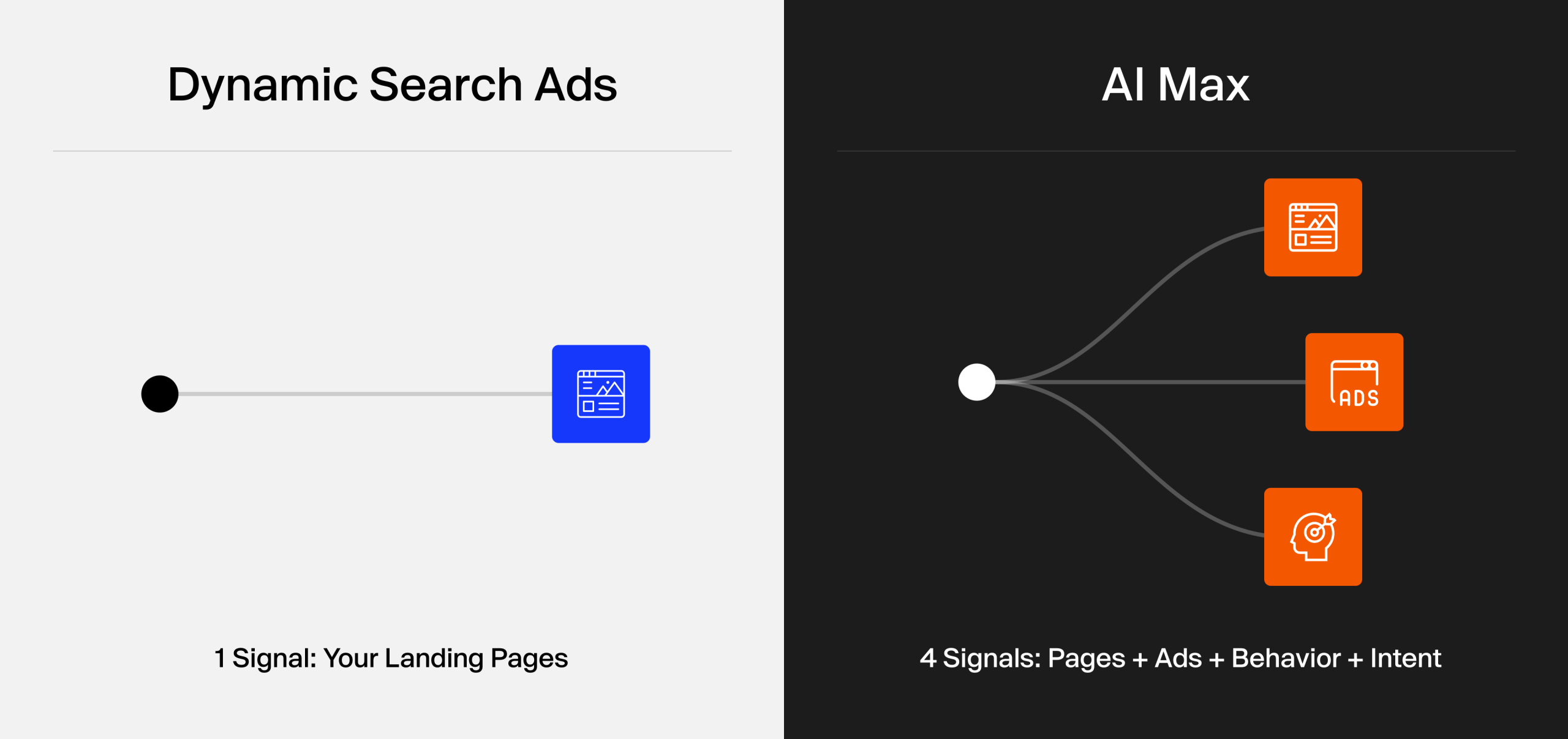
When you compare AI Max vs Dynamic Search Ads directly, the shift is architectural. DSA matches queries to your landing pages. AI Max matches queries to intent, informed by your pages, your creative, and real-time search behavior simultaneously. That is a meaningfully wider aperture, and it explains why Google’s stated reason for the transition centers on query complexity rather than website quality.
Google’s stated reason for the transition: consumer searches have become “more complex and unpredictable,” and landing page-based matching alone can no longer keep up with the range and nuance of what people are actually searching for.
NOTE: AI Max does not replace keywords. Google describes keywords as the “fuel” that powers AI Max’s matching logic. Exact match, phrase match, and standard keyword campaigns are not affected by the DSA migration. This is a campaign-type change, not a restructuring of how Search works.
What AI Max is not:
- It is not Performance Max. AI Max operates within the Search network only. Performance Max runs across all Google inventory: Search, Display, YouTube, Shopping, Maps, and Discover.
- It is not optional. The migration is mandatory for DSA, ACA, and campaign-level broad match.
- It is not the same as enabling broad match. Broad match is one component of AI Max’s search term matching. AI Max also adds asset-based and landing page-based matching on top of it.
3. How AI Max for Search Works? The Three Features Explained With a Real Ads Example
Understanding how to use AI Max for Search campaigns starts with knowing what each of its three features is actually doing. The defaults are aggressive, and the controls are where agency expertise shows up most clearly.
Google’s own video guide explains AI Max through a scenario that is worth using as a reference point because it illustrates all three features working together.
A customer searches: “serum for dry, sensitive skin.”
A standard keyword campaign might miss this. The advertiser’s exact match keyword is “face serum” or “dry skin serum.” The phrase is close but not an exact match. The ad either does not show, or it shows a generic ad that does not speak to dry, sensitive skin specifically.
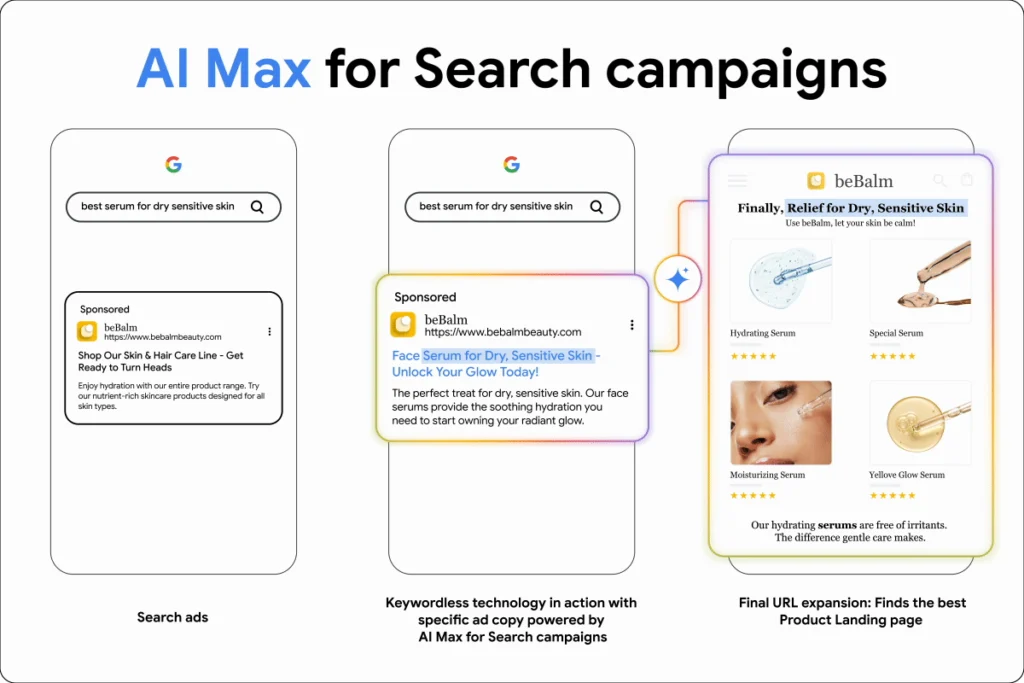
Here is what AI Max does with the same search:
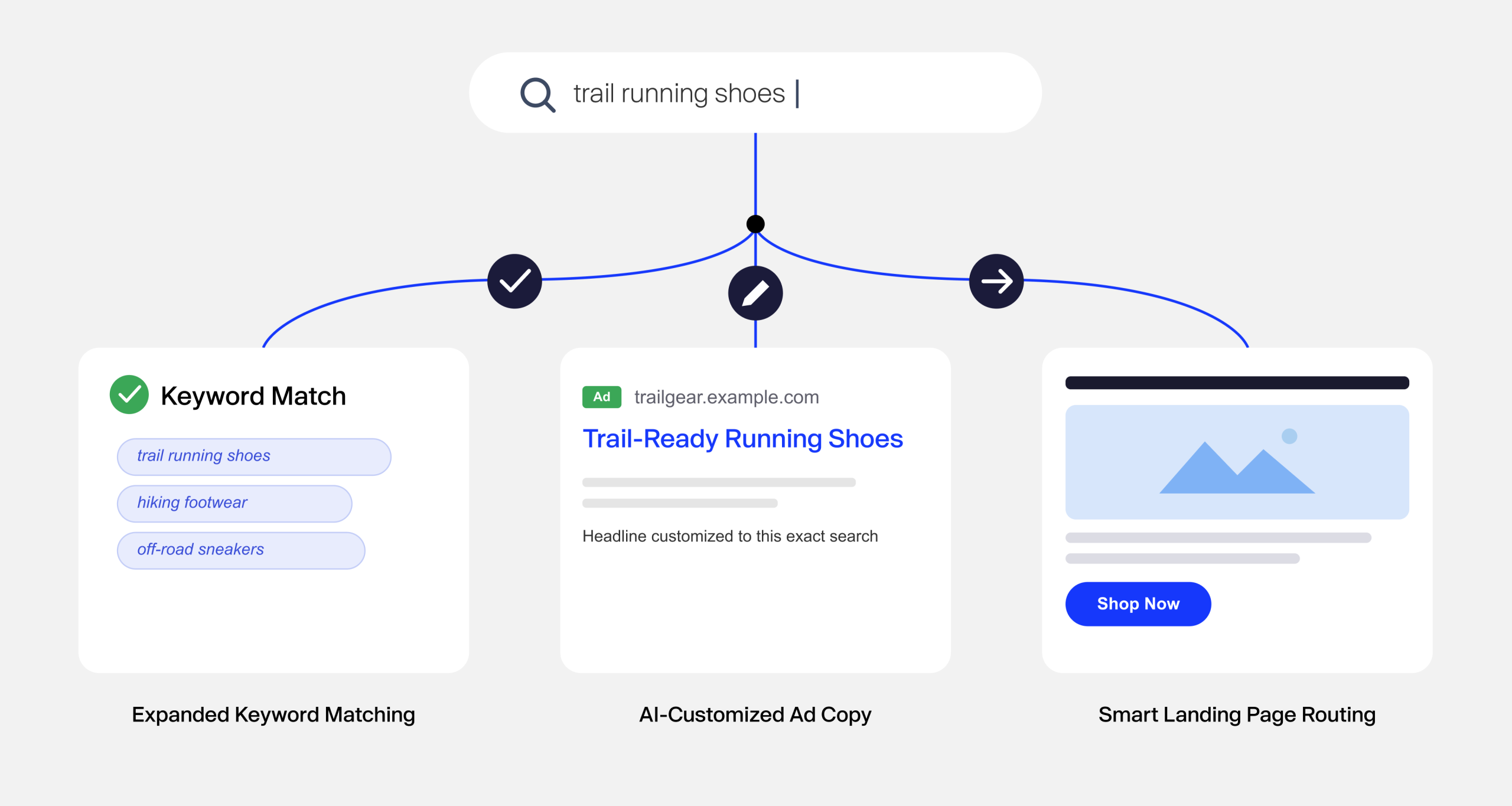
Feature 1: Search term matching reads the advertiser’s keyword list, existing ad creative, and landing page content. It understands that “serum for dry, sensitive skin” is high-intent and relevant to this account’s products. The ad is entered into the auction for a query the keyword alone would have excluded.
Feature 2: Text customization does not serve a generic headline. It generates a headline that mentions “serum for dry, sensitive skin” specifically, because the search query is specific. The copy adapts in real time to match what the user is actually looking for.
Feature 3: Final URL expansion does not send the user to the generic skincare homepage. It identifies the page on the advertiser’s domain most relevant to “serum for dry, sensitive skin” and routes the user directly there, even if that page was never manually added to a campaign.
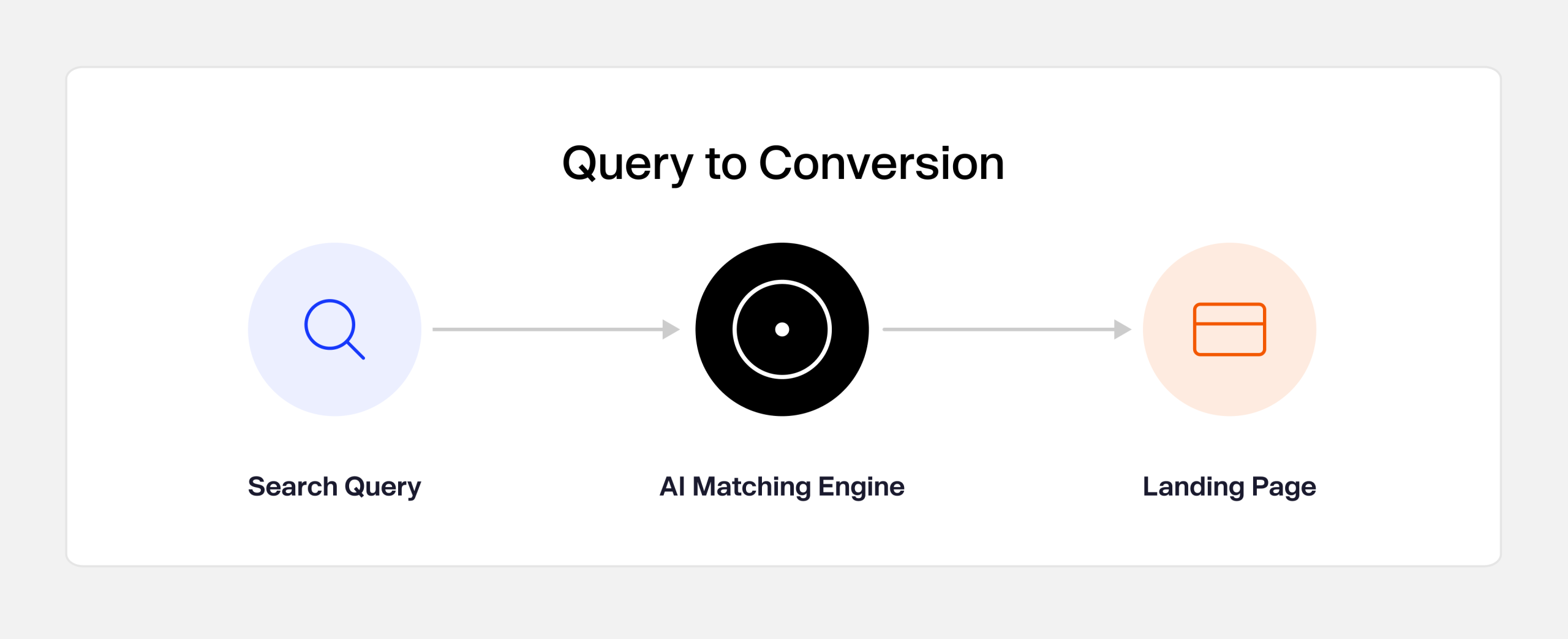
The result: a user who searched for something specific gets an ad that speaks to their specific need and lands on the exact page that answers it. That is the experience AI Max is designed to create at scale, across every query in your account.
This is also where the agency value lives. When those three features run without configuration, they do their best to reproduce this experience.
When they run with expert configuration brand controls, text guidelines, URL exclusions, and a correctly structured negative keyword framework they produce this experience consistently, on-brand, and within compliance boundaries. That difference is what a well-executed AI Max migration delivers.
4. The Full AI Max Feature and Controls Reference
Two main feature categories, six specific controls.
Search Term Matching
Uses three keyword Google Ads technologies simultaneously to expand beyond your keyword list:
| Technology | What it does |
|---|---|
| Broad match expansion | Surfaces relevant queries outside your exact keyword set using real-time intent signals |
| Asset-based matching | Reads your existing ad creative and identifies additional relevant searches based on it |
| Landing page-based matching | Crawls your destination URLs and matches ads to topically relevant searches |
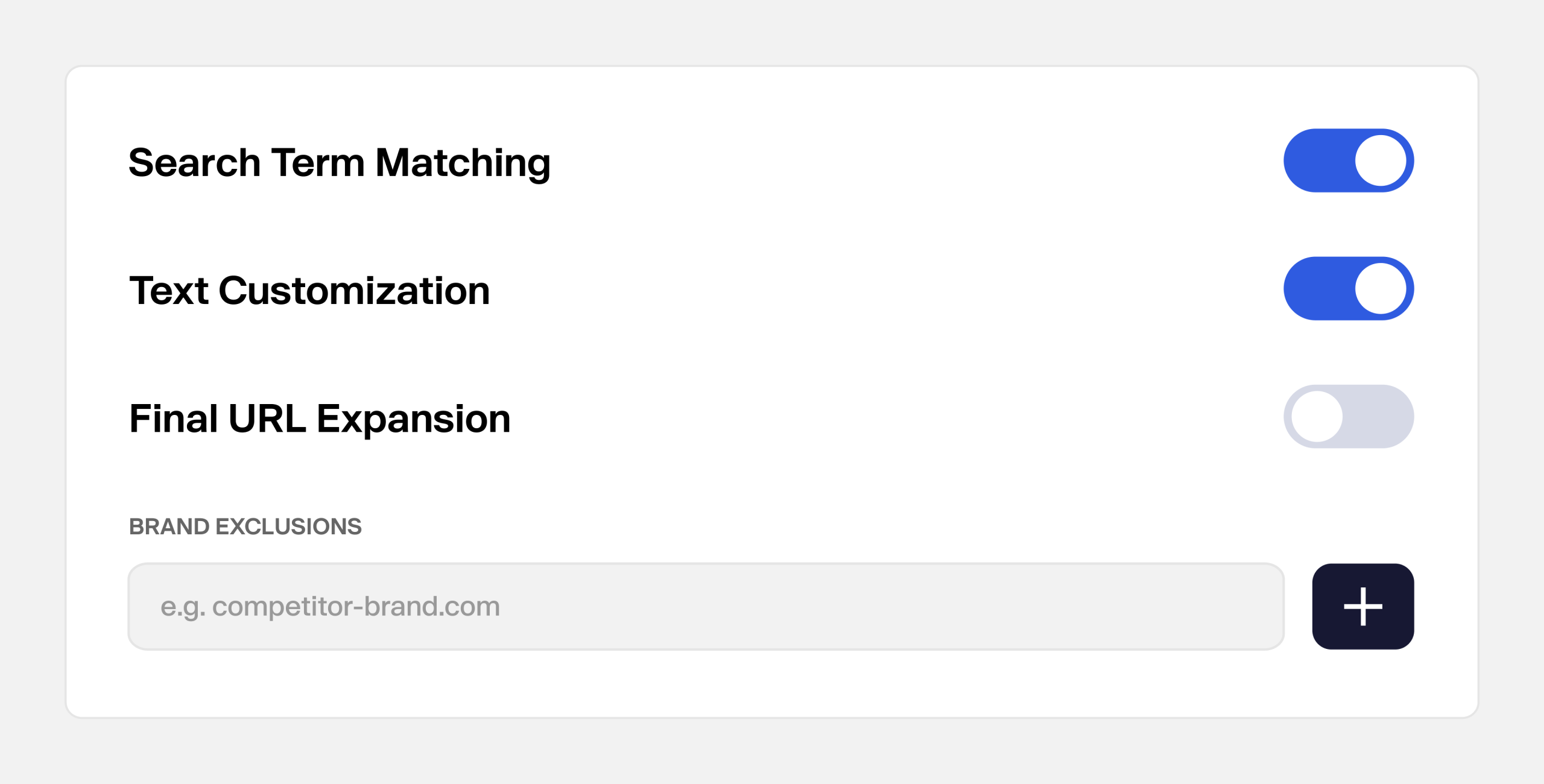
Controls available within search term matching:
| Control | What it does | Level |
|---|---|---|
| Locations of interest | Reach customers based on geographic intent, including in keywordless matches | Ad group |
| Brand inclusions | Specify which brands your ads should appear alongside | Campaign and ad group |
| Brand exclusions | Prevent ads from appearing alongside specific brands | Campaign |
| URL inclusions | Add specific URLs not captured by Final URL expansion | Ad group |
| URL exclusions | Block specific URLs from being used as landing pages | Campaign |
NOTE: Search term matching is on by default when AI Max is enabled for a campaign. You can toggle it off per ad group in ad group settings.
Asset Optimization at Campaign Level
In Google AI Max, a campaign-level panel with two settings:
Google AI Max text customization (formerly Automatically Created Assets) generates headlines and descriptions using your existing ads, landing page copy, and keyword assets alongside generative AI. Copy is customized to the specific search that triggered it, not selected from a static rotation.
AI Max Final URL expansion routes each user to the page on your domain that Google predicts will convert best for that specific query. Requires text customization to be active.
| Setting | Campaign control | Default when AI Max enabled |
|---|---|---|
| Text customization | Campaign level | On |
| Final URL expansion | Campaign level | On for DSA; off for ACA and broad match |
NOTE: AI Max Final URL expansion requires text customization to be turned on. You cannot enable Final URL expansion independently.
IMPORTANT: When Final URL expansion is active, pinned RSA assets are not respected if Google identifies a more relevant URL. For any campaign where asset pinning is part of a compliance or brand consistency strategy, this must be reviewed and reconfigured before enabling AI Max.
5. The Complete AI Max Updated Migration Timeline
We sourced from Google’s April 15, 2026 announcement and the June 11, 2026 Developer Blog update:
| Date | Event |
|---|---|
| May 2025 | AI Max enters open beta globally |
| April 15, 2026 | AI Max reaches general availability; original September DSA deadline announced |
| June 11, 2026 | Google announces DSA automigration delay to February 2027 |
| June 15, 2026 | DSA campaign creation restored |
| September 2026 | ACA and campaign-level broad match still auto-migrate on original schedule |
| January 2027 | New DSA campaign creation ends |
| February 2027 | DSA automigration begins for all remaining active campaigns |
Context on the migration window: The original DSA sunset gave agencies roughly 5.5 months of runway from the April 15 announcement to September. The 2022 Smart Shopping to Performance Max transition gave agencies approximately 9 months. The February 2027 extension now provides roughly 10 months from the original announcement, making this one of the more generous migration windows Google has offered for a forced campaign-type change.
IMPORTANT: Two deadlines now run in parallel. September 2026 applies to ACA and broad match. February 2027 applies to DSA. Accounts using all three campaign types need a migration plan that addresses both deadlines separately.
6. What Google Auto-Migration in ADS Inherits by Default
When Google migrates an ADS campaign automatically, it ports settings based on the source campaign type. Here is the exact default configuration each campaign type inherits:
| Source campaign | Search term matching | Text customization | Final URL expansion |
|---|---|---|---|
| DSA | On | On | On |
| Automatically Created Assets (ACA) | On | On | Off |
| Campaign-level broad match | On | Off | Off |
DSA campaigns inherit the most aggressive configuration: all three AI Max features active simultaneously. For a DSA account that reaches February 2027 without voluntary migration, Google’s AI takes over query selection, copy generation, and landing page routing simultaneously, on a live budget, with no pre-migration baseline in place.
7. Google AI Max Performance Data 2026: What Independent Benchmarks Actually Show
Google’s own performance claims for Google AI Max for Search and the benchmarks independent agencies have published tell different stories. Both matter. Here is what each actually measured.
Google’s Three Published Figures
| Figure | Published | What it measures | Who it applies to |
|---|---|---|---|
| +14% conversions | May 2025 beta | AI Max full-feature vs. keyword-match-only setup | All non-retail advertisers in beta |
| +27% conversions | February 2026 | Text-guidelines AI Max for exact and phrase-heavy campaigns | Campaigns historically reliant on exact and phrase match |
| +7% conversions | April 15, 2026 GA | Full-feature AI Max vs. search term matching alone | Non-retail only; sample size not disclosed |
The +7% GA figure does not compare AI Max against DSA or against a standard keyword campaign. It measures the incremental lift from enabling text customization and Final URL expansion on top of search term matching that is already running. Retail advertisers are explicitly excluded. No sample size has been disclosed.
8. The PPC Migration Checklist: Six Steps for a Clean DSA to AI Max Migration
Each Dynamic Search Ads (DSA) to AI Max Migration step below is judgment work. None of it is delivered by a February 2027 auto-migration notification.
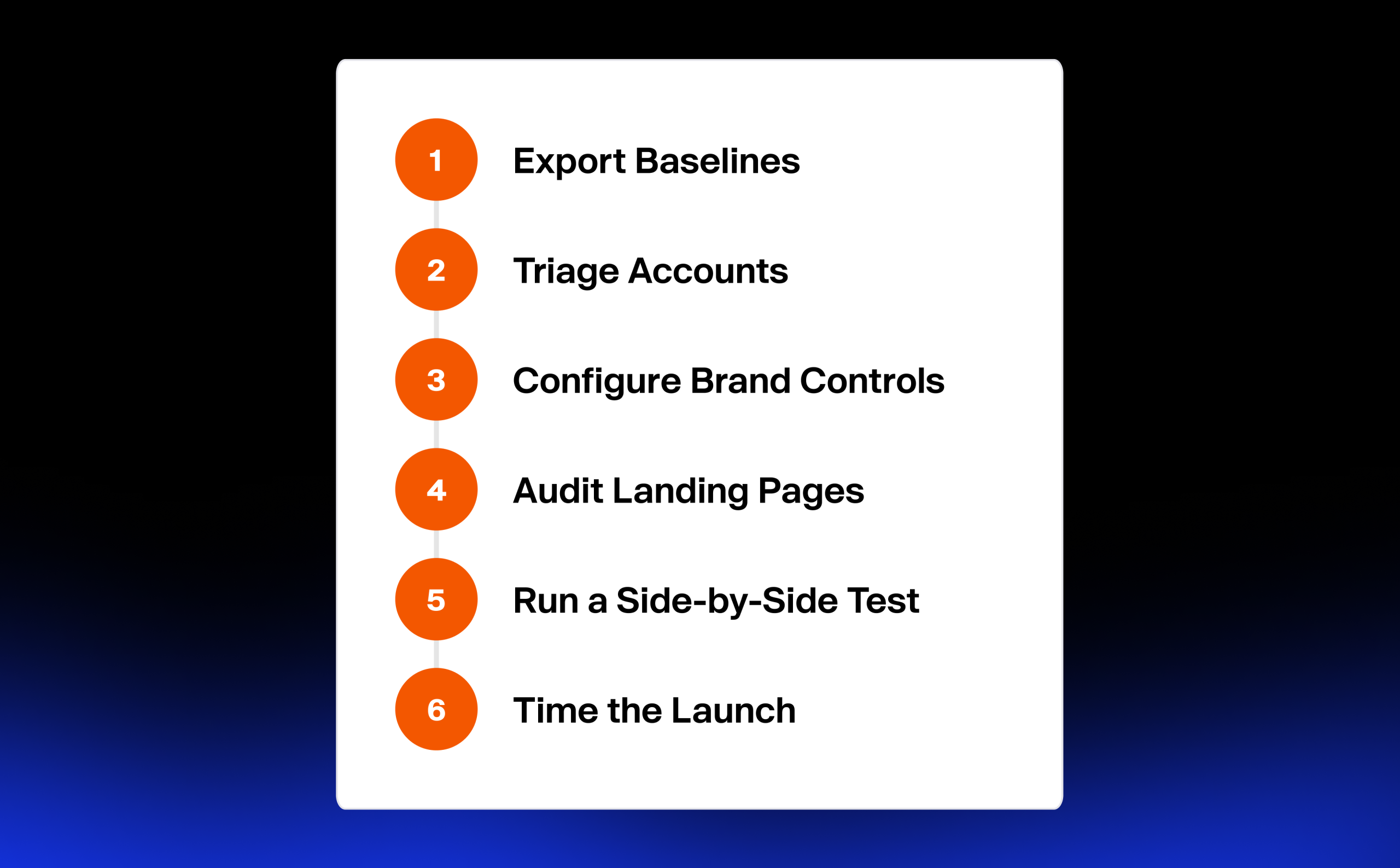
Step 1: Export pre-migration baselines now
Export keyword-level performance, search term reports, Quality Scores, ROAS by campaign, CPA by campaign, and conversion rates by landing page. Do this before any migration action, for every account.
Step 2: Triage accounts by risk level and deadline
Separate your accounts into two groups. Group one: accounts using ACA or campaign-level broad match that need September 2026 preparation.
Group two: DSA accounts where voluntary migration before Q4 2026 is the strategic goal.
Within the DSA group, prioritize voluntary migration for: regulated verticals (legal, financial, healthcare), accounts where branded copy protection is contractual, B2B accounts where lead quality over volume is the actual KPI, and accounts with specific landing pages that should not receive broad AI-routed traffic.
Step 3: Configure brand controls and text guidelines before enabling
Setting up AI Max brand exclusions correctly is the single highest-priority pre-migration configuration step for any client with competitive brand sensitivities. The SMEC data showing 69% of AI Max impressions on competitor brand terms in one unconfigured account makes this non-negotiable.
Set AI Max brand exclusions at campaign level to prevent ads appearing alongside competitor brands before the feature goes live not after. Set brand inclusions where brand association is part of the strategy. Configure text guidelines to specify what language AI-generated copy must and must not use.
IMPORTANT: Brand controls and text guidelines must be configured before AI Max is enabled. These settings cannot be managed via the API or Editor while AI Max is active. Notify any team members or developers managing campaign settings via API before making the switch.
AGENCY NOTE: For clients in regulated verticals (legal, financial services, healthcare), AI-generated copy from text customization can produce headlines that fall outside compliance boundaries. Text guidelines let you specify what language the AI must and must not use. Configure these before migration. One compliance violation on a live campaign is a client conversation no one wants to have after the fact.
Step 4: Audit Final landing page URL expansion by ADS campaign
Map every landing page against what Final URL expansion would do to routing. Configure URL exclusions before migration for: paid-only pages that should not receive broad AI-routed traffic; offer-specific or gated pages where copy-to-destination alignment is critical; any domain or subdomain the AI should not route to.
IMPORTANT: URL exclusions must be in place before migration. Once Final URL expansion is live, the AI routes based on its predicted performance, not on your campaign architecture intent.
Step 5: Run a voluntary Ads side-by-side experiment
With DSA creation restored from June 15, 2026, you can now run clean controlled experiments: keep a DSA campaign running alongside a parallel AI Max campaign on comparable traffic. Read the difference in your own account’s CPA and ROAS data before committing to a full migration.
NOTE: Google’s voluntary one-click upgrade tools are designed to preserve historical reporting and campaign learnings during migration. Where AI Max performs in a controlled test, voluntary migration on your own timeline means you go into Q4 with a stable, tested configuration rather than an active learning period.
If your agency doesn’t have the in-house bandwidth to plan, test, and manage AI Max migrations across multiple client accounts, partnering with a white label PPC team can accelerate execution while keeping your brand front and center. Learn more in our guide: White Label PPC: Your Guide to Outsourcing PPC Management.
Step 6: Time the learning period around the revenue calendar
AI Max for Search needs four to six weeks to stabilize. A migration starting in October means the learning window runs through Black Friday. A migration in July or August means AI Max is stable before Q4 begins.
9. What the DSA Migration to AI Max Means for Your Agency Business Model
This section is for agency owners. It is the most commercially important part of this article.
The Google Ads Shift That Is Actually Happening
AI Max for agencies is not primarily a technical story. It is a business model story about where the value in paid search management is relocating.
AI Max does not reduce the value of a PPC agency. It relocates where that value sits.
As Google’s AI handles more of the execution layer query selection, copy generation, URL routing what becomes scarce is everything above it. Strategic direction. Brand protection. Performance accountability when automation produces unexpected results. Migration judgment across a book of diverse client accounts.
The more Google automates, the more expensive a poor strategic direction becomes, because the AI amplifies it at scale. A Monks-style outcome (99% of AI Max terms driving zero conversions) and a Brainlabs-style outcome (+40% higher success rate) both come from the same platform. The difference is configuration and governance. That is the agency’s job.
The Updated Google Ads Opportunity Window
The original September 2026 deadline created urgency. The February 2027 extension created a longer, richer conversation window, and it added a new client-facing question:
“Now that I have until February 2027 for DSA, what should I actually do with the time?”
That question is your entry point. Most advertisers do not have a structured answer. The agency that shows up with a two-deadline migration plan, a side-by-side experiment proposal, and a Q4 protection strategy wins the conversation, and often the retainer.
The Offer to Build Now: The AI Max Readiness Audit for Paid Media Accounts
An AI Max readiness audit is the most defensible entry offer an agency can package right now. Every DSA advertiser has the same two-deadline problem, and most of them do not know it yet. For agencies that want to capture this migration business without scaling their internal PPC headcount, white label PPC services are the most direct path to delivery. Structure the audit as a fixed-scope deliverable:
- PPC Pre-migration baseline export: keyword performance, search terms, ROAS and CPA by campaign
- Two-deadline risk assessment: September 2026 actions for ACA and broad match, Q4-safe DSA migration timing, February 2027 as outer backstop
- Configuration recommendation: brand controls, text guidelines, URL exclusion requirements by account
- Side-by-side experiment setup: one DSA vs. AI Max test with a 30-day read window
With White Label PPC services under White Label Google Ads for agencies’ clients, It’s more compelling now than it was under the September deadline because it is framed around a planning question, not a deadline emergency. That is a larger conversation and a cleaner path to a managed retainer.
Who to Target First
B2B lead-gen Paid media accounts get the most relief from the delay and have the strongest case for a structured testing engagement. Local service businesses with minimal DSA configuration need brand controls and URL exclusion work done before September regardless of the DSA delay. Existing PPC clients are a natural retainer expansion from migration project to ongoing AI Max management. Accounts using ACA or campaign-level broad match need September 2026 preparation regardless of where they stand on DSA.
10. How E2M Helps Agencies Stay Ahead of Google’s AI Max for Search Updates
Google does not pause its roadmap. AI Max is the current update. It will not be the last. The agencies that serve their clients best are the ones who can consistently translate Google’s changes into client-ready strategies and executions, without rebuilding their team every time the platform shifts.
White label Google Ads management service for agencies is the exact model E2M operates under: technical migration execution, ongoing campaign management, and client reporting, all delivered under your agency’s brand. When your clients ask what you are doing about Google AI Max for Search, you have an answer that is already in production.
That is where E2M’s white label PPC team comes in.
E2M’s white label digital marketing services for agencies work with 1100+ partners globally. Our White Label PPC team manages Google Ads campaigns under partner agency brands, including AI Max migration strategy, configuration, and ongoing management. When Google ships an update, your clients do not wait for you to get up to speed. They get the response immediately, under your brand.
What E2M handles under your agency name for White Label AI Max PPC Report:
- Pre-migration baseline exports and configuration risk assessments for every account type
- Side-by-side AI Max experiment setup with 30-day read windows
- Brand controls, text guidelines, and URL inclusions and exclusions configuration
- September 2026 ACA and broad match migration planning
- Voluntary DSA migration before Q4 with full learning-period monitoring
- Post-migration ROAS, CPA, and query-quality reporting delivered under your brand
- The AI Max readiness audit packaged and presented as your agency’s deliverable
Your clients see your Paid Media Agency work. You own the relationship and the revenue. Our white label PPC team handles the execution.
For Paid Media and Digital agencies building new business around the migration:
Package the AI Max readiness audit as your entry offer. E2M creates the audit, you deliver it under your brand, and the conversation naturally opens toward a managed migration retainer. Every DSA account in your prospect list has a two-deadline problem right now. Most of them do not know it yet.
Frequently Asked Questions
Google AI Max for Search is a comprehensive suite of AI-powered targeting and creative features built into standard Google Search campaigns. It has two core feature categories: search term matching, which expands reach beyond your keyword list using broad match, asset-based, and landing page-based technologies, and asset optimization, which generates ad copy and selects landing pages tailored to each individual search. It reached general availability on April 15, 2026.
Yes. On June 11, 2026, Google announced the automatic DSA migration to AI Max is postponed from September 2026 to February 2027. Google Ads Liaison Ginny Marvin attributed the change to advertiser feedback and the need to avoid disrupting Q4. DSA campaign creation was restored from June 15, 2026. New DSA creation ends again in January 2027, and automigration begins in February 2027.
No. Only the DSA automigration moved to February 2027. Automatically Created Assets and campaign-level broad match settings still auto-migrate to AI Max in September 2026 on the original timeline.
Yes, for DSA, ACA, and campaign-level broad match campaigns. These will auto-migrate to AI Max on their respective deadlines. There is no opt-out. You can control how it happens by migrating voluntarily, which gives you the ability to configure settings, lock baselines, and manage the learning period on your own timeline.
Google migrates your DSA campaigns using default settings: search term matching on, text customization on, and Final URL expansion on. The AI selects queries, writes copy, and routes users to landing pages from your domain on your live budget. Your learning period runs in late Q1, after Q4 has already closed with an un-optimized configuration. You lose both the Q4 performance window and the ability to set your own baselines before migration.
AI Max is a feature set within Search campaigns. It operates within the Search network only and uses AI to expand keyword-based targeting and generate search ad copy. Performance Max is a separate campaign type running across all Google inventory: Search, Display, YouTube, Shopping, Maps, and Discover. They are distinct products. AI Max does not replace Performance Max.
No. Google describes keywords as the “fuel” for AI Max’s matching logic. Exact match and phrase match campaigns are not affected by the DSA migration. AI Max uses your keywords as signals to find additional relevant searches. It does not remove them.
Results vary significantly by configuration and vertical. SMEC tracked 250+ campaigns and found median revenue up 13%, but median CPA up 16%, with only 22% of campaigns hitting original ROAS targets. Brainlabs found a 40% higher success rate in structured tests. One Monks account saw 99% of AI Max search terms drive zero conversions a single-account worst-case result, not an industry benchmark. A B2B test saw your cost-per-lead potentially rise significantly despite tripling click volume, as one advertiser found when CPL rose from $493 to $850. The difference between these outcomes is configuration and brand controls in your account, not the platform itself.
The +14% figure (May 2025 beta) measures AI Max full-feature suite against keyword-match-only campaigns. The +27% figure (February 2026) applies specifically to exact and phrase-heavy campaigns using AI Max with text guidelines. The +7% figure (April 2026 GA) measures the incremental lift from adding text customization and Final URL expansion on top of search term matching alone, not AI Max versus DSA or standard campaigns. Retail advertisers are excluded from the +7% figure.
E2M’s white label PPC team executes AI Max migrations under agency partner brands. This includes pre-migration baseline exports, brand controls and text guidelines configuration, side-by-side experiment setup, learning-period monitoring, and post-migration reporting. Agencies sell the offer under their brand. E2M handles the execution.
If your campaign uses a tracking template, verify that a dynamic landing page from AI Max Final URL expansion works correctly before enabling. Tracking templates should use standard lpurl tag formats: {lpurl}?, {lpurl}&, or {lpurl}#. Static tracking URLs without an lpurl tag will direct users to that static URL instead of AI Max’s dynamic landing page, breaking Final URL expansion.